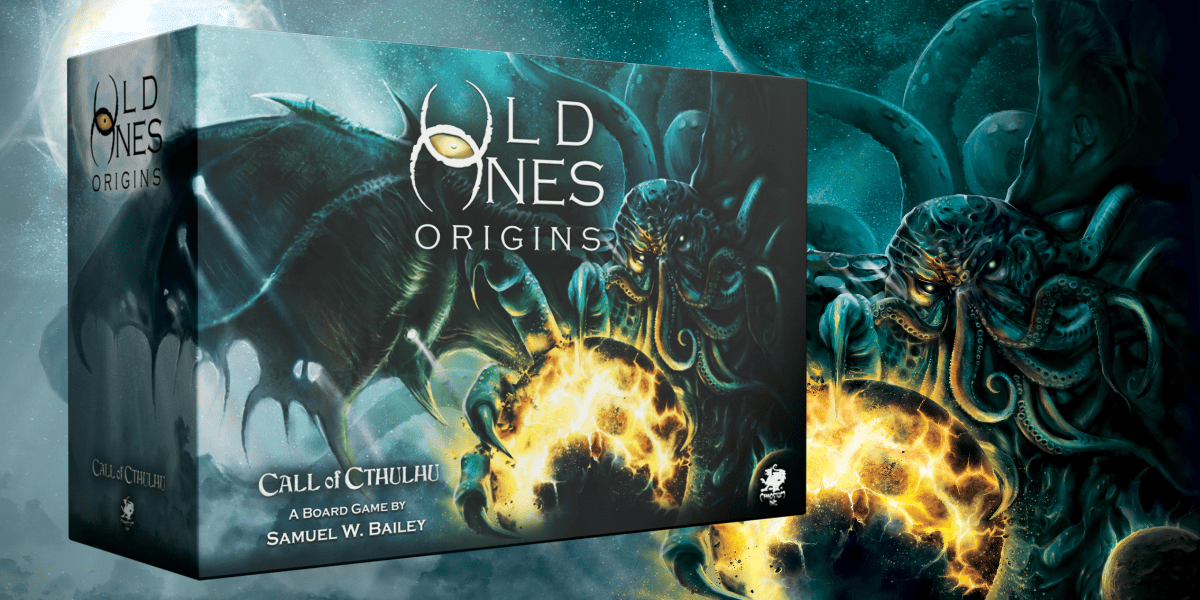
The headline this week is a double-entry that hasn’t happened on the hotness list before in quite this form: Old Ones Origins debuted at #1 and Forbidden Stars debuted at #2 - simultaneously - because one is a direct reimagining of the other, announced four days ago. Chaosium revealed Call of Cthulhu: Old Ones Origins on July 16th, describing it as a Cthulhu Mythos take on the Forbidden Stars formula, designed by Samuel Bailey, who co-designed the original. The announcement was tied to the Gen Con BGG Preview List and Chaosium’s Gen Con booth. BGG players who saw the announcement searched for the original game in numbers sufficient to push a decade-old out-of-print title to #2.
Meanwhile, Tigris & Euphrates appeared at #5 because its 25th Century Games Kickstarter launched on July 14th and immediately raised 2,600% of its target in the first days of a campaign running through July 31st. The Lord of the Rings: The Two Towers - Ascension, the second set in Stone Blade Entertainment’s LotR Ascension deckbuilding trilogy, enters at #4 on Gamefound momentum. And Gen Con is ten days away, which is pulling a pre-convention wave of announcements across the whole list - including Alexander Pfister’s Antarctic euro -60° debuting at #15.
Kingdom Come: Deliverance - The Board Game drops fourteen positions in a single week. Eight games leave the list, seven new entries arrive.
This Week’s Top 20
| # | Game | Trend |
|---|---|---|
| 1 | Old Ones Origins | 🆕 NEW |
| 2 | Forbidden Stars | 🆕 NEW |
| 3 | Rebirth | 🔻 -1 (was #2) |
| 4 | The Lord of the Rings: The Two Towers - Ascension | 🆕 NEW |
| 5 | Tigris & Euphrates | 🆕 NEW |
| 6 | The Game Makers | 🆕 NEW |
| 7 | The Resort | 🔻 -6 (was #1) |
| 8 | Container | 🔺 +3 (was #11) |
| 9 | Magical Athlete | 🔻 -3 (was #6) |
| 10 | Wingspan Pocket | 🔻 -3 (was #7) |
| 11 | The Lord of the Rings: Fate of the Fellowship | 🔺 +4 (was #15) |
| 12 | Duel of Meloch | 🔄 RETURN |
| 13 | SETI: Search for Extraterrestrial Intelligence | 🔺 +1 (was #14) |
| 14 | The Old King’s Crown | 🔻 -1 (was #13) |
| 15 | -60° | 🆕 NEW |
| 16 | Star Trek: Captain’s Chair | 🆕 NEW |
| 17 | Ark Nova | 🔺 +3 (was #20) |
| 18 | Kingdom Come: Deliverance - The Board Game | 🔻 -14 (was #4) |
| 19 | World Order | 🔻 -11 (was #8) |
| 20 | Harmonies | 🔻 -1 (was #19) |
Dropped off: JinxO (#3), Galileo’s Truth (#5), Wondrous Creatures (#9), Ringyō (#10), Yonder (#12), Cozy Stickerville (#16), dnup (#17), Moon Colony Bloodbath (#18)
Old Ones Origins and Forbidden Stars - one announcement pulls two games to the top
Old Ones Origins was announced by Chaosium on July 16th. The announcement is brief - Chaosium describes it as a game where “ancient powers rise and rival factions fight for dominance in a battle that began long before humanity existed” - and the full design details have not been revealed. What is confirmed: the game is designed by Samuel Bailey, who co-designed Forbidden Stars; it is currently on the Gen Con BGG Preview List; and Chaosium will be showing it at their Gen Con booth (#511) from July 30th. A BGG page is live with a 2028 projected release and a player count of two to four, runtime of 120 to 240 minutes, and a 14+ age rating.
The connection to Forbidden Stars is explicit. Multiple sources describe Old Ones Origins as a “refined reimagining” of the 2015 Fantasy Flight Games title - transplanting the Forbidden Stars framework from the Warhammer 40,000 universe into the Cthulhu Mythos. Forbidden Stars is a two-to-four player area control game in which factions from the 41st millennium - Space Marines, Eldar, Orks, Chaos Space Marines - compete for control of a procedurally assembled sector of space. The game’s defining mechanism is an order system in which players simultaneously place command tokens face-down on contested worlds, creating a fog-of-war layer over what is otherwise a direct conflict game with considerable tactical depth. Each faction plays asymmetrically with unique unit types, upgrade paths, and win conditions.
Forbidden Stars went out of print when Fantasy Flight Games lost its Warhammer 40K licence, and has not returned. Secondary market prices have settled above $200 for a long time. The game has maintained a devoted following on BGG - it currently rates above 8.0 with a substantial collection count - and periodically surges on the hotness list when discussions about reprints or spiritual successors circulate. This week’s #2 entry is the most dramatic single-week appearance it has made in years, and it is almost entirely driven by the Old Ones Origins announcement linking the two titles on BGG.
The story here is what Bailey is bringing across from Forbidden Stars and what he is discarding. The Cthulhu Mythos setting removes the faction identity that comes with the 40K IP - no Space Marines, no Eldar - and replaces it with cosmic entities and factions operating before human history. That is a thematic shift that either opens design space or constrains it depending on how clearly differentiated the Mythos factions can be made without the decades of existing lore the 40K setting provided. A 2028 target release gives the project time to answer those questions. The Gen Con preview will begin to tell us whether the bones of Forbidden Stars translate cleanly into the new setting or whether Bailey is rebuilding more substantially than “refined reimagining” suggests.
Tigris & Euphrates - Kickstarter passes $260,000
Tigris & Euphrates is one of Reiner Knizia’s most celebrated designs: a 1997 tile-laying civilisation game for two to four players in which leaders of four dynasties compete to build civilisations across the ancient Fertile Crescent. The game’s central mechanism is conflict - internal, between two leaders of the same colour within a kingdom, and external, between kingdoms sharing a border region. Strength in conflict is determined by the number of tiles of the relevant colour adjacent to the contested leader, which means the position of every tile matters across all potential conflicts, not just the immediate one. The game is simultaneously a tile-placement puzzle and a territorial negotiation, and it scales unusually well across the player count.
The 25th Century Games Kickstarter opened on July 14th and raised its $10,000 funding target within hours. As of today, the campaign has collected over $260,000 - 2,600% of goal - and is trending toward $2.3 million by the July 31st close date. The reprint carries Ian O’Toole art across all components and retains the original rules without changes. Publisher Chad Elkins has been consistent on that point since the announcement: this is a reprint of the original, not a revised edition. An affordable base version and a deluxe version with upgraded components will both be available through the campaign.
This is the Tigris & Euphrates reprint that has been in negotiation and delay for several years. The licence changed hands more than once before landing with 25th Century Games, which has been on a productive run of Knizia reprints: Ra: The Dice Game and Rheinländer preceded this. The O’Toole art gives it visual appeal that the various older editions lacked. For a game at #5 on the hotness list with a campaign running for another eleven days, the crowdfunding position is likely to hold or climb before normalising post-campaign.
The Lord of the Rings: The Two Towers - Ascension - Stone Blade’s trilogy continues
The Lord of the Rings: The Two Towers - Ascension is the second set in Stone Blade Entertainment’s three-part LotR Ascension deckbuilding series. The first set, Fellowship of the Ring, introduced the LotR Ascension framework: players choose whether to align with the Free Peoples or the Shadow of Mordor, recruit heroes, build their deck through a randomised marketplace, and navigate a Corruption mechanic tied to the One Ring. Corruption functions as a modified push-your-luck layer - using the Ring accelerates power at the cost of increasing the risk of losing.
The Two Towers adds a dedicated Helm’s Deep board on top of the base Ascension structures, expanding the co-operative elements introduced in Fellowship. Designer Justin Gary described the set in a recent Q&A as carrying more total content than any previous Ascension release. All three sets are standalone and fully playable individually; they are designed to interlock as a trilogy for players who acquire all three.
The Gamefound campaign for the complete trilogy bundle crossed $1 million with 25 days remaining. The bundle pricing sits at $150 for all three games, $60 for Fellowship alone, and $499 for a deluxe leatherbound Saga Collection. At #4 on the hotness list, The Two Towers is benefiting from active campaign momentum and from the LotR brand presence that has been sustained on the list across multiple weeks - Fate of the Fellowship remains at #11, and the dual LotR entries suggest the IP is generating consistent BGG traffic from multiple audiences rather than a single spike.
Stone Blade announced the LotR licence shortly after Asmodee opened the Middle-earth tabletop rights to multiple publishers in May 2026. The speed from announcement to a live, heavily-backed campaign suggests the design was substantially complete before the licence was confirmed.
The Game Makers arrives - Ben Rosset’s board-game manufacturing engine
The Game Makers is a one-to-six player engine-building and worker placement game from designer Ben Rosset and publisher Bezier Games. The premise is precisely what the title suggests: players are board game manufacturers racing to produce the most impressive collection of games. The hook that has driven it to 2,692 BGG collections and a Kickstarter that raised over $1 million is that every card in the game is a real, licensed board game - over 300 titles from more than 100 publishers, with each card bearing the actual box art. Wingspan, Brass: Birmingham, Terraforming Mars, Twilight Imperium, Ark Nova - if you have played it, it is probably in the deck.
The mechanical structure uses a rondel. Players deploy miniature forklift worker tokens around a warehouse wheel, collecting the raw materials of game manufacturing: wood, cardboard, plastic, dice, and cards. Each resource type serves double duty - it can be spent to manufacture a game card and score points, or invested into improving your factory or boosting your marketing operations. The games themselves function as both the product you are building and, when needed, as resources to feed the manufacturing of something more ambitious.
At #6 this week, The Game Makers is likely riding a combination of fulfillment arrivals and retail availability. Bezier Games’ Kickstarter delivered to backers; retail stock is now appearing, and players receiving their copies tend to post about it. The self-referential thematic layer - building a game that references the games on your shelf - generates the kind of social engagement that translates into BGG wishlist additions and forum activity. The price point at $150 base ($199 complete edition) positions it as a premium purchase, but the licensed content and production scale of what Bezier built to secure 300+ real-game agreements justify the cost in ways that most engine-builders cannot.
-60° - Alexander Pfister takes the euro genre to Antarctica
-60° is a one-to-four player euro from Alexander Pfister and Peter Prinz, published by Nanox Games and dlp Games. The premise is an alternate-history scientific expedition: on September 23rd, 1971, an unidentified object impacts the Antarctic ice sheet. Players lead rival research teams racing to establish station networks across the continent, gather resources, develop technology, and ultimately reach the crash site before their competitors.
Pfister’s name in the euro space carries consistent weight - he is the designer of Great Western Trail, Mombasa, and Oh My Goods!, each of which found significant audiences within the hobbyist segment. -60° sits in that same mid-to-heavyweight euro tradition: worker placement intersecting with deck construction and hand management in a 120-180 minute playtime that targets serious players rather than casual audiences. The Antarctic theme is unusual enough to generate notice - most exploration euros reach for age-of-discovery or fantasy settings, and the 1970s alternate-history framing gives Pfister design latitude that a strictly historical game would not.
The game is confirmed for an Autumn 2026 release, with Essen Spiel circled as the target launch window. Its appearance at #15 this week likely reflects early coverage reaching the pre-Gen Con hobbyist cycle of attention - the week before a major convention is when the enthusiast press front-loads its coverage of titles planned for the fall show calendar. -60° is not showing at Gen Con, but Pfister’s name ensures it draws coverage whenever information surfaces.
Star Trek: Captain’s Chair - Turczi and Buckle’s second edition arrives
Star Trek: Captain’s Chair is a one-to-two player asymmetric thematic deck-builder designed by Nigel Buckle and Dávid Turczi, originally published by WizKids and localised by Frosted Games. Players choose from six playable captains - Jean-Luc Picard, Benjamin Sisko, Sela, Shran, Michael Burnham, and Koloth - each with their own unique card deck of roughly two dozen crew cards, a captain board, and corresponding starship miniatures. Over the course of the game, each captain commands ships, recruits new crew, sends out away teams, and manages resources and alliances across a Star Trek universe stretched from the original series era to Discovery.
The game carries a BGG rating of 8.7 - unusually high for a licensed thematic deck-builder - and nearly 2,700 BGG collections, suggesting it has found a hobbyist audience that extends well beyond Star Trek fans seeking franchise products. Turczi and Buckle have a combined résumé that includes Anachrony, Imperium, and several other well-regarded designs, and Captain’s Chair reflects that design pedigree: the asymmetric captain decks and the crew management layer add enough strategic texture to interest experienced players.
Frosted Games has a second edition listed as a preorder with estimated delivery this summer. The hotness entry at #16 likely reflects second-edition stock arriving or shipments dispatching, generating the community activity that follows new copies landing in players’ hands.
Kingdom Come’s fourteen-spot collapse - and the Spiel des Jahres fade
Kingdom Come: Deliverance - The Board Game drops from #4 to #18 - fourteen positions in a single week. This is one of the sharper single-week falls we have tracked this year. The game is not new: it has been present on the hotness list across multiple weeks, with a strong initial debut followed by sustained positions driven by ongoing crowdfunding activity and the video game adaptation’s brand recognition. The fourteen-spot drop this week signals that both the campaign-driven engagement and the brand awareness traffic have largely exhausted themselves. There is no new announcement to sustain attention, the crowdfunding discussion has moved to fulfillment phase rather than discovery phase, and the wider market has shifted its attention to this week’s newer entrants.
World Order also drops sharply - eleven spots, from #8 to #19. Container, by contrast, holds at #8 despite no obvious campaign or announcement driving it, suggesting the game is building genuine word-of-mouth rather than riding a single announcement.
The Spiel des Jahres effect continues to normalise. JinxO, last week’s Spiel des Jahres winner, does not appear on this week’s list at all after debuting at #3 following the ceremony. That is a single-week burst typical of award announcements that lack immediate retail availability to convert attention into purchases. Rebirth, the Kennerspiel winner, holds at #3 - the Kennerspiel audience tends to be more engaged BGG users, which produces more durable hotness positions than the broader consumer audience the Spiel des Jahres winner typically reaches first.
The pre-Gen Con acceleration
Gen Con runs July 30th through August 2nd in Indianapolis. The week before the convention is consistently the most active week of the year for board game announcements, previews, and campaign launches - publishers and designers want their BGG pages, press coverage, and Gamefound or Kickstarter follow pages populated before the convention foot traffic begins. Old Ones Origins is explicitly positioned for Gen Con. -60° is building toward Essen but drawing pre-Gen Con coverage. The Two Towers - Ascension is running a live campaign timed to peak during convention season.
Next week’s hotness will likely reflect what Gen Con itself reveals - convention floor announcements, demo traffic generating forum posts, and the BGG live stream previews that run throughout the event. This week is the ramp. Next week is the spike.