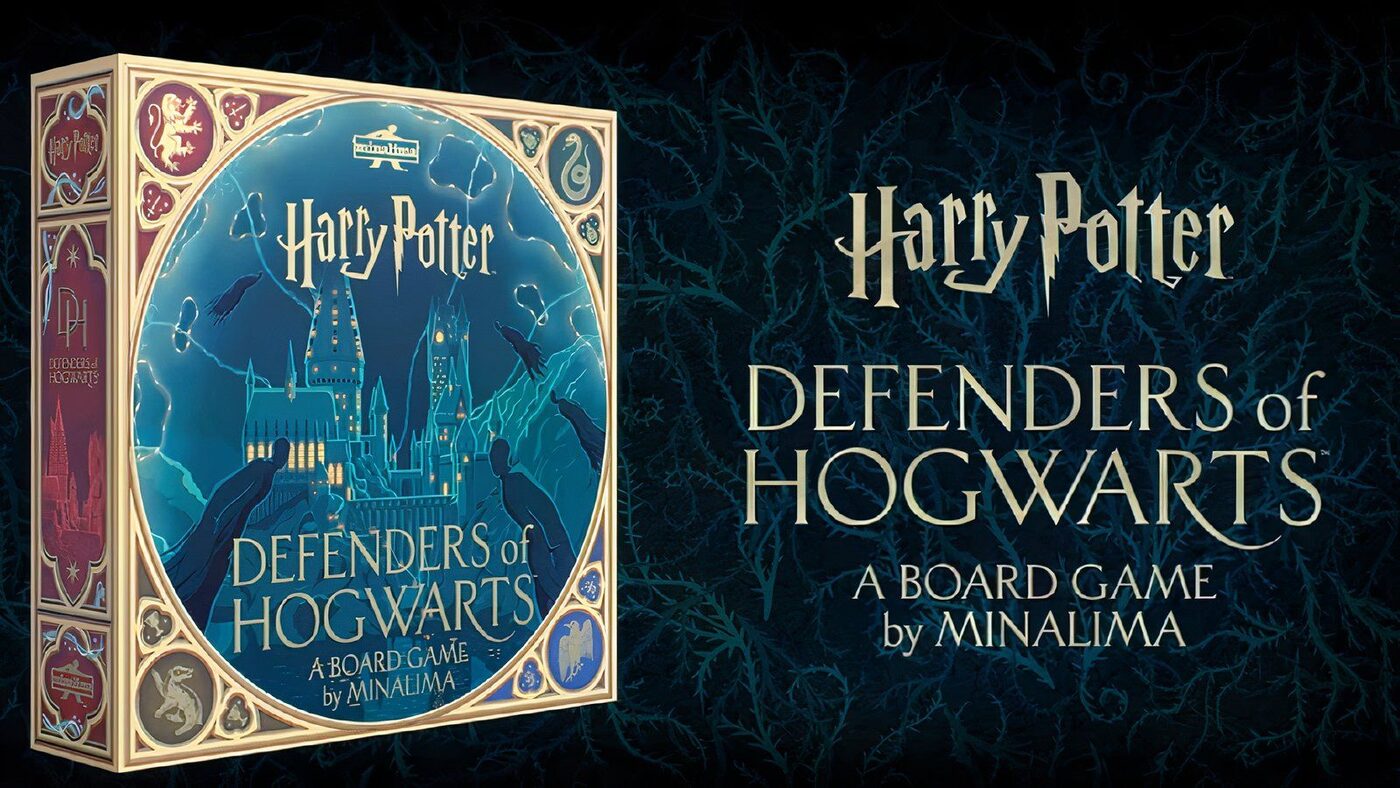
The biggest single movement this week belongs to a Kickstarter. Defenders of Hogwarts, the Harry Potter deck-builder designed by MinaLima - the studio behind the original film’s graphic props - jumped from #13 to #3 in one week, a ten-position climb that tracks almost exactly with the campaign going live. Kickstarter launches reliably generate this kind of hotness burst; the question is whether the underlying interest holds into next week once the announcement noise settles.
Meanwhile, Duel of Meloch dropped eleven places - from #4 to #15 - after its debut spike last week. The Scythe-meets-Expeditions crossover generated strong first-week curiosity, but the novelty appears to have faded quickly. That’s a common pattern for concept-driven releases: the announcement draws eyeballs, then the list moves on.
Four new entries join this week: Quickdraw: Battle for Silver City at #10, Magical Athlete at #16, Diables at #17, and Ark Nova making a familiar return at #19. The Kingdom Come double-header at #1 and #4 continues to hold, though the two entries have swapped relative positions compared to last week.
This Week’s Top 20
| # | Game | Trend |
|---|---|---|
| 1 | Kingdom Come: Deliverance - The Board Game | ➡️ STEADY (was #1) |
| 2 | Wingspan Pocket | 🔺 +1 (was #3) |
| 3 | Defenders of Hogwarts | 🔺 +10 (was #13) |
| 4 | Kingdom Come: Deliverance - The Board Game | 🔻 -2 (was #2) |
| 5 | Container | ➡️ STEADY (was #5) |
| 6 | Politik | 🔺 +4 (was #10) |
| 7 | dnup | 🔻 -1 (was #6) |
| 8 | SETI: Search for Extraterrestrial Intelligence | 🔻 -1 (was #7) |
| 9 | The Old King’s Crown | 🔺 +2 (was #11) |
| 10 | Quickdraw: Battle for Silver City | 🆕 NEW |
| 11 | World Order | 🔺 +1 (was #12) |
| 12 | Wondrous Creatures | 🔺 +4 (was #16) |
| 13 | The Lord of the Rings: Fate of the Fellowship | 🔺 +1 (was #14) |
| 14 | Harmonies | 🔺 +6 (was #20) |
| 15 | Duel of Meloch | 🔻 -11 (was #4) |
| 16 | Magical Athlete | 🆕 NEW |
| 17 | Diables | 🆕 NEW |
| 18 | Nippon: Zaibatsu | 🔻 -3 (was #15) |
| 19 | Ark Nova | 🆕 NEW |
| 20 | The Quest for El Dorado | 🔻 -12 (was #8) |
Dropped off: The Glorious Guilds of Buttonville (#9), Rolling Deep (#17), Moon Colony Bloodbath (#18), Sankoré: The Pride of Mansa Musa (#19)
Defenders of Hogwarts - MinaLima takes Harry Potter to Kickstarter
Defenders of Hogwarts is designed by David Waterman in partnership with MinaLima - the graphic design studio founded by Miraphora Mina and Eduardo Lima, who spent two decades creating the iconic props and printed materials for the Harry Potter film series. The Marauder’s Map, the Daily Prophet, Harry’s Hogwarts acceptance letter: all MinaLima. This is their first board game.
The design is asymmetric. Players set in the hours before Voldemort’s assault choose at the start of each session whether to defend the school alongside its houses or to join the Death Eaters already infiltrating the castle. That choice determines objectives, spell-casting options, and win condition. The game supports two to five players, runs up to 90 minutes, and is rated 13+.
The Kickstarter campaign launched over the weekend, which explains the ten-position jump from #13 to #3 in a single week. Announcement-driven hotness spikes of this size are almost always tied to a campaign going live. The limited fall 2026 release goes through selected retailers, House of MinaLima gallery locations, and Harry Potter Shops; a wider global multilingual launch follows in spring 2027.
The interesting question for a licensed Harry Potter game coming from the original film’s prop designers is whether the core mechanisms hold up for hobbyist players or whether it reads primarily as a collector’s item for franchise fans. The deck-building structure and asymmetric faction play suggest genuine design intent, but the audience at 13+ and the 90-minute ceiling also position it firmly as a gateway-level product. Both things can be true. If the campaign performs well, the hotness position will tell us which audience found it first.
Duel of Meloch’s eleven-spot drop - novelty without staying power
Duel of Meloch debuted at #4 last week as a deliberately unusual concept: a standalone two-player game that combines mechanisms from two existing Jamey Stegmaier titles, letting one player use Scythe rules while the other plays under Expeditions rules. The concept generated strong early interest.
It dropped to #15 in a single week. That’s an eleven-position fall, which is steep by hotness standards. What it suggests is that the initial burst was driven almost entirely by announcement curiosity - fans of both existing games paused to look - but that curiosity didn’t convert into sustained discussion. There’s no crowdfunding campaign driving engagement, no ongoing review wave, and the novelty of the hybrid premise doesn’t regenerate interest the way ongoing availability tends to for games with active releases.
Whether Duel of Meloch recovers depends on how well it plays. A game that resolves the “what would happen if these two systems clashed” question well tends to build its audience slowly through play reports. A game that answers that question poorly tends to disappear entirely. It’s too early to read the outcome from one week of hotness movement, but the trajectory so far doesn’t signal a slow burn - it signals a spike that’s already cooling.
Quickdraw: Battle for Silver City - Wild West asymmetric dueling at #10
Quickdraw: Battle for Silver City is a two-player asymmetric squad-building and dueling card game by Ryan Migalla, published by RAM Games. The setting is a Wild West standoff between the Law and the Bandits. The mechanical hook is a double-edged deck: at the start of each game, you select four units to deploy in the field. The other four go into your ammunition deck, which serves as the probability engine for whether your attacks succeed. Your strongest units are also your most powerful ammo, so every deployment decision is a trade-off between field presence and firepower.
The game was on Kickstarter earlier in the year, which means it’s now in the hands of backers or entering retail. At #10, it’s performing well for a smaller asymmetric two-player title. The Wild West genre doesn’t generate hotness positions by brand recognition - it has to earn them through mechanics or word of mouth. The double-edged deck concept is genuinely novel for the dueling card game space, and that kind of mechanism tends to generate ongoing BGG discussion as players work out optimal deployments and counters.
Magical Athlete - Richard Garfield’s chaotic racer gets the CMYK treatment
Magical Athlete is a roll-and-move racing game co-designed by Takashi Ishida and Richard Garfield, published by CMYK. It’s a reprint of a game that previously appeared in Japanese under a different publisher, updated and expanded with more than 20 additional characters. The core structure is a draft-and-race: players draft a team of four bizarre racers before the game starts, then assign one racer to each of four races. Each racer has an ability that breaks the game in a different way - moving five instead of rolling, swapping positions, attaching to other racers, tripping opponents on contact. The chaos compounds because every character is warping the rules simultaneously.
CMYK has built a reputation for publishing lighter games with high production quality and strong shelf appeal. Magical Athlete fits that profile: simple enough for ages 6 and up, short enough for repeated plays, weird enough that the experience doesn’t feel the same twice. The Garfield co-designer credit brings hobbyist interest from players who associate his name with Magic: The Gathering and Robo Rally. At #16, it’s a measured debut for a reprint - not headline performance, but steady.
Diables - Dani Garcia’s Gamefound worker placement arrives on the list
Diables is a mid-weight euro for one to four players designed by Dani Garcia, published by Salt & Pepper Games. The theme is the Ball de Diables - a Mediterranean street performance tradition from Catalonia involving demon costumes and elaborate pyrotechnics. Players manage a performance troupe, coordinating different types of fireworks, sending workers into the streets to interact with crowds, and adapting to events across three rounds.
The mechanics combine worker placement (with variable worker types), multi-use cards, and an evolving board where the performance area shifts as the parade advances. The game’s Gamefound campaign opened on July 3rd - three days ago - which explains the hotness debut at #17. Garcia has developed a following in the eurogame community, and a crowdfunding launch from Salt & Pepper typically generates enough BGG activity to land on the list. The theme is unusually specific by eurogame standards - most worker placement games reach for wine regions or renaissance trading - which either works as a differentiator or limits the audience depending on how much the mechanics can carry players past initial unfamiliarity.
Ark Nova’s recurring return
Ark Nova appears on the hotness for what is almost certainly the tenth or twelfth time in the past two years. It’s one of the highest-rated games on BGG, it hasn’t stopped generating discussion, and new players continue discovering it in a way that periodically pushes it back onto the list. There’s no specific trigger this week - no expansion announcement, no Kickstarter, no notable review. It just keeps showing up because it’s one of those games that people keep recommending, keep playing for the first time, and keep discussing afterward.
Ark Nova’s consistent hotness presence is the strongest possible signal that a game has achieved genuine long-term traction in the hobby. Most games that spike never return. Ark Nova returns without needing a reason to.
The steady core - what didn’t move much
Kingdom Come at #1 continues its now-three-week run at the top. Wingspan Pocket nudged up one position to #2 as the Stonemaier franchise brand continues to generate engagement. Container holds at #5. SETI drops one spot to #8 but remains a consistent presence. Harmonies climbed six positions to #14 - a quiet but meaningful recovery for a game that had been drifting down the list.
The Quest for El Dorado’s twelve-position drop (from #8 to #20) mirrors Duel of Meloch’s trajectory: strong positioning last week following a reprint announcement, followed by rapid normalisation. Neither game appears to have found the sustained discussion needed to maintain a high rank without an active campaign behind them.