Last week the hotness list was reshaped overnight by Gen Con. This week it settles. The convention is two weeks in the past and the shorter-lived buzz is burning out: CRAB RAGE!, Timespan, Mobius, and Québec - all genuinely Gen Con-driven entries - have fallen off the top 20 entirely. What remains is either durable (Dominant Species, The Lord of the Rings: The King’s Gambit, Wingspan Pocket) or newly arriving (Hell of a Deal, Avalon: The Riven Veil). The algorithm, as usual, is unkind to games that live only on floor buzz.
Five new entries this week. Five exits. A measured churn compared to the double-digit swaps of the past two weeks. The list is doing what post-convention lists do: digesting the noise and surfacing the signal.
This Week’s Top 20
| # | Game | Trend |
|---|---|---|
| 1 | Dominant Species | 〰️ (was #1) |
| 2 | Hell of a Deal | 🆕 NEW |
| 3 | Drillers | 🔻 -1 (was #2) |
| 4 | Avalon: The Riven Veil | 🔺 +16 (was #20) |
| 5 | Dune: Imperium - Conspiracy | 🔺 +9 (was #14) |
| 6 | The Lord of the Rings: The King’s Gambit | 🔺 +2 (was #8) |
| 7 | SETI: Search for Extraterrestrial Intelligence | 🔺 +4 (was #11) |
| 8 | Magical Athlete | 🔺 +1 (was #9) |
| 9 | Entropy | 🔻 -3 (was #6) |
| 10 | Wingspan Pocket | 🔻 -5 (was #5) |
| 11 | The Lord of the Rings: Fate of the Fellowship | 🔻 -1 (was #10) |
| 12 | Harmonies | 🔺 +6 (was #18) |
| 13 | Rebirth | 🔺 +3 (was #16) |
| 14 | Ark Nova | 🔺 +3 (was #17) |
| 15 | Night at the Zoo | 🆕 NEW |
| 16 | Container | 🔻 -4 (was #12) |
| 17 | Spirit Island | 🆕 NEW |
| 18 | Brass: Birmingham | 🆕 NEW |
| 19 | The Old King’s Crown | 🔻 -4 (was #15) |
| 20 | Lost Ruins of Arnak | 🆕 NEW |
Dropped off: CRAB RAGE! (#3), Timespan (#4), Mobius (#7), Greylune (#13 → now #46), Québec (#19)
Dominant Species - Holding the summit
Dominant Species sits at #1 for the second consecutive week, which is notable. The Allplay Masterworks announcement at Gen Con - a new Ian O’Toole edition of Chad Jensen’s 2010 area-control heavyweight - generated enormous buzz two weeks ago, and that buzz has not decayed at the rate you would normally expect from a crowdfunding-campaign-that-doesn’t-launch-yet story.
Part of the explanation is the nature of the game itself. Dominant Species is not a title that needed rediscovery; it has been in continuous print through GMT’s P500 system for sixteen years and sits comfortably in the weight-heavy prestige category. When Allplay announced that David Turczi was handling the solo mode and O’Toole the visual identity, the audience for that announcement was already primed - people who own the GMT edition but want a definitive shelf version, people who have played it at clubs and never pulled the trigger on a copy, and people who follow O’Toole’s work and track whatever he touches.
The crowdfunding campaign is not expected until 2027. The game holding at #1 in August 2026 tells you something about the depth of latent demand.
Hell of a Deal - The devil’s at the door
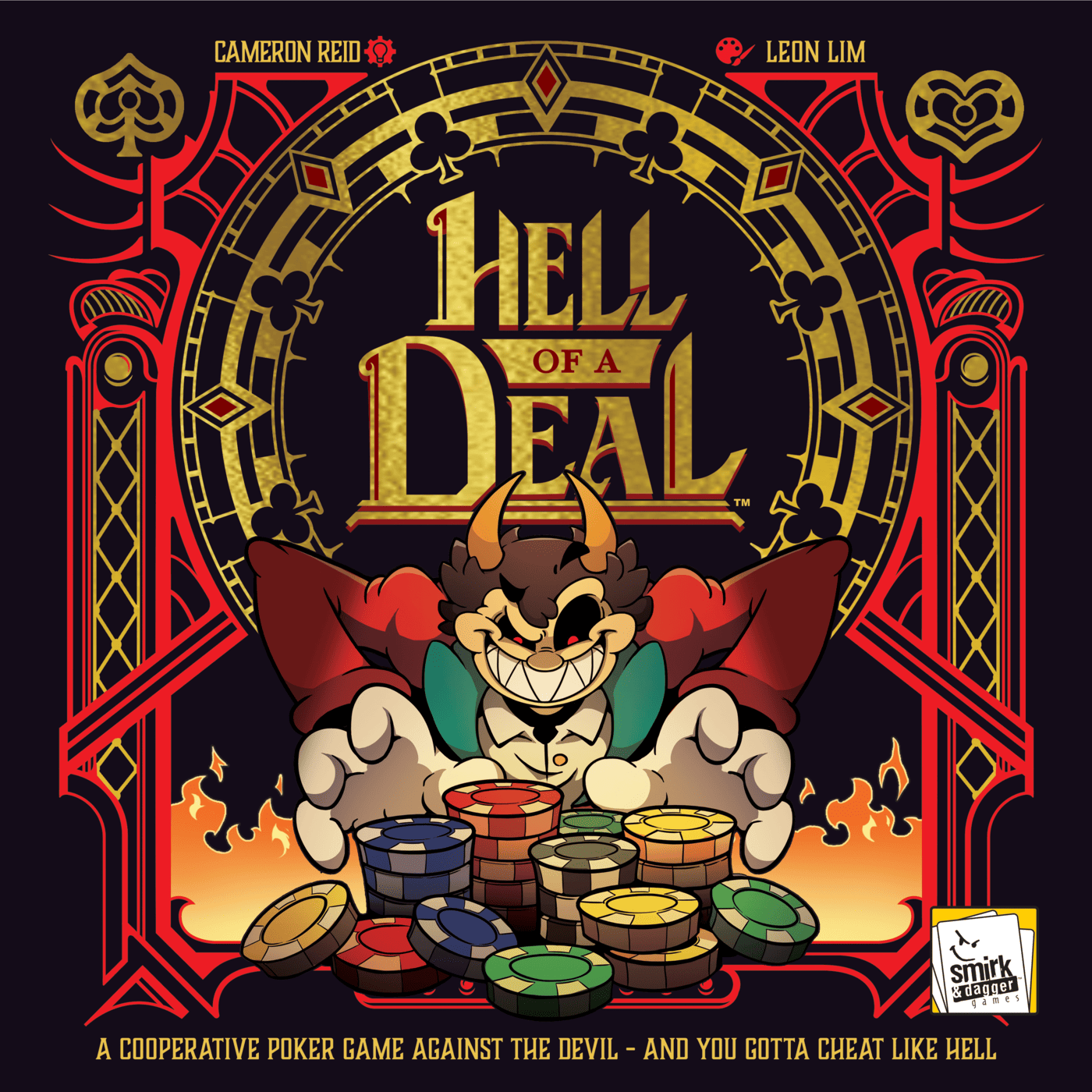
Hell of a Deal from Smirk & Dagger Games enters at #2, and its release date - August 31 - explains the timing precisely. Pre-orders are open, retail copies are listed on major US stores in the $70 range, and the game has been demoed in a steady stream of YouTube content since March.
The concept is tight enough to explain in a sentence: you and up to three other players cooperate to play poker against The Devil Himself and the minions of Hell, and everyone cheats - including you, up to a point. Exceeding that point earns Temptation tokens, and Temptation can end your run before the final table.
Structurally, each round pits the team against a new Boss with a game-twisting special ability and a minimum hand to beat. The four standard poker phases - pre-flop, flop, turn, river - unfold in sequence. Winning hands earn Souls (the game’s currency); losing hands drain them. To win, at least one player must beat the Devil in the final round.
Favor cards are the cheat mechanism: legal in-game actions that bend the poker rules in your favour, purchasable on your turn after placing a bet. The design tension is in calibrating how much you lean on them. Cheat aggressively and you accumulate Temptation. Cheat timidly and you lose to the Devil’s minimum hand. The game teaches you the equilibrium through failure.
At 90 minutes and rated for ages 14+, Hell of a Deal positions itself as a session game with real tension - the kind of thing that works at a game night where half the table knows poker and the other half has to pick it up on the fly. The theme does the heavy lifting for table presence. Neoprene poker mats and custom chips are in the box.
Copies ship August 31 in North America. European retail lands in September.
Avalon: The Riven Veil - Kickstarter copies arrive, +16 surge
Avalon: The Riven Veil from Jamie Jolly jumps sixteen places this week, from #20 to #4. The mechanism is standard and predictable once you recognise it: Kickstarter copies are arriving at backers’ doors, and unboxing and first-impression content is flooding BGG and YouTube simultaneously.
The game is an Arthurian area control and exploration title for two to four players. You lead one of multiple factions through the misty veil to the isle of Avalon, exploring terrain tiles, claiming legendary artefacts, bonding mythic beasts, and building toward a grail hunt that functions as both a strategic goal and a tempo lever. Seasons structure the game’s length - two or three depending on your selected game mode - and end-of-season scoring determines the winner.
The component ambition, from what arriving unboxings are showing, is significant: the box is large, the terrain tiles are substantial, and the Arthurian miniature set apparently justifies the Kickstarter-era price point. Reaction from backers receiving copies this week has been largely positive, with specific praise for the card art and the way the mythic beast bonding mechanic interacts with area control.
Whether the hotness position holds through next week depends on whether the review cycle follows through. First unboxings are engagement events. Actual play impressions, arriving in the second week, tend to either sustain or deflate the surge.
Dune: Imperium - Conspiracy - The franchise pulls everything up
Dune: Imperium - Conspiracy climbs nine places to #5, extending a strong post-Gen Con run. It was not a Gen Con launch - the expansion has been available since spring - but convention season creates a wave effect for established games with active communities, and the Dune: Imperium ecosystem is one of the most active in modern euro gaming.
Conspiracy is a standalone expansion compatible with the base game and Uprising, adding an intrigue-focused layer that alters the hand management rhythm of the core experience. The expansion generated significant table time at Gen Con and continues to benefit from positive word-of-mouth as those sessions convert to ratings and forum posts.
The broader Dune: Imperium series now occupies two positions in the hotness top 20 simultaneously - Conspiracy at #5 and the original Dune: Imperium at #47. This is a franchise doing the work of a franchise.
The classics reappear - Spirit Island, Brass: Birmingham, Lost Ruins of Arnak
Three evergreen titles enter the top 20 this week with no obvious release catalyst: Spirit Island at #17, Brass: Birmingham at #18, and Lost Ruins of Arnak at #20.
This pattern is recognisable. In the weeks following a major convention, a segment of the hobby’s audience - people who picked up their first game at Gen Con, or who spent the convention finally watching games they had been avoiding - surfaces on BGG and starts logging plays, writing reviews, and adding to wishlists. The games they reach for are the ones with deep play counts, high ratings, and active communities: Spirit Island (2017, the cooperative area-control behemoth), Brass: Birmingham (2018, the most-rated game on the site), Lost Ruins of Arnak (2020, deck-building and worker placement combined).
None of these games needed convention buzz to stay relevant. They are on the hotness list because enough people are looking at them right now to push them there, and the post-Gen Con discovery wave is the most plausible explanation for why this week in particular.
Notable drops - The Gen Con shelf life problem
Five games exit the top 20 this week. Three of them - CRAB RAGE!, Timespan, and Mobius - were Gen Con entries that landed in the August 3 chart on pure floor buzz. None of them has shipped yet to the general public. None of them has a Kickstarter or crowdfunding campaign open to convert interest into backing momentum. They were trending because people saw them on convention floors and added them to BGG wishlists on their phones. That wave passed.
Greylune is the sharper fall: from #13 last week to #46 this week. Greylune had a multi-week run in the top 10 before Gen Con, driven by its own pre-release anticipation. The convention overshadowed it completely, and now the post-convention settling is not restoring its position. It still exists on the chart - #46 is not oblivion - but the momentum is clearly broken.
Québec’s exit is the least surprising. It entered last week as a curiosity, climbed briefly, and left without much follow-through discussion. Short-shelf-life hotness entries tend to share a common profile: an announcement or re-announcement, no buy-it-now mechanism, and no community content waiting to sustain the interest. Québec checked all three boxes.
The BGG hotness list is a snapshot of what’s trending on BoardGameGeek by page traffic and activity, updated daily. It is not a chart of sales or critical consensus - it is a measure of current attention. Games that appear repeatedly, or that hold positions for multiple consecutive weeks, are typically in the middle of something real: a funded campaign, an imminent release, or a sustained critical conversation.