Most board games have a theme. A few board games are their theme - where the mechanics do not illustrate the story but actually become it, where every design decision from the map layout to the card icons exists in service of a single coherent feeling.
Sleeping Gods is one of those rare second cases.
This is a game about being lost. Not just strategically lost - not the pleasant puzzle-solving kind of lost you feel in Wingspan or Brass. Genuinely, disorienting, where am I, what am I doing here lost. And the extraordinary thing is that this feeling is not an accident or a side effect. It is the entire design intention, and Ryan Laukat - who designed and illustrated the whole thing, solo - has constructed every mechanical layer to produce exactly that sensation.
The Premise: 1929, a Steamship, a Sea That Should Not Exist
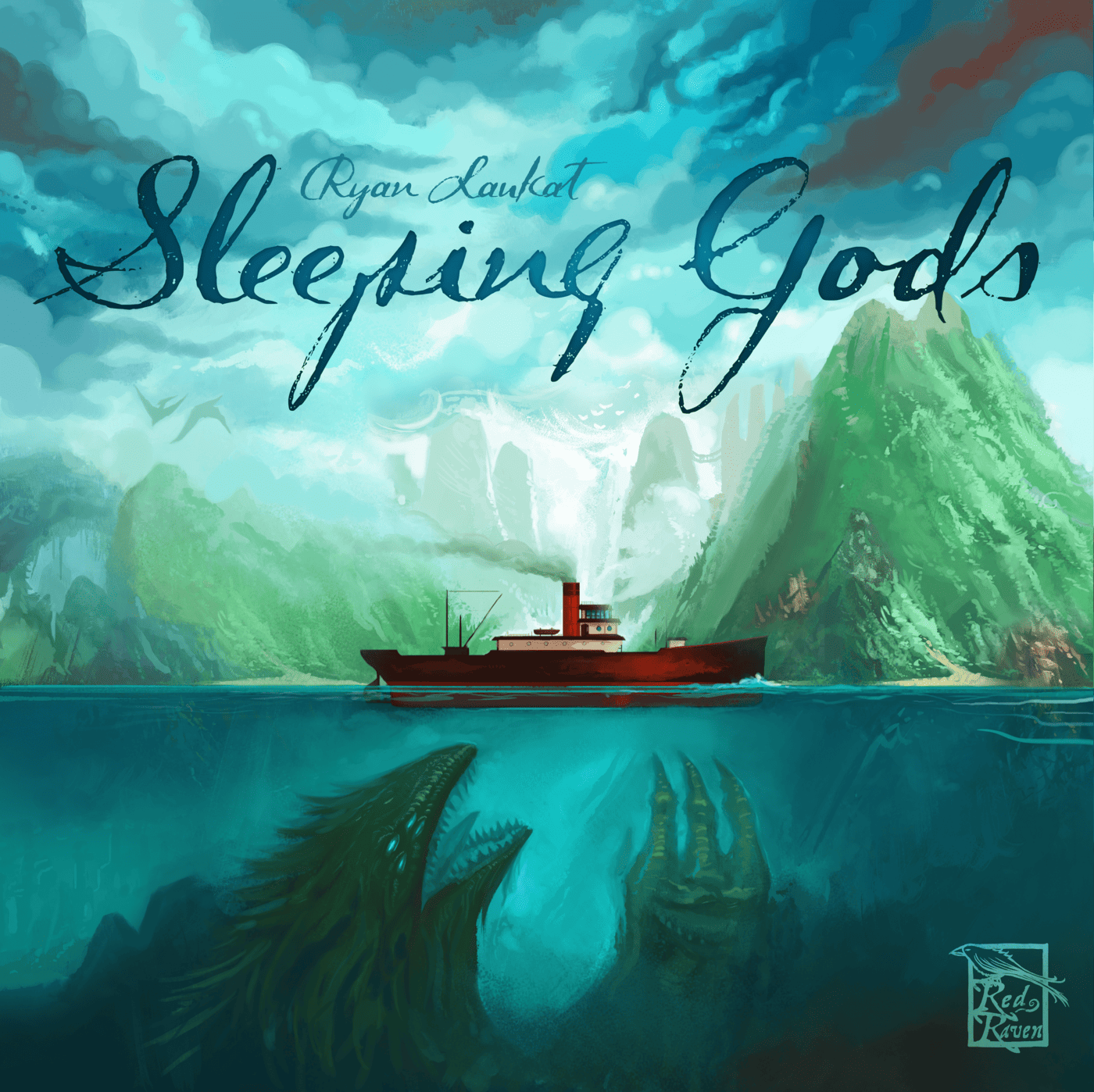
The setup is deceptively simple. It is 1929. You are Captain Sofi Odessa, commanding the steamship Manticore with a crew of sailors who were just doing their jobs. A storm hits. When the weather clears, the stars are wrong.
You are in the Wandering Sea - a realm that should not exist, populated by mythological creatures, impossible geography, and sleeping gods who have been dormant for centuries. To return home, you must find and awaken those gods by gathering their totems. Nobody knows how many totems there are, or where they are, or what you will encounter while looking.
That is the entire premise. There is no further briefing. No tutorial island easing you in gently. You open the Atlas - the game’s large-format map book - find your starting location, read the entry, and begin.
The Manticore becomes your world. You will live in it for 10 to 15 hours across multiple sessions.
Ryan Laukat Did Something Unusual Here
Before getting into the mechanics, it is worth pausing on the creative context, because it explains a lot about why Sleeping Gods works the way it does.
Ryan Laukat is the founder of Red Raven Games. He has designed games before - Above and Below, Near and Far, City of Iron - and he has illustrated all of them. Every game Red Raven has ever published carries his distinctive art style: warm, slightly otherworldly, painterly in a way that sits between storybook illustration and concept art.
The typical board game pipeline separates design from illustration. A designer builds the mechanisms; a studio hires artists to dress them up. Laukat does not work that way. In Sleeping Gods, the same mind that decided you need action points to manage crew fatigue also drew every coastal inlet in the Atlas, every creature you will encounter, every character portrait.
That unified vision is not just aesthetically pleasant - it has structural consequences. When a designer says “we need a card for the sea monster encounter” and a separate artist draws it, there is always some creative translation happening, some drift between intention and execution. When the same person does both, the image is the intention. You can feel that coherence in play. Nothing in Sleeping Gods feels decorative. Every illustration is doing mechanical work.
The Atlas: A Map That Withholds Information
The physical object at the centre of the game is the Atlas - a spiral-bound book of maps, each page showing one region of the Wandering Sea in Ryan Laukat’s illustrated style.
Here is the key thing: you cannot see the whole map at once.
The Atlas sits on the table open to the page showing your current region. You can see adjacent regions - enough to navigate to them - but unexplored areas remain closed. You do not know what is on the next page until you sail there. You do not know how large the sea is. You do not know where the edges are.
This sounds like a minor production detail. It is actually one of the most effective mechanical expressions of theme in modern board gaming. The physical act of turning the page when you sail into new waters is the discovery. The slight anxiety of not knowing what is there until you arrive is the exploration. The game does not need to tell you to feel uncertain about what lies ahead - it builds the uncertainty into the physical object you are holding.
Compare this to how most exploration games handle discovery. Usually they reveal tiles, or draw cards, or flip tokens. These are adequate. They communicate “you found something new.” What Sleeping Gods does instead is make you feel the unfamiliarity of the space - the way an actual sailor might feel navigating without a complete chart.
Action Points and Crew Fatigue: The Mechanics of Exhaustion
Each round, your crew has a shared pool of action points to spend. Move the ship. Send crew members to explore an island. Fight a creature. Rest and recover cards. Cook and restore health. Consult the Atlas entry for your current location to discover what is here.
The crew members have stats - strength, agility, spirit, wisdom - and encounters will call on specific stats in specific combinations. Combat is a hand-management affair with event cards that require responses. Resting is slow but necessary.
What the action point system does, quietly and persistently, is model the weight of the journey. You are never fully resourced. You are always making triage decisions - do we explore this island now or push on towards the totem rumoured to be three regions east? Do we rest and lose momentum, or push on and risk running low on health and cards when the next encounter hits?
That low-level scarcity - never desperate, but never comfortable - maps directly to the emotional experience of being lost and trying to make it home on limited supplies. The game does not need to say “this is hard and exhausting.” The action point economy tells you.
The Log Book: Your Crew’s Personal History
Alongside the Atlas sits the Log Book - a companion text that stores the numbered entries corresponding to Atlas locations. When you arrive somewhere and read the entry, you are often given choices: investigate the ruins, talk to the stranger on the shore, take what you need and move on.
These choices branch. Some have consequences that only appear ten sessions later, when you return to a location and find it changed by something you did earlier. Some unlock new crew members who join the Manticore. Some reveal fragments of the mythology - who the sleeping gods actually are, what the Wandering Sea is, why it exists.
The Log Book is deliberately incomplete as a reading experience. It is not a novel. Individual entries are short - sometimes just a paragraph, sometimes a page. They do not connect into a conventional narrative with a clear through-line. They are more like fragments of folklore, glimpsed out of context and only partially understood.
This is the right call. A board game that tried to tell you a complete, coherent story through text entries would be competing with novels, and it would lose. What the Log Book does instead is give you enough texture to build the story yourself - to interpret what these fragments mean, to decide what matters, to feel the mythology as ambient background rather than foreground plot. The Manticore crew is your story. The world provides the context.
Replayability and the Open-World Structure
Sleeping Gods is not a linear campaign. There is no set sequence of events. The totems you need could be anywhere. The encounters you have depend entirely on where you go, in what order, at what point in your campaign.
Two playthroughs of Sleeping Gods will feel substantially different - not because the content changes (the Atlas entries are fixed) but because the order and combination of discoveries is yours. A crew that sails north first will understand the mythology differently from a crew that explored the southern islands first. Both are experiencing the same Wandering Sea, but through a different sequence of revelation.
This open structure means the game rewards re-reading. Entries you rushed through in a first campaign become more meaningful in a second, when you recognise a name, understand a reference, or know what became of a character you met somewhere else.
The Quiet Space Between Sessions
One underappreciated design element is the save structure. Sleeping Gods is designed to pause and resume across multiple sessions. You note your location, resources, crew status, and discovered totems, and pick it back up next time.
This creates something unusual: a game that exists in your imagination between sessions. In the days between plays, you find yourself thinking about the Manticore. About the island you did not fully explore before sailing on. About the creature encounter you barely survived. About the totem you almost have enough information to locate.
That between-session presence is something novels and video games produce regularly and board games rarely do. Sleeping Gods manages it because the world is just specific enough to hold your imagination, and just incomplete enough to give your imagination something to fill in.
How It Compares
Vs Tainted Grail: Fall of Avalon: Tainted Grail is darker, more text-heavy, and more explicitly narrative in structure. Where Sleeping Gods trusts the player to construct meaning from fragments, Tainted Grail tells you the story more directly. Both are excellent; Sleeping Gods feels more like exploration, Tainted Grail more like reading a dark fantasy novel interactively.
Vs Gloomhaven: Gloomhaven is a dungeon crawler with campaign structure. Its narrative is secondary to its tactical combat. Sleeping Gods flips the priority - the story is primary, combat is one of many ways the world pushes back. Very different experiences despite superficial structural similarities.
Vs Near and Far (same designer): Near and Far is Ryan Laukat’s previous Atlas-based storybook game. It is lighter, shorter, and more structured. Sleeping Gods is the deeper, more ambitious successor - more complex mechanically, more ambitious thematically, more willing to let you sit with uncertainty.
The Stats
| Stat | Value |
|---|---|
| BGG Rating | 8.08 |
| BGG Rank | #75 all time |
| Thematic Rank | #23 |
| Ratings Count | 16,220 |
| Weight | 3.26 / 5 |
| Players | 1-4 |
| Campaign Length | 10-15 hours |
| Year | 2021 |
| Designer / Illustrator | Ryan Laukat |
The #23 thematic rank is the number that tells the story. In the category that specifically measures how well a game delivers its thematic experience, Sleeping Gods sits behind only the very best - Gloomhaven, Spirit Island, Oath. The BGG community, when asked specifically about thematic execution, places it higher than almost anything else on the market.
Who This Is For
Strongly recommended for:
- Players who want a campaign game that feels genuinely exploratory, not just narrative checkbox-ticking
- Solo players - the 1-player mode is fully supported and many consider it the best format for this game
- Anyone who has ever wanted a board game that lingers in their thoughts between sessions
- Fans of Ryan Laukat’s art who want to spend 15 hours inside it
Skip it if:
- You need clear win conditions and structured objectives - Sleeping Gods is deliberately vague about progress
- Your group bounces off text-heavy games or finds reading aloud awkward
- You want high-crunch tactical combat (this is not that game)
- You cannot commit to a campaign across multiple sessions
The Verdict
There is a specific kind of game that does not feel like a game while you are playing it. The mechanics become transparent - you stop thinking about action points and hand management and start thinking about where the Manticore should go next, about what happened to the sailor who went ashore alone, about whether you trust the stranger offering safe harbour.
Sleeping Gods earns that transparency through the deliberate, unified vision of a designer who has never separated the look of his games from how they play. Every card, every entry, every Atlas page exists in service of one sustained feeling: you are lost in an impossible world, and the only way home is through.
That is what theme looks like when it actually works.
Sleeping Gods is designed and illustrated by Ryan Laukat, published by Red Raven Games. It plays 1-4 players across a campaign of 10-15 hours. BGG weight: 3.26/5. BGG rating: 8.08 (#75 all time, #23 thematic).