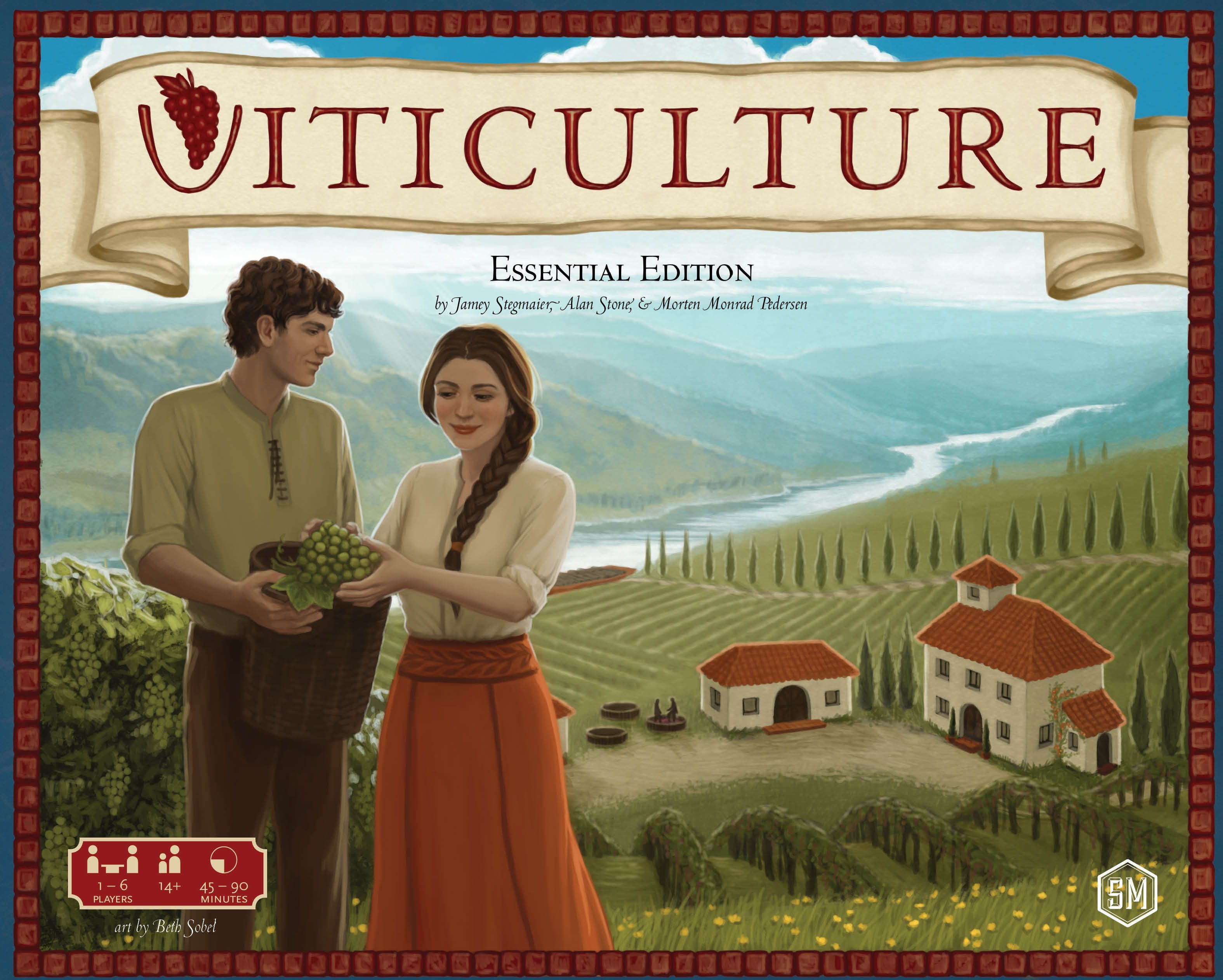
If you own one worker placement game, there’s a fair chance it’s Viticulture Essential Edition. Sitting at rank #45 on BoardGameGeek with a 7.96 rating from over 55,000 users, it’s become the default recommendation for anyone entering the hobby - accessible enough for first-timers, deep enough for veterans to return to again and again.
But here’s the question that gets asked less often: how does it play solo?
The answer is surprisingly satisfying. Viticulture includes a full Automa system - a solo opponent that doesn’t just fill a seat, but actually pushes back. It blocks your workers, contends for the same spaces, and applies meaningful pressure throughout the game. This isn’t a solitaire mode bolted on as an afterthought. It’s a fully engineered second experience.
Let’s dig into what makes it work.
The Numbers (Verified via BGG)
| Stat | Value |
|---|---|
| BGG Rank | #45 |
| Rating | 7.96 / 10 |
| Weight | 2.90 / 5 |
| Players | 1-6 |
| Playtime | 45-90 min |
| Publisher | Stonemaier Games |
Solo poll data (BGG community votes, 579 responses):
- Best at 1 player: 36 votes
- Recommended at 1 player: 373 votes
- Not Recommended at 1 player: 170 votes
The community leans Recommended at one player - not Best, which is meaningful. The solo mode is genuinely good, but most people agree the game shines brightest at 3-4 players (Best: 437-493 votes). That’s a realistic place to start.
How the Automa Works
The Automa (designed by Morten Monrad Pedersen of Stonemaier Games’ Automa Factory) is the solo system included in every copy of Viticulture Essential Edition. You don’t need any additional purchase to play solo.
Here’s the mechanical loop:
Each round, you draw an Automa card from a shuffled 16-card deck. The card has symbols on it - each symbol tells you which worker placement spaces the Automa will attempt to occupy, in priority order, until it has placed as many workers as it has available.
You resolve your season normally. When it’s the Automa’s “turn,” it goes through the symbols on its current card and places workers wherever it can - taking spaces from you in the process. It doesn’t care about optimal play. It cares about blocking.
This creates a critical dynamic: you cannot plan around the Automa the way you’d plan around a passive puzzle. That space you’re counting on for the Grande Worker bonus? The Automa might grab it first. That early spring action you need to plant your vines? Better go early, because the Automa has no sympathy.
The Automa earns points automatically at the end of each year based on a simple formula - progress markers tracked on the Automa board rather than a complex simulation of its actual winery. It’s streamlined by design, because the point isn’t to simulate a perfect opponent; it’s to create enough pressure that your decisions matter.
Setup and Teardown: A Realistic Look
This is where Viticulture solo genuinely shines compared to heavier games.
Setup: ~10 minutes. You’re dealing out a standard player board, shuffling four decks (vine cards, wine orders, summer visitors, winter visitors), laying out the central board, and preparing the Automa deck. If you’ve played the game a few times, this drops to 7-8 minutes.
Table footprint: Modest. One player board plus the central board. No sprawling island maps. No 400 tokens sorted into 12 piles. Viticulture lives comfortably on a kitchen table without a formal game room.
Teardown: ~5 minutes. Cards back in their decks, tokens sorted, done.
Compare this to Spirit Island (20-30 minutes setup, exhausting teardown) or Arkham Horror: The Card Game (campaign tracking, deck construction, scenario setup). Viticulture is the solo game you can actually play on a Tuesday night after dinner without committing your entire evening.
Decision Density: What Actually Happens During Play
Solo Viticulture is a tighter experience than multiplayer, but not a lesser one.
Your core loop across six years (the standard game length):
Wake-up order - choose where on the wake-up track you want to sit. Early wakers get fewer perks but go first; late wakers pick from a menu of small bonuses. Solo, you’re deciding whether to trade tempo for resources.
Summer actions - place workers to plant vines, draw vine cards, play summer visitor cards, build structures. The Automa competes for the same spaces.
Winter actions - harvest, make wine, fill orders, play winter visitor cards. This is where points accumulate.
Year end - age your wines, check for game-end triggers.
Each year presents roughly 5-8 meaningful choices (depending on card draws and the Automa’s interference). That’s not the decision density of Mage Knight or Food Chain Magnate - it’s something more comfortable. The puzzle is clear. You know what you’re trying to do. The question is whether the Automa lets you do it in the order you planned.
What makes solo interesting is visitor card variance. These are the heart of Viticulture’s depth - each card bends the rules in small, specific ways. A good summer visitor hand can accelerate your engine dramatically. A bad one forces creative rerouting. The Automa doesn’t draw visitors, which means your path to victory is always asymmetric in an interesting way: you’re managing chaos, it’s managing tempo.
Replayability: How Long Does It Stay Fresh?
Viticulture solo has solid replay legs for a few reasons:
The Automa deck shuffles differently every game. You’ll never face the same blocking pattern twice. Early-game pressure varies. Sometimes the Automa vacates the harvest spaces and lets you build an early wine stockpile; sometimes it camps on exactly the spaces you need all game.
Visitor card draws are different every session. The 80-odd visitor cards mean your strategic options shift each play. Some games you’re an order-fulfilment machine. Others you’re a structural powerhouse with a Grande Worker advantage.
The wake-up track creates meta-decisions. Choosing to go late (bonus resources, less tempo) versus early (more control, fewer resources) is a recurring strategic tension that doesn’t get old.
Where it plateaus: Once you’ve played 15-20 times, the Automa’s lack of real strategic agency becomes visible. It’s a pressure mechanism, not a true opponent. Against an experienced player, it stops being surprising. The game’s complexity ceiling is genuinely lower than the heavy solo games - that’s not a flaw, it’s a design choice, but set your expectations accordingly.
For medium-complexity enthusiasts who want a reliable, relaxing solo session rather than a brain-burning ordeal, this is almost infinitely replayable. For people chasing the hardest challenge the hobby offers, you’ll want something heavier eventually.
With Tuscany: The Essential Edition Expansion
If you love solo Viticulture and want more, Tuscany Essential Edition is worth knowing about.
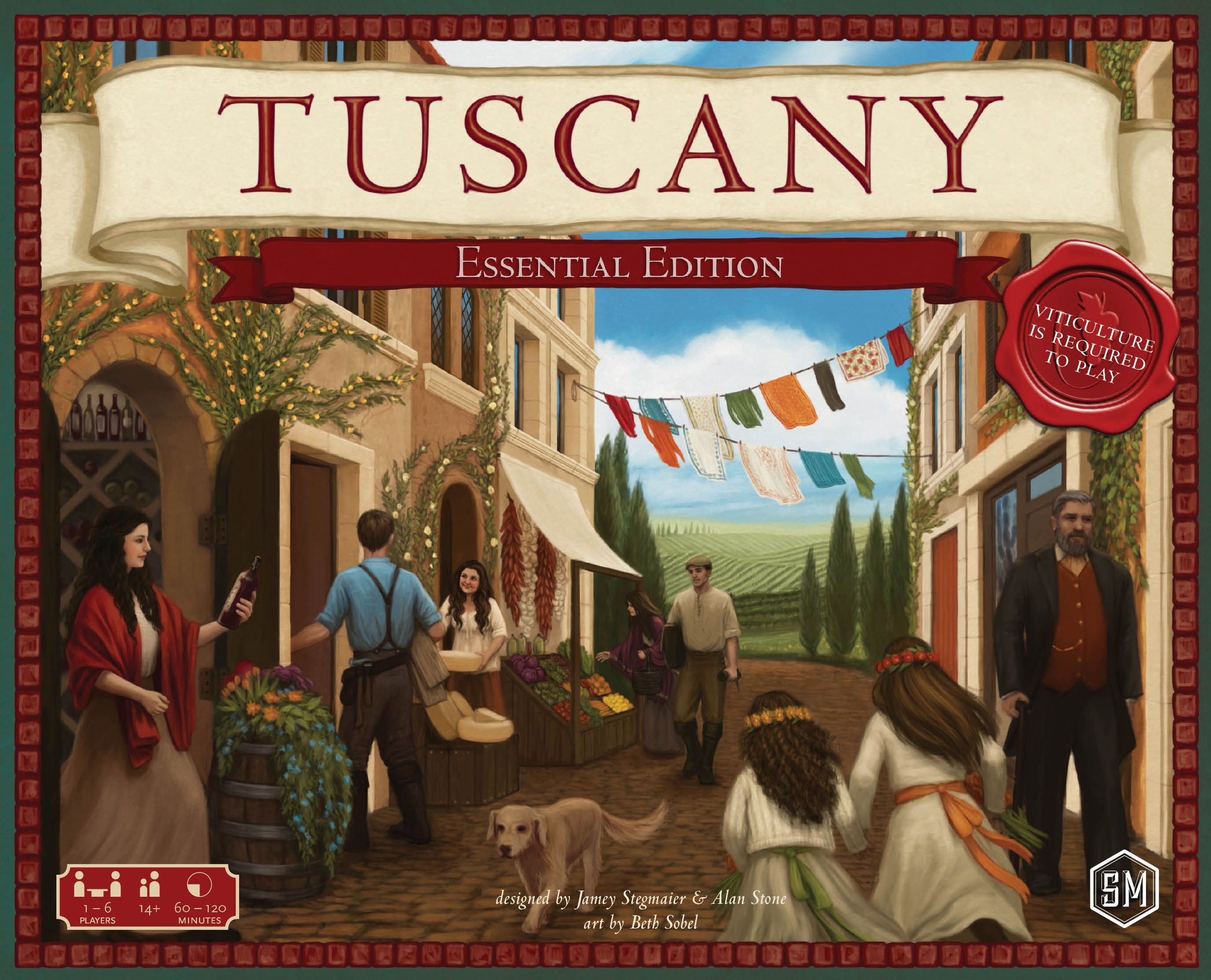
Tuscany Essential Edition - Image credit: Stonemaier Games / BoardGameGeek
| Stat | Value |
|---|---|
| Rating | 8.53 / 10 |
| Weight | 3.26 / 5 |
Tuscany adds a modular expansion to the central board (seasons track, extended map), new structures, special workers, and more visitor cards. The weight jump from 2.90 to 3.26 is real - Tuscany makes Viticulture meaningfully more complex.
Critically: Tuscany includes an expanded Automa deck compatible with the new mechanisms. The solo mode scales properly with the expansion. This is how expansion content should work.
Most experienced solo players recommend starting with base Viticulture EE, playing 8-10 games to get comfortable, then adding Tuscany modules one at a time.
How It Stacks Up Against Multiplayer
Solo Viticulture is good. Multiplayer Viticulture at 3-4 players is better.
Here’s why: worker placement tension is fundamentally a social mechanism. The read-your-opponent layer - knowing that your friend always goes for the harvest space in autumn, recognising when someone is holding a powerful winter visitor - adds a psychological richness the Automa can’t replicate. The wake-up track negotiation in a live game is genuinely tense. The moment someone blocks a space you needed and you have to improvise? That’s a story you tell. The Automa doing it is just a card symbol.
This isn’t a knock on the solo mode - it’s a fair calibration. If you have people to play with, play with people. Viticulture is one of the best gateway worker placement games ever made, and it’s best experienced around a table with wine and friends.
But when those people aren’t available - when it’s a quiet weeknight and you want something engaged but not exhausting - solo Viticulture delivers. It’s in a tier of its own among accessible solo worker placements.
The Tonight Test
Can you actually play this tonight?
Yes - with minimal friction.
- You need: the base game (1 copy, everything included)
- Setup: 10 minutes
- Playtime: 45-60 minutes solo (runs faster than multiplayer)
- Teardown: 5 minutes
- Prior knowledge needed: one rules readthrough, or a 15-minute How-to-Play video
The rulebook is well-written for Stonemaier. The Automa rules section is short and clear. You will not get stuck trying to parse ambiguous language. If you’ve played the game before and want a solo session tonight, you can be playing within 15 minutes of opening the box.
Starting difficulty recommendation: Play your first solo game on Easy (Automa at lower difficulty setting). Get your bearings with the visitor card ecosystem and the order-fulfilment engine. Then ratchet it up once the rhythm is familiar.
Who Is This For?
Play it solo if you:
- Want accessible, medium-weight worker placement without a 3-hour commitment
- Own the game but usually need 3+ people to get it to the table
- Are new to solo gaming and want a low-friction entry point
- Enjoy the pastoral theme and want a relaxing, thoughtful experience
Look elsewhere if you:
- Want maximum challenge and brutal decision density (try Spirit Island, Mage Knight, or Arkham Horror LCG)
- Are chasing the deepest solo experience in the hobby
- Need competitive tension - the Automa is pressure, not a player
Viticulture Essential Edition earned its place in the hobby by being exactly what it says it is: a well-designed worker placement game that respects your time. The solo mode carries that philosophy forward. It’s not trying to be the hardest solo game ever made. It’s trying to be a great way to spend an evening with your vineyard.
On that front, it succeeds completely.
Viticulture Essential Edition is published by Stonemaier Games. BGG data current as of May 2026. Solo poll data: 579 community votes.