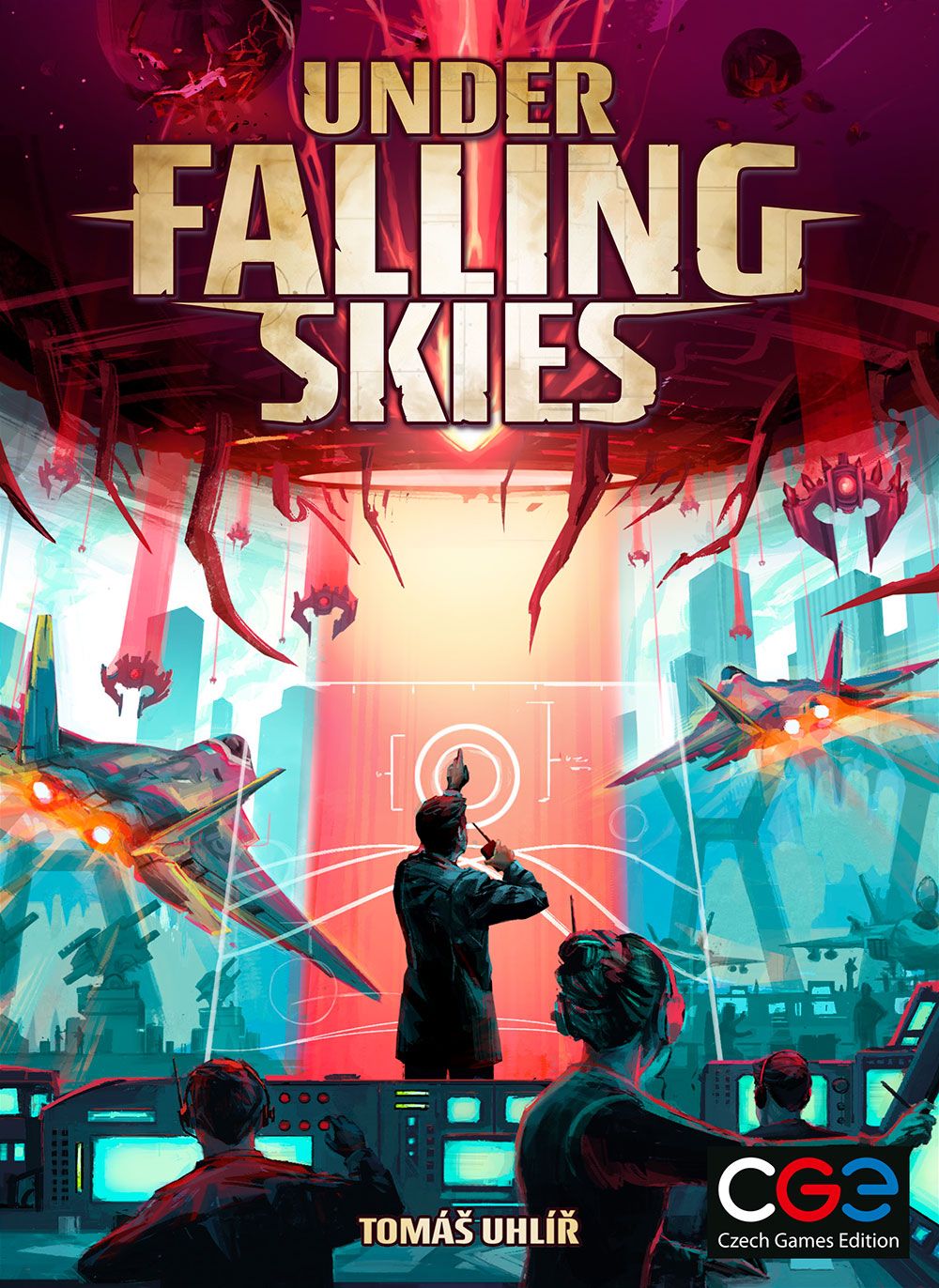
A giant alien mothership descends toward your city. Five columns of enemy fighters rain down between you and oblivion. Your only weapons? Five dice and whatever you can build in an underground bunker before the sky literally falls.
Under Falling Skies is the rare solo-only game that feels like it was born this way rather than bolted on as an afterthought. Designed by Tomáš Uhlíř and published by Czech Games Edition in 2020, it evolved from a 9-card print-and-play contest winner into a full retail release packed with one of the most impressive campaign modes in solo gaming. And it does it all in a box that fits in your coat pocket.
The Numbers
| Stat | Value |
|---|---|
| BGG Rating | 7.60 |
| BGG Rank | #265 |
| Weight | 2.39 / 5 |
| Players | 1 (solo only) |
| Play Time | 20-40 minutes |
| Year | 2020 |
| Ratings | 13,931 |
The BGG solo player count poll tells the story: 231 votes for “Best” at 1 player, 8 for “Recommended,” and zero - zero - for “Not Recommended.” When the community says a game belongs at a specific player count, those numbers are about as emphatic as it gets.
How It Actually Works
Under Falling Skies is a dice placement game dressed in a Space Invaders costume. Each turn, you roll five dice (three grey, two white) and assign them one per column to rooms in your underground bunker. Higher numbers mean more powerful actions - more research progress, more energy, stronger defences. But here’s the twist that makes the whole thing sing: placing a die also advances the alien ship in that column by a number of spaces equal to the die’s value.
That 6 you need for a critical research push? It also sends an alien fighter screaming six rows closer to your city. The careful 2 you placed for energy? At least that ship barely moved. Every single placement is a negotiation between what you need and what you can afford to let through.
The rooms in your bunker handle distinct functions:
- Research labs - push the research track toward victory (the only win condition)
- Energy generators - power other rooms that need fuel
- Anti-aircraft guns - slow descending fighters
- Jet fighters - destroy ships outright when they cross explosion markers
- Excavators - dig deeper into your bunker to unlock more powerful rooms
You don’t have access to everything from the start. Spending dice on excavation means not spending them on defence or research - and the mothership doesn’t wait. It drops one row every turn, spawning new fighters and triggering increasingly nasty effects as it descends.
The White Dice Gambit
Two of your five dice are white, and they come with a mandatory wrinkle: when you place a white die, you must re-roll all remaining unplaced dice. This sounds like a minor rule. It is, in fact, the engine of pure anguish.
You’ve got a perfect grey 5 lined up for your lab and a grey 3 for your excavator. But you need to place a white die first for energy. You put it down, re-roll the remaining dice, and watch your beautiful 5 and 3 become a 1 and a 1. Your research stalls. Your excavation stalls. The aliens advance. You stare at the board and try to figure out how to survive with scraps.
This re-roll mechanic transforms what could be a straightforward optimisation puzzle into something far more human - a game about timing, about when to lock in value and when to gamble. It’s the reason Under Falling Skies doesn’t feel like doing maths homework despite being, at its core, a numerical puzzle.
The Campaign: Where It Gets Serious
The base game is solid, but the campaign is where Under Falling Skies becomes something special. And it’s not a small add-on - the campaign makes up over half the content in the box.
Spread across four chapters, the campaign introduces:
- Scenarios that twist the rules (satellites between you and the invaders, leaking nuclear reactors that make energy dangerous, reinforcements that alter fighter behaviour)
- Characters with once-per-game abilities (die manipulation, bonus research, defensive powers)
- New cities with unique layouts and special abilities
- Difficulty scaling that builds naturally as you progress
The structure is clever: each chapter gives you a choice between two missions, and you only play one - which means your second campaign playthrough will be genuinely different. If you lose a mission, you flip the city board to its damaged side (slightly more powerful) and play again, then move on regardless. It’s forgiving enough to maintain momentum but challenging enough that victories feel earned.
What’s remarkable is how lean the whole thing is. There are no miniatures, no app, no legacy components you destroy. It’s cardboard tiles, cleverly doubled-sided, creating meaningful variety from minimal material. As one Meeple Mountain reviewer put it: the campaign is “absolutely phenomenal” and finds ways “to use and reuse components in excellent ways that feel all the more satisfying for their efficiency.”
The Practical Stuff Solo Gamers Actually Care About
Setup & Teardown
Setup: 2-3 minutes. Lay out sky tiles, pick a city, slot in bunker boards, grab dice and tokens. For the campaign, add selecting a scenario and character - another minute or so.
Teardown: 2 minutes. Everything fits back in the box with room to spare (a rarity for campaign games).
Table Footprint
The board is tall and narrow - roughly the width of two hands side by side. It fits on a coffee table, an airline tray, a hotel desk. One BGG reviewer called it “wind-proof” compared to card-based solo games, and they’re not wrong. No loose cards to blow away on a porch.
Decision Density
High, but compressed. You’re making 5 meaningful placements per turn across perhaps 12-15 turns per game. Every placement has immediate visible consequences - you can trace exactly how each die affects the alien fighters, your resources, and your research progress. The transparency is both satisfying and occasionally brutal.
Replayability
Strong. Between the modular sky tiles (flip for harder variants), multiple cities, campaign content, and adjustable difficulty, there’s easily 20+ meaningfully different games in the box. After completing the campaign, you can mix and match all unlocked components freely.
Analysis Paralysis Warning
This game will induce AP if you’re prone to it. Because the consequences of each placement are fully visible and calculable, the temptation to count every possible permutation is real. Multiple BGG reviewers flag this as their primary complaint. If you’re someone who needs to solve each turn optimally, budget closer to 40-50 minutes rather than the advertised 20-40.
Who This Is Actually For
You’ll love it if:
- You want a solo game that’s designed for solo, not adapted from multiplayer
- You enjoy puzzles where every decision has a visible cost
- You like the idea of a 30-minute game that still feels weighty
- You appreciate elegant design over component excess
- Campaign games appeal to you but you don’t want a 20-hour commitment
It might not click if:
- You want narrative-driven solo experiences (the campaign has comic book flavour but minimal story)
- Repetition bothers you quickly - the core loop, while excellent, is the same loop every game
- You prefer dice games with more mitigation options (you get the white die re-rolls and… that’s it)
- You want surprises from the AI opponent - the aliens react deterministically to your placements, so there are no curveball moments
That last point is the most interesting criticism. As one thoughtful review noted, the aliens only ever respond to what you do - they advance where you place high dice, they threaten wherever you’re making progress. There are no random events, no sudden escalations, no “the crisis deck flips and everything changes” moments. The tension comes entirely from your own decisions and the dice. For some players, this is the game’s greatest strength. For others, it makes the experience feel like fighting a conveyor belt rather than an intelligent invader.
How It Compares
| Game | Rating | Weight | Play Time | Type |
|---|---|---|---|---|
| Under Falling Skies | 7.60 | 2.39 | 20-40 min | Solo only |
| Friday | 7.11 | 2.16 | 25 min | Solo only |
| Warp’s Edge | 7.64 | 2.39 | 30-45 min | Solo only |
| Robinson Crusoe | 7.72 | 3.83 | 60-120 min | 1-4 players |
| Spirit Island | 8.34 | 4.07 | 90-120 min | 1-4 players |
| Mage Knight | 8.08 | 4.38 | 60-240 min | 1-4 players |
Under Falling Skies occupies a distinct niche: it’s lighter and faster than the heavyweights (Spirit Island, Mage Knight) while being meatier and more replayable than the micro-solos (Friday). Warp’s Edge is its closest sibling - similar weight, similar playtime, both solo-only - but where Warp’s Edge leans into bag-building and a more narrative sci-fi feel, Under Falling Skies is purer puzzle.
If you already own Spirit Island or Mage Knight and need something for the nights when a 2-hour commitment isn’t happening, Under Falling Skies is close to the perfect complement.
The Verdict
Under Falling Skies is one of those games where the design is so clean that you almost don’t notice how clever it is. The dice-placement-equals-enemy-advancement mechanic is one of the most elegant ideas in modern solo gaming - a single rule that creates cascading consequences on every turn. The campaign is generous, the footprint is minimal, and the price point (typically £20-25) makes it one of the best value propositions on the solo shelf.
It’s not without limits. The deterministic AI means experienced players will eventually feel like they’re optimising against a known system rather than battling an unpredictable foe. The core loop, while brilliant, is the loop - if it doesn’t hook you by game three, game ten won’t change your mind.
But for the solo gamer who wants a game that respects their time, fits on any surface, and delivers genuine tension from five dice and a cardboard bunker? Under Falling Skies is essential. It started as nine cards and a good idea. CGE turned it into one of the best solo games you can buy.
Under Falling Skies is available from Czech Games Edition and most major board game retailers.
What’s your go-to 30-minute solo game? Has Under Falling Skies earned a permanent spot on your shelf? Let us know on Twitter/X.