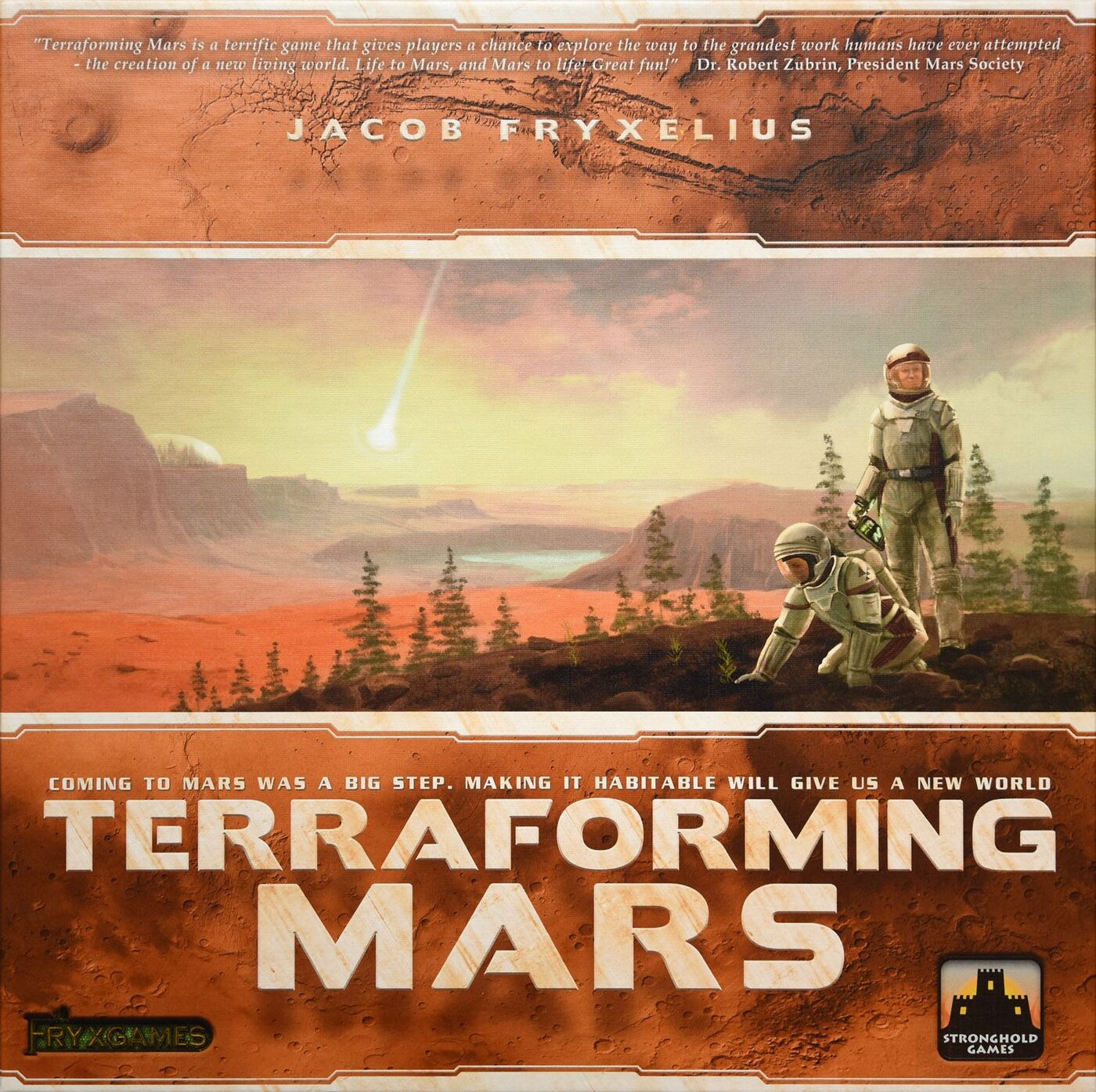
Terraforming Mars sits at #9 on BoardGameGeek with a rating of 8.33 from over 114,000 players. It’s been a permanent fixture in the hobby’s top ten since its 2016 release - a genuine modern classic. The question this article answers: what does that feel like when you’re playing alone?
The standard solo mode has always polarised the community. Some players find the 14-generation deadline a perfect pressure cooker - every card decision matters, every production point counts, and winning feels earned. Others find it hollow: no opponent to react to, no competitive stakes, just a complex puzzle with a win/loss switch at the end. Both camps are describing the same game.
What changed in 2024: Terraforming Mars: Automa - a card-driven AI expansion from Stronghold Games that drops a simulated opponent onto the board. BGG rating of 8.45 from players who specifically sought it out to fix the solo experience. That number tells you something.
Here’s the full picture on both.
The Numbers (Verified via BGG)
| Stat | Value |
|---|---|
| BGG Rank | #9 |
| BGG Rating | 8.33 |
| BGG Weight | 3.27 / 5 |
| Players | 1-5 |
| Play Time | 120 min |
| Publisher | FryxGames / Stronghold Games |
| Designer | Jacob Fryxelius |
| Year | 2016 |
| Add-on | BGG Rating | What It Adds to Solo |
|---|---|---|
| Prelude | 8.85 | 4 project cards + 2 prelude cards at game start; reduces limit to 12 gens |
| Automa (2024) | 8.45 | Card-driven AI opponent competing on the same board |
How Standard Solo Works Mechanically
The base game’s solo variant is stripped back by design. No other corporations. No drafting. Just you, the full card deck, and three planetary systems ticking upward.
The win condition: raise all three global parameters to their maximum values within 14 generations.
- Temperature: from -30°C to +8°C - that’s 19 steps of 2°C each
- Oxygen: from 0% to 14% - 14 steps
- Oceans: place all 9 ocean tiles on the board
Miss any one of them when generation 14 ends and you lose. Hit all three and you win - then count your victory points for a score.
What changes from multiplayer:
- Your Terraforming Rating starts at 14 instead of 20 (lower income)
- Only Corporate Era cards are used (the blue-backed full deck)
- No milestones or awards - those require multiple players to be meaningful
- No “pass to next player” phase - you keep playing actions until you choose to stop the generation
That last point matters. In multiplayer, each player takes exactly two actions before passing. Solo, you take as many actions as you want each generation - limited only by your resources and available plays. The tempo is entirely yours. This creates a fundamentally different rhythm: you’re not reacting to what opponents do, you’re optimising an engine as efficiently as possible before the clock ticks.
The 14-Generation Clock
The tension comes entirely from the deadline. In multiplayer, the end-game triggers when someone achieves the third global parameter - the pacing is emergent, driven by how aggressively corporations compete. Solo, you know from turn one that generation 14 is your hard limit. This changes how you evaluate cards.
Cards that provide incremental victory points become lower priority. Cards that move global parameters - temperature tags, plant production leading to forests (which raise oxygen), titanium tags for projects that place oceans - become the entire game. A card that gives you 5 VP but does nothing for the parameters is, in standard solo terms, nearly worthless.
This is the legitimate criticism of the base solo mode: roughly a third of the card deck underperforms because VP optimization is secondary to parameter optimization. Players who know the deck well will simply skip a large subset of project cards.
The counter-argument from experienced players: the constraint is the design. Building the fastest possible parameter-pushing engine from a random card draw is genuinely interesting. The puzzle framing isn’t a bug - it’s what the mode is. Whether you find that satisfying is a matter of taste, not quality.
The Automa: What It Actually Adds
Terraforming Mars: Automa is a standalone expansion (you still need the base game) that introduces MarsBot - a card-driven AI corporation competing against you on the same board.
The mechanism is clean. Each generation after you finish your actions, you resolve a MarsBot card drawn from a dedicated deck. The card tells the AI what it does: place tiles, raise a global parameter, take income, score points. MarsBot doesn’t manage resources the way you do - it executes simplified actions based on card draws. But it places tiles on the board, contesting territory. It claims milestones. It scores VP from the same award criteria you do.
What this changes:
- Victory is now comparative, not absolute. You don’t just need to terraform Mars - you need to outscore MarsBot
- Tile placement competition returns: MarsBot will claim bonus spaces, block good placements, and contest forest adjacency bonuses
- Milestones and awards become relevant again - and MarsBot will sometimes grab them before you
- The “every card matters” pressure shifts: VP cards regain value because the win condition is now relative
The r/soloboardgaming consensus is consistent: Automa transforms the solo experience from a puzzle into a game. One thread from early 2026 captured it: “the base solo is a solvability challenge. Automa is actual board game design.”
MarsBot has three difficulty levels controlled by the Automa deck composition - you add or remove certain cards to make the AI more or less aggressive. The system scales, and players who found the standard solo trivially beatable report Automa on hard difficulty as a genuine challenge.
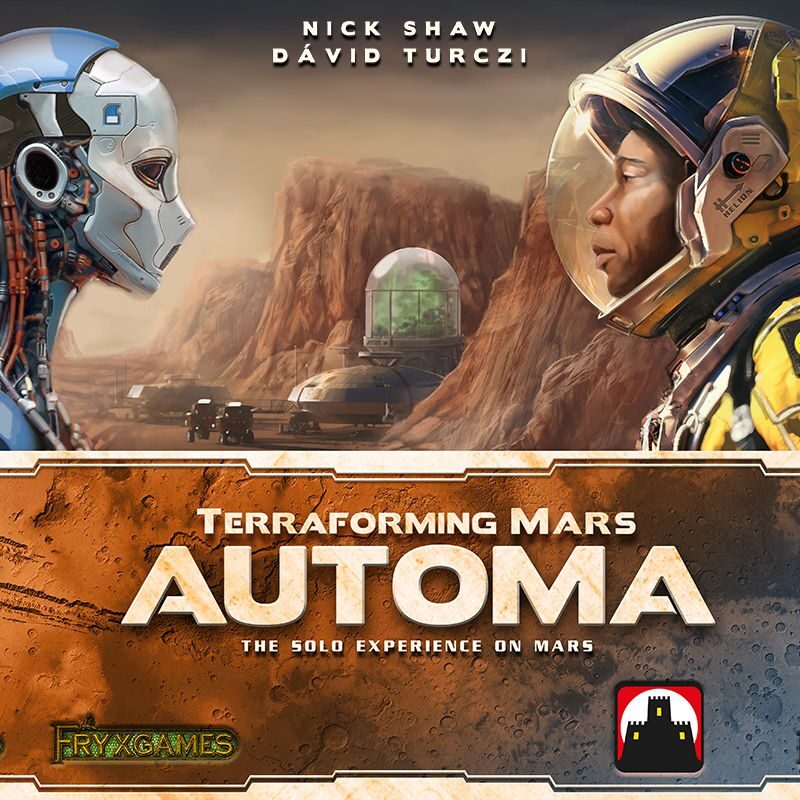 Terraforming Mars: Automa (2024) - the card-driven AI opponent that brings competitive stakes to solo play. Image credit: Stronghold Games / BoardGameGeek
Setup and Teardown
Standard solo setup: 20-30 minutes the first few times, dropping to 15-18 minutes once the process is routine.
Steps:
- Sort and shuffle the full project card deck
- Set up the main board (global parameter tracks, ocean tile spaces, bonus spaces)
- Choose your corporation, read its ability, collect starting resources
- Deal starting project cards (10 with Corporate Era rules) - buy what you want for 3 MC each, discard the rest
- Set TR track to 14, not 20
- No other player setups needed
Adding Prelude: deal yourself 4 Prelude cards (mini-projects that give you a flying start) and pick 2. Add perhaps 3-5 minutes.
Adding Automa: prepare the MarsBot deck at your chosen difficulty level, place the AI corporation card. Adds roughly 5 minutes to setup, 3-4 minutes to teardown (shuffling the Automa deck back).
Teardown: 12-15 minutes. The main task is returning tiles to their boxes and sorting the project cards back if you keep them sorted. Many solo players don’t bother sorting between sessions - they shuffle and draw. Reasonable given how large the deck is (208 cards in the base game).
Compared to other solos: faster than Arkham Horror: The Card Game (no encounter set assembly), faster than Mage Knight (no map tile system), comparable to Spirit Island. If you keep the game on a shelf with components pre-organised, you can be playing in under 15 minutes.
Table Footprint
The main board is large - 67×48 cm - and that’s before your player board, resource tokens, card spreads, and tile stocks. Expect to need:
- Standard solo: ~90×60 cm comfortably. Tight on a small coffee table.
- With Automa: add a modest AI card zone (~15 cm) alongside the main board - same table comfortably handles it.
- With multiple expansions: Colonies adds small colony boards around the main board. Venus Next adds a Venus track board. A full expansion setup needs a generous dining table.
The board is the unavoidable physical fact of this game. It’s not the largest footprint in the hobby, but it’s not compact. Playing on a dedicated gaming table with the full component spread is noticeably better than cramping onto a laptop desk.
Decision Density
Very high - and the solo mode actually concentrates it.
In multiplayer, you wait between your turns. You have time to plan, react, reconsider. Solo, there’s no downtime. Every action is immediately yours. The decision-making is continuous.
Every generation, you’re evaluating:
- Which project cards are worth playing this generation vs holding
- Whether to spend resources on standard projects (always available but expensive) vs waiting for a better card
- Which global parameter needs attention most urgently given your current engine
- Whether to plant greenery (raises oxygen and gives a tile for territory) or push temperature directly
- Resource allocation across 6 production tracks (MC, steel, titanium, plants, energy, heat)
The six-track resource system is where TM’s depth lives. A well-tuned engine produces enough of the right resources to play the right cards at the right moment. Getting there requires reading your hand accurately from the opening buy. Misreading it - buying cards that don’t synergise - is how you lose tight solo games.
With Automa: add tile placement decisions. Now you’re thinking not just about your engine but about where MarsBot might land and whether you need to pre-empt a specific territory bonus.
Replayability
High, driven primarily by the corporation variety and the random project deck.
Corporations: the base game has 12 corporations; Prelude adds another 5; further expansions add more. Each corporation has a unique starting ability and resource configuration that fundamentally changes your strategy. Thorgate (energy production engine) plays nothing like Ecoline (plant-focused forest rush) or Phobolog (titanium specialist for space cards). A new corporation effectively makes the game feel different at its core.
The project card deck: 208 cards in the base game, drawn randomly each session. You’ll see roughly 50-70 cards in a typical game, which means each session surfaces a different subset. Cards synergise in different ways depending on what arrives - the same corporation will play very differently across two sessions depending on what comes up.
Difficulty settings (with Automa): three AI difficulty levels effectively triple your replayability ceiling. Once you’re winning reliably at one level, stepping up gives you a genuinely harder puzzle.
Expansions as replayability multipliers: each expansion adds a new resource system and a new map option (Hellas and Elysium alternate boards). Venus Next adds the Venus track. Colonies adds a separate resource economy. Each fundamentally changes what you’re optimising.
Practical ceiling: most solo players report 40-80+ sessions before reaching saturation on the base game alone. Full expansion play has a significantly higher ceiling.
BGG Solo Poll - Community Verdict
BGG’s community poll on Terraforming Mars for solo play lands in the “Recommended” tier - not “Best.” The distinction matters here.
“Best” solo games on BGG are typically designed with solo as the primary or co-equal play mode (think Arkham Horror: LCG, Mage Knight). Terraforming Mars was designed as a 1-5 player game, and the standard solo mode reflects that - it’s a capable adaptation, not a purpose-built solo experience.
The “Recommended” consensus captures the split accurately: the solo mode works well, the base game is deep enough to sustain it, but the absence of a real opponent is a genuine limitation some players never reconcile.
The Automa changes this. Players reviewing TM specifically with the Automa expansion rate the experience significantly higher, with several BGG users who previously voted “Not Recommended” for solo revising their assessment after adding the AI expansion.
On r/soloboardgaming, TM appears regularly in “recommend a solo game” threads - almost always with the qualifier “get Prelude and Automa at the same time.”
Multiplayer vs Solo: What You Give Up (And What You Don’t)
Terraforming Mars multiplayer is a different game in a meaningful way. With 3-5 players, the global parameters move faster (everyone is contributing to terraforming simultaneously), competition for bonus spaces on the board is fierce, and the award and milestone race creates emergent pressure. The game’s interactive “take that” elements - cards that steal resources, force trades, or target specific opponents - activate fully.
What you gain going solo:
- Complete control of the table state - no decisions made without you
- Faster turns (no waiting)
- Ability to play an entire campaign arc of games at your own pace
- The focused pressure of the deadline without players accelerating or stalling the parameters to suit their strategies
What you lose:
- Interactive card effects become background flavour (many “opponent” cards are useless solo)
- No emergent race to grab milestones before a rival
- No negotiation-adjacent moment when someone unexpectedly claims an award you were building toward
- The shared excitement of watching someone pull off a surprising engine combo
With Automa: the gap narrows considerably. MarsBot restores board contention, milestone competition, and comparative scoring. You won’t replicate the social dynamics of a full table, but the mechanical experience is meaningfully richer than standard solo.
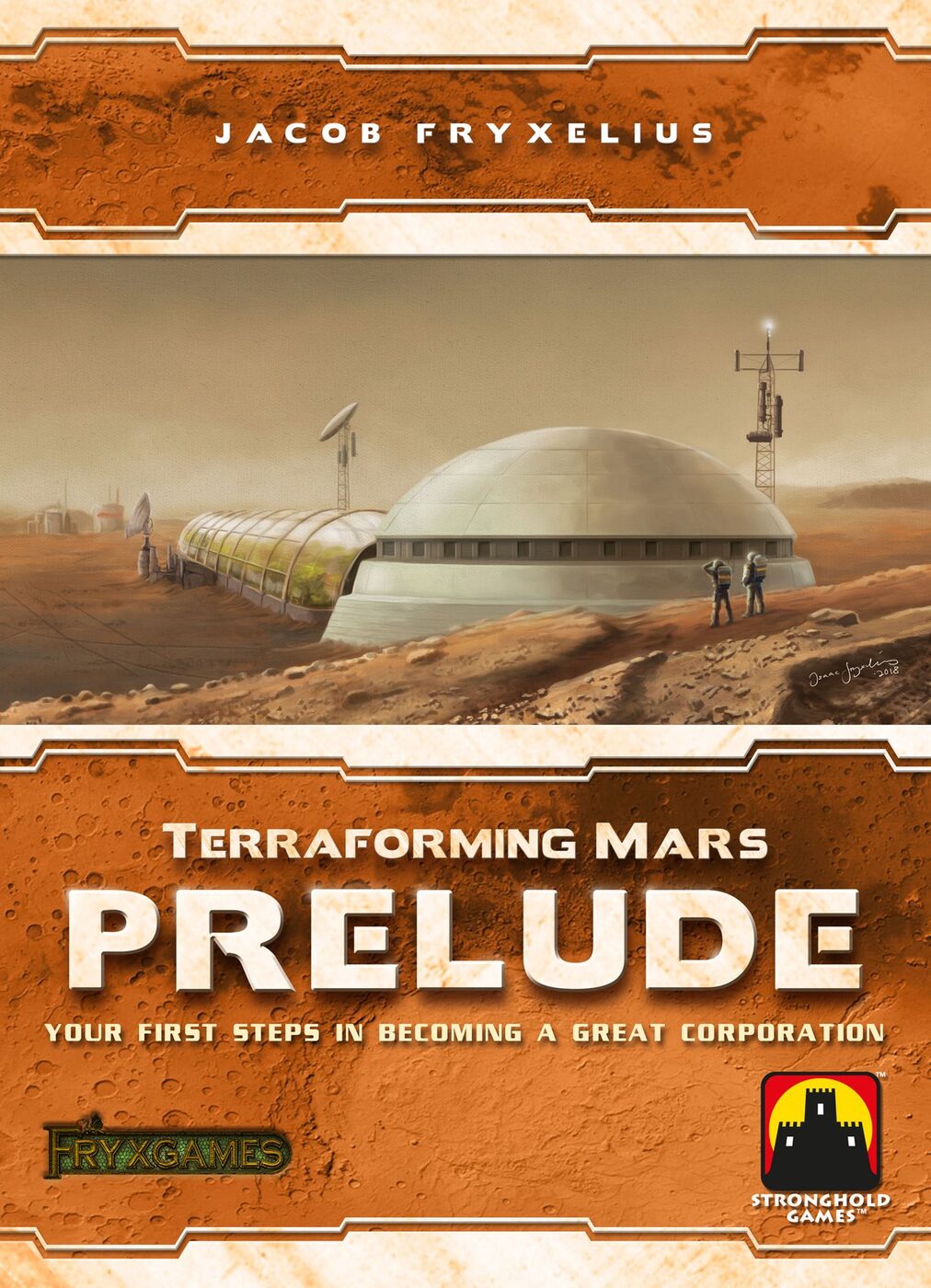 Terraforming Mars: Prelude - rated 8.85 on BGG, it’s the most-recommended expansion for improving the solo experience. Image credit: FryxGames / BoardGameGeek
Can You Play Tonight?
Yes, if you already own the game. Clear 90-120 minutes. Setup is manageable. The solo rules are 2 pages in the rulebook - read them, then start.
If you’re buying new: get the base game and Prelude together. Prelude (rated 8.85 on BGG - higher than the base game) dramatically improves the opening rounds by giving you a flying start with four bonus project cards and two Prelude cards. Without it, the first three generations of solo play can feel slow while your engine assembles from scratch. With it, you’re in the action immediately.
If you’ve played TM before but never tried the Automa: seriously consider it. It’s a 2024 release, widely available, and the 8.45 BGG rating from a niche audience who sought it out specifically is a strong signal. It doesn’t fix every criticism of TM solo - you’re still managing the same six-track engine, still reading the same project deck - but it puts an opponent on the board, and that changes the game’s feel at a fundamental level.
Tonight test: one corporation, base game only, no Prelude, 14 generations. Pick Thorgate (easy) or Beginner Corporation if it’s your first time. Read the solo rules. Deal your 10 starting project cards, buy what you can afford. Play. You’ll know within two generations whether the mode hooks you.
If it does: add Prelude next session. Add Automa the session after that.
BGG stats verified at time of publication. Terraforming Mars is designed by Jacob Fryxelius and published by FryxGames and Stronghold Games. Terraforming Mars: Prelude published by FryxGames/Stronghold Games; Terraforming Mars: Automa published by Stronghold Games (2024). Image credits: FryxGames / Stronghold Games via BoardGameGeek.