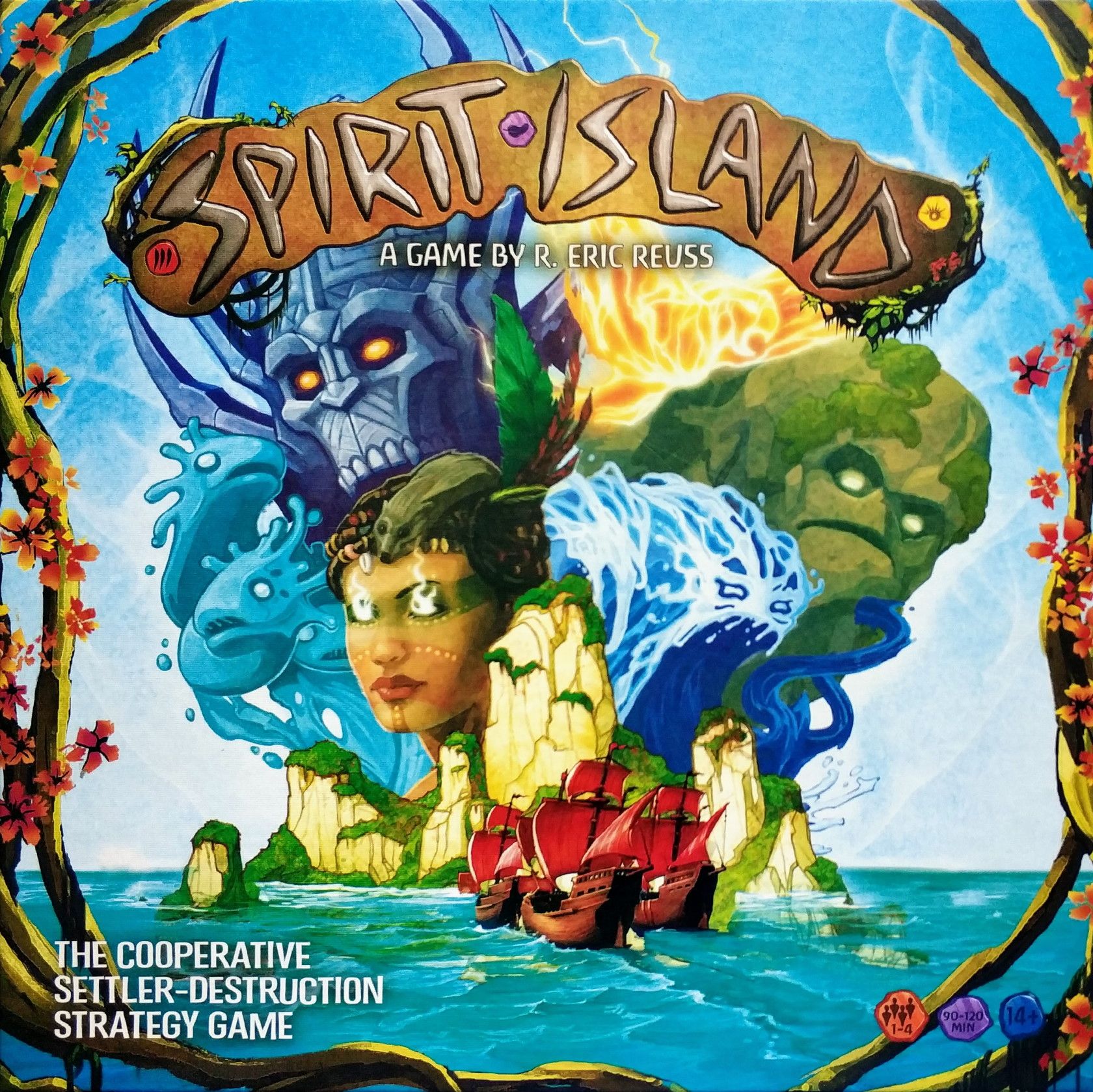
Spirit Island sits at BGG #11 with a rating of 8.34. It weighs in at 4.08/5 - one of the heaviest cooperative games on the market. Most people buy it for the full two- or three-player experience and assume solo is a consolation prize you’d pull out when nobody’s available on a rainy Tuesday.
That assumption is wrong.
What the BGG Solo Poll Actually Says
Let’s get straight to the data. With 2,211 total votes, the BGG solo poll for Spirit Island breaks down like this:
| Verdict | Votes | % |
|---|---|---|
| Best | 606 | 32% |
| Recommended | 1,142 | 61% |
| Not Recommended | 131 | 7% |
93% of voters recommend solo play. That puts Spirit Island in a vanishingly small club of complex games where solo isn’t an afterthought. For context: the community rates it Best at 2 players (1,449 Best votes), but the solo gap is smaller than you’d expect given the game’s cooperative DNA.
How Solo Actually Works
You control one spirit. The island board stays the same size as a two-player game (one board each for two players in multiplayer; you use a single board solo). The Invader deck ticks forward on its own - Explore, Build, Ravage - and you fight back alone.
There’s no simplified ruleset, no “solo mode” with training wheels. You play the full game. What changes is this: you lose the synergy layer. Spirit Island’s depth in multiplayer comes substantially from spirits combining powers - Lightning’s Swift Strike pairs with Shadows Flicker Like Flame’s card-cycling, Vital Strength of the Earth anchors a slow defensive core while faster spirits run interference. Solo, that’s gone. You’re working with one hand, making every card choice feel more consequential.
What fills the gap is adversary scaling. Each adversary (the Kingdom of England, Sweden, Prussia, etc.) has six difficulty levels. A solo run at England 0 is a tutorial. England 6 will end your evening in under an hour if you’re not paying attention. The range is generous enough that the game meets you wherever your skill level is.
The Decision Load
This is where solo Spirit Island earns its weight. On a two-player turn, you and your partner split roughly 20-30 meaningful decisions: which powers to play, what to prioritise, how to spend presence placement. Solo, those 20-30 decisions are all yours, plus you’re tracking the entire board state without a second brain.
The upside: zero analysis paralysis from committee thinking. No negotiating. No explaining why you’re not defending the Sands when your partner wants to. You see the problem, you own the solution (or the failure).
The downside: solo Spirit Island is genuinely taxing in a way that multiplayer isn’t. After a 90-minute solo session with Bringer of Dreams and Nightmare, I had the same low-grade mental fatigue I get from a long chess session. That’s a feature, not a bug - but it’s worth naming.
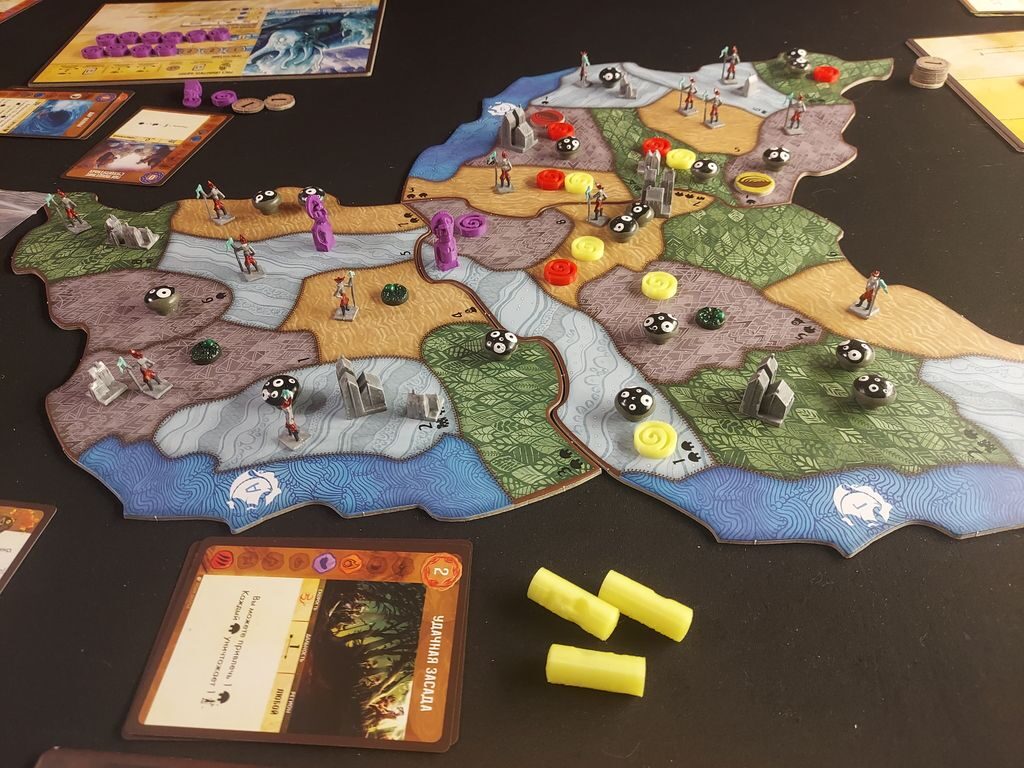 Spirit Island’s island board and spirit panels at full stretch - component shot via BGG
Practical Realities
Setup time: 20-25 minutes. You’re laying out the island board, seeding the invader starting positions, setting up your spirit panel, shuffling the invader and power decks, and choosing your adversary and scenario. It’s not fast. There’s no getting around it.
Teardown: 15-20 minutes. Sorted - each spirit has its own storage slots in the insert if you have the base game. The Fear and Power card decks take the most time to return.
Table footprint: Substantial. A 1-player solo game with one island board, one spirit panel, the fear board, and your power/invader decks comfortably fills a 60×90 cm table. You can squeeze it tighter, but you’ll want space to spread out power cards during planning. This is not a laptop-tray or coffee-table game.
Session length: The BGG estimate of 90-120 minutes is accurate for solo at standard difficulty once you know the game. Your first five solo plays will probably run 2+ hours as you double-check rules. Once it clicks - expect 70-90 minutes for a standard adversary.
Replayability
This is Spirit Island’s trump card. At the time of writing, the base game includes 8 spirits, plus the free Spirit Island Promo Pack adds two more. Each spirit has a completely different power deck, a different playstyle, and different placement options. The island board randomises setup each game. Adversaries add 7+ distinct opponents, each with unique mechanics that force you to adapt strategy. Scenarios layer another twist on top.
Conservative estimate: you’ll get 50-80 hours out of the base game before repetition becomes a factor. Most dedicated solo players add Branch & Claw or Jagged Earth expansions well before that point.
Who This Game Still Isn’t For
Clarity matters here. Spirit Island solo isn’t for everyone:
- If you want a quick weeknight game: You’re looking at a minimum 45-minute setup/teardown overhead before a single decision. Not the right tool.
- If heavy text on cards stresses you out: Spirit Island has a lot of card text. Many powers have conditional clauses and elemental thresholds. This is not a game you can learn in 20 minutes.
- If you dislike punishing defeat: Solo Spirit Island can end in blights or invader deck depletion faster than expected at high difficulty. The game does not soften the blow. Your island gets razed, and you stare at the wreckage.
- If you’re new to heavy games: Spirit Island is not a solo entry point to the hobby. Start with Arkham Horror: The Card Game (weight 3.57) or Robinson Crusoe (weight 3.83) to calibrate.
What r/soloboardgaming Actually Says
The community consensus on r/soloboardgaming is remarkably consistent. New players frequently post “I finally got Spirit Island to the table solo - why did I wait?” threads. The recurring themes:
“The game felt like it would be lesser solo. It’s actually better. No one second-guessing every move, no explaining why I’m slow-growing when they want me to rush.”
The criticism that does come up: learning curve versus solo is a painful combination. Teaching yourself a 4.08/5 weight game without a partner to share the load is a real commitment. Most experienced players recommend watching one of the lengthier YouTube playthroughs (rather than the 10-minute “quick explains”) before your first solo attempt.
The Verdict
Spirit Island solo is not a compromise. It’s a complete, standalone experience - demanding, replayable, and mechanically coherent without a second player. The 93% “recommend” rate from 2,000+ BGG voters isn’t an accident.
The barriers are real: the setup cost, the table space, the mental load. But for players who want a game that rewards deep engagement and punishes sloppy thinking, solo Spirit Island delivers something most games don’t even attempt: a cooperative puzzle you can solve - or fail - entirely on your own terms.
BGG Rating: 8.34 / 10 | Weight: 4.08 / 5 | BGG Rank: #11
Players: 1-4 | Best: 2 players | Solo: Recommended (606 Best, 1,142 Recommended)
Time: 90-120 min | Publisher: Greater Than Games