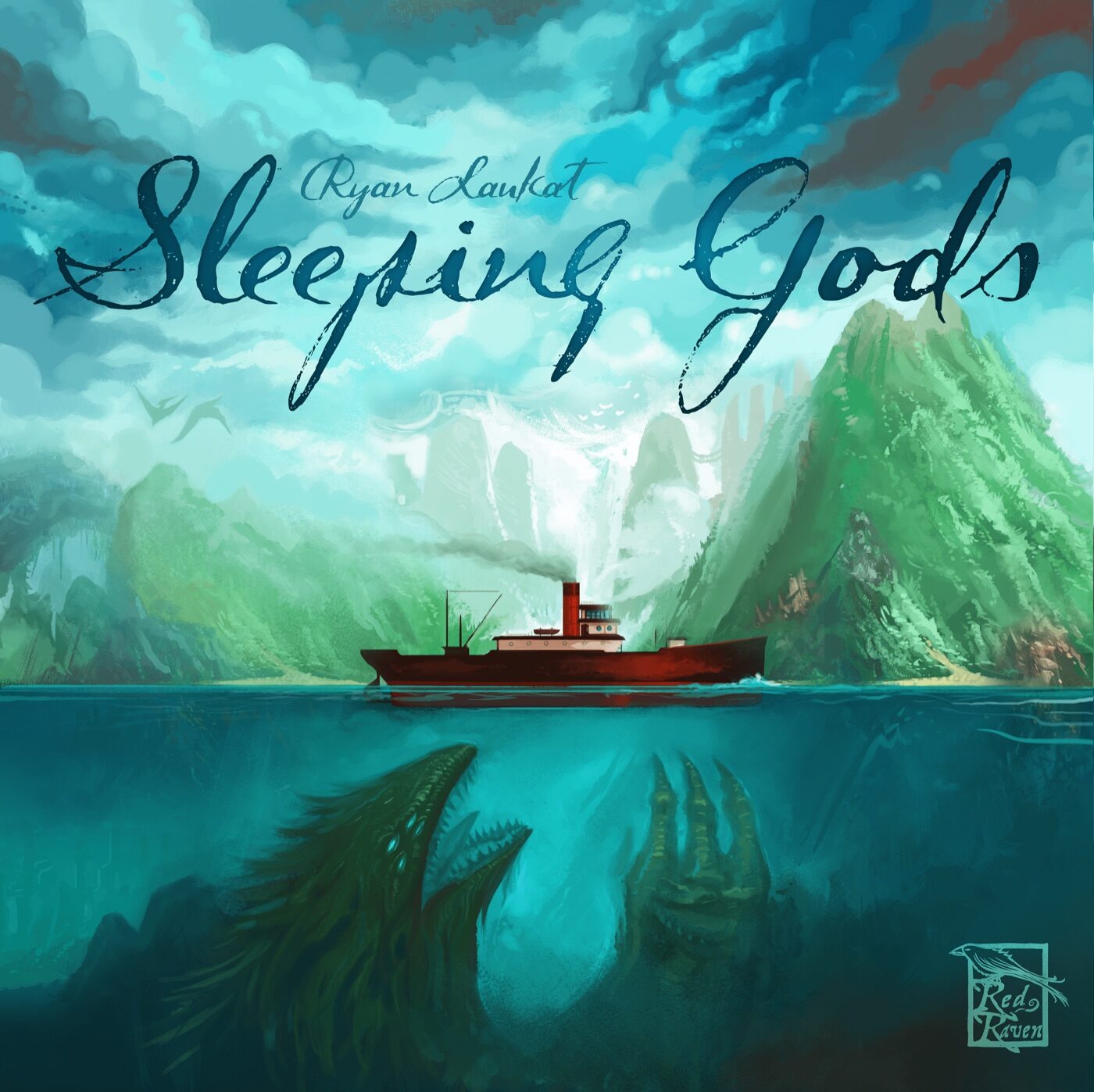
There’s a moment in Sleeping Gods that hits differently when you’re playing alone.
You’ve spent three sessions mapping this strange realm, building relationships with your crew, following a rumour across sea and jungle to a crumbling temple. You push open the encounter book to the right entry. You read a few paragraphs. Something unexpected happens. And there’s no one at the table to react to it with - just you and your journal and the atlas spread open before you.
That’s either a problem or exactly the point, depending on who you are.
Sleeping Gods is BGG’s #74 ranked game overall, rated 8.09/10 across thousands of votes. Designer Ryan Laukat spent five years building it. The BGG community rates it Best with 1-2 players - and the solo numbers are striking: out of 423 voter responses, 177 rate solo Best, 145 Recommended, and just 30 Not Recommended. That’s a 76% approval rate for solo play, which is unusually high for a game that supports up to four.
This is a game where going it alone isn’t a compromise. For many players, it’s the recommendation.
What Sleeping Gods Is
You’re Captain Sofi Odessa, at the helm of the steamship Manticore. A storm has pulled you and your crew of ten into a strange realm you don’t recognise. The only way home is to find and awaken the sleeping gods - ancient totems scattered across the world.
That world is an atlas: a physical book of double-page map spreads you navigate by moving your ship token between numbered sea hexes. The encounter book is keyed to location numbers - sail to hex 217, find entry 217, and discover whether it’s a market, a dungeon, a conversation, a trap, or something stranger. The world isn’t randomised or procedurally generated. It’s hand-crafted by Laukat, drawn by Laukat, and narrated by Laukat. Every page of text is his.
Each session, you play through a set number of turns. Your crew have hit points and fatigue. They can develop skills, pick up items, take injuries that persist across sessions. When a session ends, you note your position, bookmark the encounter book, tuck your crew cards away, and pick it up next time. A full campaign spans 10-20 hours across however many sessions you choose to carve it into.
This is not a game you learn on a Tuesday evening and finish by midnight. This is a game you live in for weeks.
How Solo Actually Works
In multiplayer, each player takes one or two crew members. Turns are shared, decisions are argued over, the atlas is everyone’s problem. In solo, you run the whole ship - all ten crew members, all decisions, all consequences.
This sounds overwhelming. It isn’t.
The key insight is that the game’s systems are elegant enough to manage alone. You’re not tracking ten independent character sheets simultaneously. You have a crew roster with individual hit points and skills, but the management layer is shallow enough to feel like diary-keeping rather than admin. When a crew member is needed for an action - combat, exploration, a skill check - you pull them from the roster, use them, mark any fatigue or injury, and slot them back.
Solo turns use the same structure as multiplayer: move or take actions (explore, rest, trade, fight, search). What changes is pacing. Solo sessions move briskly. There’s no discussion, no consensus-building, no turn-waiting. You make a decision, you see the result, you move on. A solo session that might run 90 minutes with two players can wrap comfortably in 60 minutes alone.
The narrative experience - arguably the game’s main draw - is actually improved solo. You absorb every word. You build the fictional world in your head without another player summarising or skimming. The story lands harder when it’s just you and the page.
The Practical Breakdown
Setup time: 15-20 minutes for your first session. Subsequent sessions are 8-10 minutes (unpack your saved state, find your atlas position, open the encounter book). Red Raven includes a campaign journal template - filling it in at session end takes 5 minutes and means setup is almost trivial next time.
Teardown: 10-15 minutes. The atlas and encounter book close flat. Crew cards go in a small stack. The main overhead is the token organisation - there are a lot of small tokens representing resources, ship health, quest markers and collected items. A few small zip bags eliminates this entirely.
Table footprint: Large. Plan for a full 6-seat table for comfortable play. The atlas (open to two pages) takes up roughly 30x20cm on its own. Add the main game board, encounter book, your crew mat, your ship board, and the market/item area and you’re looking at significant real estate. Sleeve the atlas if you want to write directly on laminated surfaces - or use dry-erase markers on the included sheets.
Decision density: Medium-high. Most turns offer 3-4 meaningful choices (where to sail, which crew to use, whether to fight or flee, which items to take). The density comes from resource management (food, rope, torches) and crew health - conserving your best fighters for the dungeon you’re approaching while keeping morale up. It’s not paralysing, but it rewards forward planning.
Replayability: This is the most nuanced part. The core campaign is fixed - the world doesn’t change between plays. But Sleeping Gods is long enough (and branching enough) that you’ll miss large chunks on any given run. Community consensus on BGG and r/soloboardgaming suggests 2-3 full campaigns before feeling like you’ve seen most of what it has to offer. Red Raven also released Distant Skies, a standalone sequel with a wholly different setting and cast, which effectively doubles the replayable content.
The Solo Poll: In Full
BGG’s suggested player count poll gives Sleeping Gods one of the clearest solo endorsements you’ll find on a game that isn’t explicitly solo-only:
| Player Count | Best | Recommended | Not Recommended |
|---|---|---|---|
| 1 (Solo) | 177 | 145 | 30 |
| 2 | 230 | 120 | 11 |
| 3 | 40 | 159 | 90 |
| 4 | 11 | 97 | 174 |
Source: BGG community poll, 423 votes
The numbers tell a clear story. At 3-4 players, the game bogs down - too many crew to juggle, sessions run long, the narrative gets interrupted constantly as everyone waits for a reading that only one player is fully tracking. At 1-2 players, it sings. And solo beats 2-player on “Best” votes, even though 2-player takes the top slot overall. Many experienced players go further and say solo is the intended experience, regardless of what the box says.
Voices from the Solo Community
Players on r/soloboardgaming consistently report the same arc: surprised by how well it works alone, then converted into long-term fans who replay the campaign specifically for the solo feel. Common themes:
What works: The story delivers harder in solo. No one else to process it for you. You feel the weight of crew injuries differently when they’re all yours. The pacing is tighter. Decisions land with more clarity when you’re the only one making them.
What requires adjustment: Some players find the self-competition of solo play requires a mindset shift - you’re not trying to “win” in any traditional sense, you’re managing a narrative. If you need a score or a ranking to feel accomplished, Sleeping Gods may frustrate. The campaign ends with a points tally, but most solo players ignore it.
Worth knowing: A minority of solo players find the fixed world a replayability ceiling - once you’ve done two or three runs, surprise starts to drain away. If you value mechanical novelty over narrative revisiting, the value proposition shifts after that third campaign.
Multiplayer: The Straight Assessment
Playing Sleeping Gods at 3-4 is a noticeably different experience, and not all the differences are good.
Sessions stretch significantly - each player turn is faster, but downtime while others resolve their actions accumulates. Narrative immersion fragments when players are distracted or skimming. Decision-making can degrade into one confident player quarterbacking while others follow.
Two players is genuinely good. You get company, shared reaction to story beats, and someone to split the crew management with. If you have a regular gaming partner who wants a shared campaign experience, 2-player is the sweet spot the poll reflects.
Anything above two: proceed with care and the right group.
Who This Is For
Sleeping Gods is a strong buy if:
- You want a narrative-driven solo campaign that feels like reading an illustrated novel you control
- You have 3-4 hours per week across multiple sessions to sustain a campaign
- You’re comfortable with a game that doesn’t reset between plays - progress is permanent
- You appreciate hand-crafted world design over procedural generation and random encounter tables
- You have shelf space and table space for a box this substantial
Be cautious if:
- You want high replayability from a single purchase on the first pass (two or three campaigns is the ceiling before novelty fades)
- You prefer competitive or high-tension systems - this is a cooperative narrative experience with modest mechanical crunch by heavy-euro standards
- Your gaming sessions are shorter than 60 minutes - the campaign structure works best in 60-90 minute chunks minimum
- You’re easily put off by significant table footprint - this game needs room
Key Stats at a Glance
| Stat | Value |
|---|---|
| BGG ID | 255984 |
| BGG Rank | #74 Overall |
| Rating | 8.09 / 10 |
| Weight | 3.26 / 5 |
| Players | 1-4 (Best: 1-2) |
| Play Time | 60-1200 min (campaign, multi-session) |
| Year | 2021 |
| Designer | Ryan Laukat |
| Publisher | Red Raven Games |
| Solo Poll | 76% recommend (Best + Rec) |
The Verdict
Sleeping Gods is rare: a game designed for 1-4 players that’s arguably strongest at one. Ryan Laukat built a world worth exploring slowly, a crew worth protecting across weeks of play, and an atlas worth getting lost in. The solo experience doesn’t ask you to give anything up - it strips away the coordination overhead and lets you go deep into the fiction on your own terms.
That’s the pitch. Either it excites you or it doesn’t.
If you’re a solo gamer looking for a campaign with real narrative weight, real craft in its writing, and the kind of sessions that stick in your head between plays - Sleeping Gods earns your time. Budget for three full campaigns across a year and you’ll get your money’s worth many times over.
If you want to share it, bring exactly one other person. Two captains, one Manticore. The ship has room.