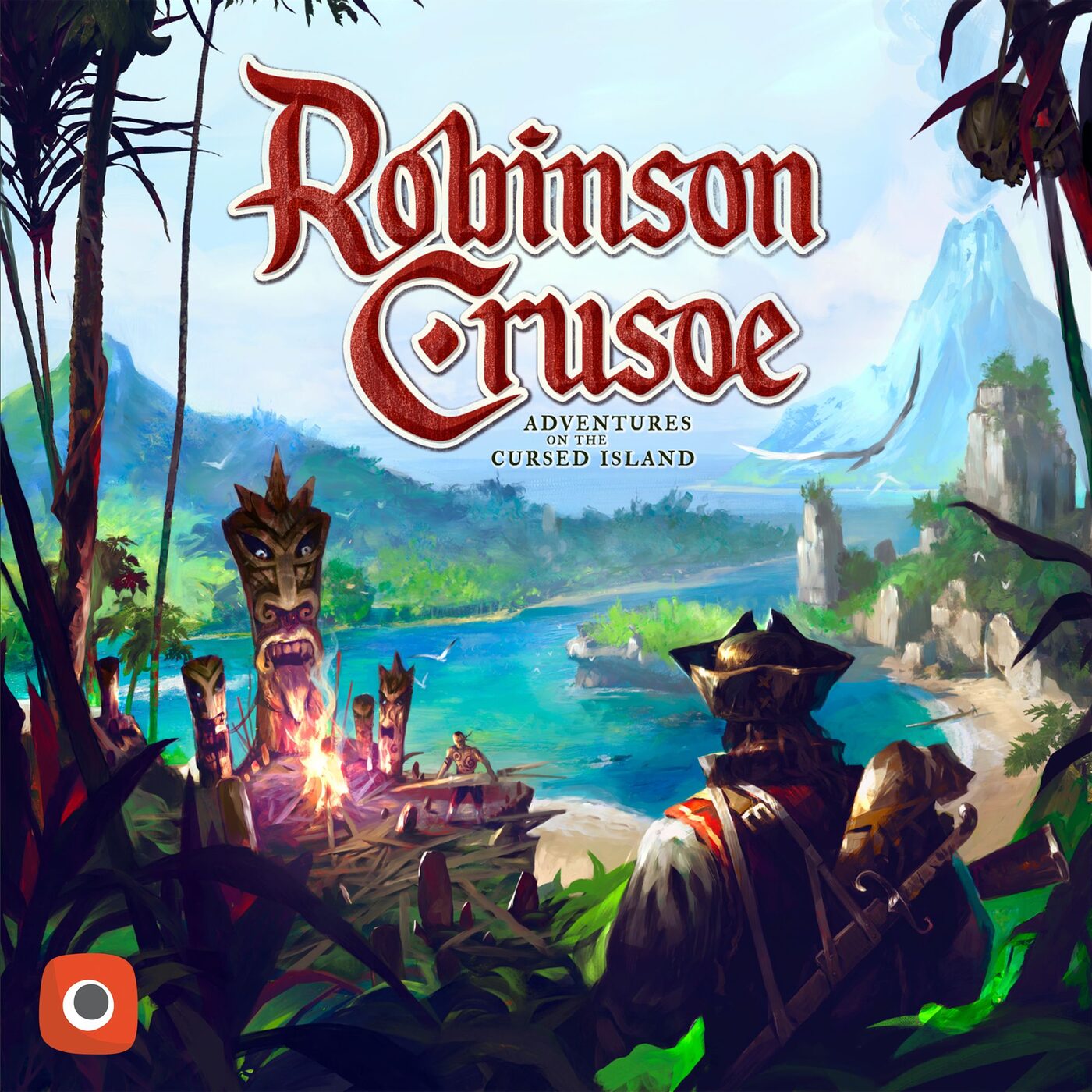
Robinson Crusoe: Adventures on the Cursed Island - BGG #121 · Rating: 7.72 · Weight: 3.83/5 · Players: 1-4 · Time: 60-120 min
There are board games that let you down gently when you lose. Robinson Crusoe is not one of them.
You will starve. You will catch wounds that cascade into more wounds. You will spend three turns gathering wood for a shelter only to have a storm tear it apart the same night you finish it. You will make the right decision, watch it go wrong anyway, and then read the flavour text on the event card - which has the audacity to be evocative - while your character slowly dies on a very detailed island you spent twenty minutes setting up.
And you will set it up again.
This is the peculiar appeal of Robinson Crusoe. It’s a game that genuinely tries to kill you, has the tools to do it, and makes the attempt feel meaningful rather than cheap. Solo, it’s one of the most complete and demanding experiences in modern board gaming.
BGG Solo Verdict
Before the deep dive, the numbers:
| Vote | Count |
|---|---|
| Best | 451 |
| Recommended | 473 |
| Not Recommended | 71 |
That’s 92.9% positive for solo play out of 995 votes - among the highest solo approval ratings of any game at this weight class. The community isn’t hedging. Robinson Crusoe was built for one.
The Solo Setup: What You’re Actually Doing
Robinson Crusoe is a cooperative survival game set across six included scenarios. The baseline scenario (Castaways) drops you on an uninhabited island and gives you a simple objective: survive long enough to signal a passing ship. Later scenarios ask you to build a specific structure, protect a palisade from attackers, or navigate the island hunting a specific beast.
Each scenario runs for a fixed number of rounds. When they run out, you either win or you don’t - but the game doesn’t let you limp to the finish. It has active mechanisms designed to put pressure on you throughout.
In solo play, you control a single character. You choose one of six characters (the Adventurer, Cook, Carpenter, Explorer, Doctor, or Soldier), each with a unique starting skill, passive ability, and personal item. Your character’s abilities define what you’re good at, and in solo, you don’t have a partner to cover your weaknesses.
Your action economy works like this: each round, you have 4 Action Pawns to distribute across the available actions. Two pawns on the same action count as a “determined” action (no risk of failure). One pawn alone is a “risky” action - you must flip an adventure card, which may introduce wounds, resource losses, or events on top of your intended outcome.
Determination tokens let you convert failed dice results. You start solo with 2, compared to the larger pools in multiplayer. They run out faster than you’d like.
The round structure is strict:
- Weather Phase - Draw and resolve a weather tile. Cloud tokens accumulate. When it snows or rains, these resolve into food shortages, wound triggers, or shelter damage.
- Event Phase - Draw and resolve an event card. Most have a threat that carries forward to the Threat Space; if unresolved by the next round, the threat fires.
- Morale Phase - Your morale track shifts based on current conditions. Low morale reduces your starting action pawns the following round.
- Production Phase - Each Source marker on the board generates its resource.
- Action Phase - Spend your 4 pawns. Gather resources, build, explore, hunt, arrange camp, rest.
- Night Phase - Check if you have shelter (no shelter means wound). Check if you have food (no food means morale penalty and hunger wound).
Every single phase has the potential to damage you. That’s not an exaggeration. The game is a machine for generating problems, and you are the only maintenance crew.
The Mechanics That Make Solo Work
Actions Are Always a Compromise
With 4 Action Pawns and six or seven things you genuinely need to do each round, Robinson Crusoe forces constant triage. Do you double-up on building the palisade (safe, but slow) or take a risky single-pawn gather for food (fast, but potentially punishing)?
The risk/determination split is the mechanical heart of the game, and it plays differently solo than in a group. In multiplayer, someone else might cover a risky action while you take the safe one. Solo, you absorb every consequence yourself. A failed adventure card that wounds you can break your plan for two rounds - and you have no one to pick up the slack.
This creates a very particular kind of decision tension that fans describe as “puzzle-like but with catastrophe risk.” Every turn, you’re solving an optimisation problem under the shadow of potential collapse.
The Threat Space Is Relentless
Event cards generate threats. Threats sit on the Threat Space and activate at the end of the following round if you haven’t resolved them with the right action. The problem is that resolving threats costs action pawns - the same action pawns you need for everything else.
Solo, this is brutal in a way that’s hard to convey. In multiplayer, you might assign one player to threat-clearing while another hunts or builds. Alone, every pawn you spend on a threat is a pawn you didn’t spend on food, shelter, or objective progress.
Players on r/soloboardgaming describe the Threat Space as “the slow poison” - you can usually manage it, but not without cost, and the cost compounds. Skip a threat once and the penalty hits. Skip it while your morale is already low and a shelter you haven’t finished yet, and the domino effect begins.
Wounds Scale Dangerously
You start with a Wound Track. Wounds don’t just reduce your health - they can cancel actions, reduce your action pawn count, and eventually kill you. The problem in solo is that wound recovery is slow. The Cook has the best healing ability in the game; the Adventurer (the default recommendation for new players) heals only via a basic camp arrangement action.
A single unlucky risky action early in the game can put you on the back foot for the entire session. This isn’t a design flaw - it’s the game communicating that preparation matters, that risky pawns should be spent with intention, and that the Cook exists for a reason.
Inventions and Scenarios Create Replayability
The core game includes the Invention Deck: a set of cards showing buildable tools and structures that modify your capabilities. A Knife improves hunting rolls. A Bed reduces wound accumulation. A Palisade protects against beast attacks. Which Invention cards are available depends partly on scenario setup and partly on what you’ve explored - and you’ll rarely see the same combination twice.
Combined with six scenarios, each with distinct win conditions and setup variations, the game has genuine legs for solo play. The later scenarios (particularly Scenario 4: Cannibal Island and Scenario 5: Volcano) introduce entirely different threat profiles that demand different strategic approaches.
Multiplayer vs. Solo: The Real Comparison
Robinson Crusoe is primarily a cooperative game, and the multiplayer experience is not identical to solo. Worth being direct about both modes:
In multiplayer, you can specialise. The Cook heals. The Carpenter builds faster. The Explorer reveals terrain. Characters that cover each other’s weaknesses can split the action point load and reduce the frequency of risky single-pawn actions. The game is still hard - it’s one of the most frequently “co-op lost” games in the hobby - but the distribution of labour makes it more forgiving.
In solo, everything converges on you. You’ll make more risky actions because you have to. You’ll lose more rounds to threat-clearing. You’ll feel the morale penalties more acutely because there’s no narrative between players to smooth over the difficult moments.
The solo game is approximately 30-40% harder than a well-coordinated 2-player game, by most community estimates. Some players find this punishing in a bad way. Most solo-focused players find it precisely as hard as it should be - the island is genuinely trying to kill you, and the game commits to that premise.
One clear solo advantage: pace and focus. In multiplayer, the constant discussion, rule lookups, and coordination takes time. Solo, you can move through the action phase efficiently. A solo session that would take 90 minutes in multiplayer often takes 60-70 minutes alone, because you don’t need consensus on how to spend shared pawns.
Practical: Setup, Table Space, and Teardown
Setup time: 20-25 minutes for the first play of a session; around 15 minutes once you know the game. The scenario card specifies your starting inventory, starting event cards, and scenario-specific adventure deck configuration. You’ll shuffle and sort multiple decks, populate the island board with terrain and source markers, and arrange character boards with their starting equipment.
The island board is one of Robinson Crusoe’s strengths: it builds out as you explore. You start with the Beach and Camp spaces revealed; the rest are hidden terrain tiles you flip as you explore. This means early setup is actually faster than it looks - you’re not populating the whole board.
Table footprint: Large. The island board alone takes substantial space, and you’ll also need room for your character board, the various card decks (Event, Adventure, Mystery, Beast, Invention), weather tiles, and token pools. A standard 60x60cm gaming table will fit it, but it’s close. Most solo players use a larger surface or leave the decks stacked nearby.
Teardown: 10-15 minutes. The token count is significant, but the game has good component organisation if you have a reasonable insert or ziplock system. The first-party insert is functional but not elegant - a third-party organiser (or patient ziplock setup) makes teardown considerably faster.
Decision Density: What to Expect
Robinson Crusoe is a high-decision-density game. Every action phase presents genuine strategic choices, and the right answer changes based on current board state, weather forecast, and scenario progress. You’re rarely on autopilot.
A typical Action Phase solo involves:
- Evaluating which 2 or 3 actions are highest priority
- Deciding which to double-up (determined) vs. single-pawn (risky)
- Considering whether Determination tokens are worth spending
- Anticipating the next round’s Weather Phase based on cloud tokens
- Checking whether a Threat resolves this round or next
This is genuinely engaging solo. The game generates enough variety through card draws and board state that two plays of the same scenario rarely feel identical, and the decisions feel meaningful because the consequences are real.
The game doesn’t stretch - there are no “obvious” turns where you’re just executing an obvious plan. If you find yourself with an obvious turn, it usually means you’ve gotten lucky or you’ve made very good decisions for several rounds running. Enjoy it. The island will find you again.
Which Character for Solo?
The community consensus on r/soloboardgaming is consistent:
Start with the Cook. The Cook’s passive healing ability makes the solo game more forgiving for new players. Being able to recover wounds during the Night Phase without spending action pawns is a significant advantage when you’re still learning what kills you.
Once you know the game: The Carpenter rewards careful building chains. The Explorer turns exploration into a meaningful offensive tool. The Adventurer is high-variance and genuinely punishing solo - save them for when you want a harder experience.
Avoid the Doctor solo for your first ten games. Their ability to prevent wounds is powerful, but it requires advance planning that’s difficult when you’re still learning to anticipate the game’s kill patterns.
Is Robinson Crusoe the Right Solo Game for You?
Robinson Crusoe earns its BGG solo reputation - 92.9% positive from 995 votes is about as clear a community statement as you’ll find at weight 3.83.
But it’s not for everyone, and the plain read is that the same properties that make it great make it inaccessible to some players.
It’s for you if:
- You want a solo game that actively creates a narrative through emergent chaos
- You don’t mind losing - or specifically enjoy playing games “better” over time
- You find punishing consequence systems engaging rather than frustrating
- You want something that genuinely changes each play, not just randomises numbers
It’s not for you if:
- Solo gaming for you is about relaxation; this is not a relaxing game
- You dislike heavy setup for sessions that might end early due to cascade failure
- You prefer clear feedback loops (Robinson Crusoe’s feedback is “everything is your fault, but also fate hated you”)
- You want a clear path to winning; Robinson Crusoe’s solo mode is about quality of defeat as much as victory
The shelf-of-shame reputation is real - we’ve covered it before. But if you’ve rescued it from the shelf and want to understand why it’s one of the most revered solo experiences in the hobby, this is the game that earns that distinction round after brutal round.
Quick Reference
| Category | Detail |
|---|---|
| BGG Rank | #121 |
| Rating | 7.72 / 10 |
| Weight | 3.83 / 5 |
| Players | 1-4 (designed for solo) |
| Play Time | 60-120 min (solo: 60-80 min) |
| Setup | 15-25 min |
| Table Footprint | Large |
| Decision Density | High - every action phase matters |
| Solo Poll | Best: 451 · Recommended: 473 · Not Rec: 71 |
| Scenarios Included | 6 (significant expansions available) |
| Designer | Ignacy Trzewiczek |
| Publisher | Portal Games |