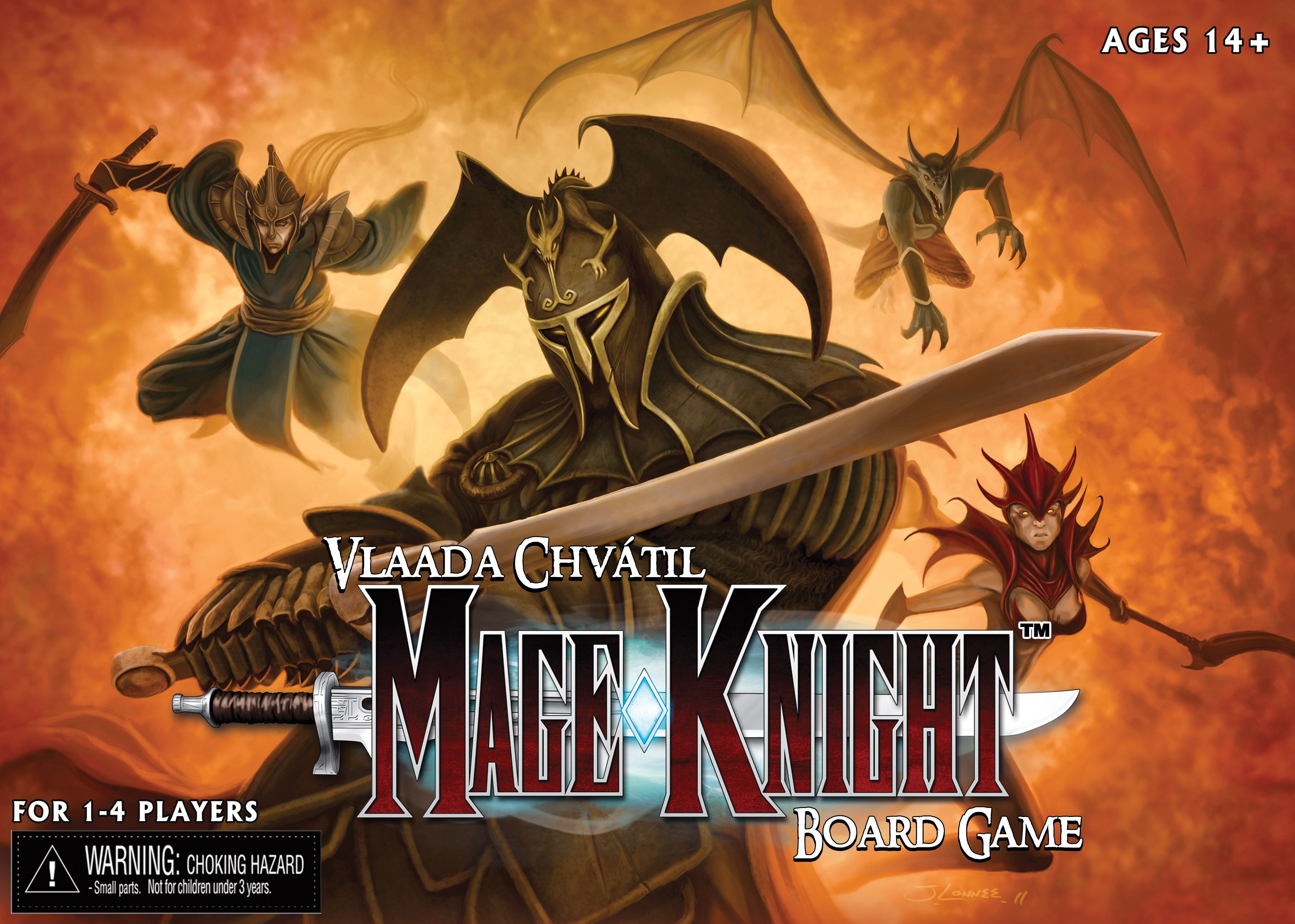
Some games get called “the best solo game ever made” as a compliment. Mage Knight gets called it as a statement of fact - and then immediately followed by a warning. This is a game that will eat your entire Saturday, make you feel like a genius, leave you staring at a table covered in tiles and tokens at 1am, and make you want to do it all again next weekend.
Designed by Vlaada Chvátil and published by WizKids in 2011, Mage Knight sits at #39 on BGG with an 8.08 average rating and a weight of 4.38 - firmly in the heavyweight category. It plays 1-4 in theory, 60-240 minutes in practice (read: closer to 240), and has one of the most decisive solo polls on BoardGameGeek: 852 votes for Best at 1 player, 333 Recommended, and just 30 Not Recommended. That’s 70% Best - not “works fine solo” but “this is the definitive way to play the game.”

What you’re actually doing
You’re a Mage Knight - a powerful warrior-sorcerer exploring an unknown land tile by tile, fighting monsters, recruiting units, levelling up, and ultimately trying to conquer one or more fortified cities before time runs out.
The core of the game is a deck of action cards. Each card has a basic ability on top (move 2, attack 3, block 2) and a powered-up version on the bottom that requires spending the right colour of mana. Your turn is a puzzle: look at the cards in your hand, look at the map, look at the available mana, and figure out the most efficient way to accomplish something meaningful.
Move through grasslands to reach a dungeon. Fight the monsters inside using a combination of ranged attacks, blocks, and regular attacks - each a separate phase with its own rules. Gain fame, level up, acquire powerful new cards and skills. Rinse, repeat, grow stronger. The game runs on a day/night cycle across three rounds (days), with terrain costs changing, spells becoming supercharged at night, and the map growing as you explore new tiles.
The destination is a city - heavily fortified, garrisoned by multiple defenders, and brutally difficult to conquer. Everything you do in the first five rounds is preparation for this final assault. Get it right and you feel unstoppable. Get it wrong and you’ll watch your Mage Knight crumble under a pile of wound cards three steps from the city gates.
How the solo mode works
Here’s what makes Mage Knight remarkable as a solo design: the solo mode is essentially the real game. There’s no complex AI to manage, no flowchart of enemy decisions, no parallel board state to track.
You play your Mage Knight normally. A “dummy player” uses another character’s deck, but they never appear on the board. On the dummy player’s turn, you flip three cards from their deck - that’s it. The dummy player acts purely as a timer, burning through the round deck and forcing you to play efficiently rather than agonising over every move until you’ve optimised your way to an easy victory.
As one solo reviewer put it: “When I play this solo game, I can focus purely on playing the game and what I am doing rather than what the dummy player is doing.” The AI overhead is almost nonexistent. Your mental energy goes entirely into the puzzle of your own hand of cards.
The dummy player also interacts with the game in small ways - they take a tactic card each round (removing it from your options) and occasionally acquire advanced action cards from the offer row. But these are minor bookkeeping tasks, not decision trees. If you’ve ever bounced off a solo game because the AI opponent needed its own rulebook, Mage Knight is the antidote.
The game includes multiple solo scenarios of varying length and difficulty. The standard “Solo Conquest” has you conquering a single city in three rounds. The full-length scenarios push to two cities across six rounds. And if you own The Lost Legion expansion (included in the Ultimate Edition), you get Volkare - a roaming enemy general with his own action deck who moves across the map, building an army, and eventually marching toward the city you’ve just conquered. Volkare’s Return is widely considered the best solo scenario in the game, adding genuine tension and a narrative arc that the base scenarios lack.
Setup, teardown, and table footprint
Let’s not sugarcoat this: Mage Knight’s setup is a project. Budget 15-20 minutes to sort tiles, shuffle multiple decks, lay out the offer rows, set up the day/night board, position tokens, and organise your character’s starting components. Good organisation helps - many veterans invest in custom inserts or bagging systems - but even optimised, you’re not sitting down to play in under ten minutes.
Table footprint is substantial. You need space for the growing map (which sprawls as you explore new tiles), your character area (deck, hand, discard, units, skills), the common area (advanced actions, spells, artifacts, unit offer), and the day/night board. A standard dining table works. A small desk does not.
Teardown mirrors setup. Sorting everything back into the box takes another 10-15 minutes. This is the game’s biggest practical barrier: the total time commitment for a full solo session - setup, play, teardown - can easily hit four hours. Compare that to Hadrian’s Wall, which goes from box to playing in two minutes and fits on a plane tray table. Mage Knight demands your evening, your table, and probably your dining room.
Many solo players leave it set up between sessions, playing a round or two at a time over several days. If you have a dedicated game table or a room where you can close the door on an in-progress game, Mage Knight becomes much more accessible.
Decision density
At 4.38 weight, Mage Knight is one of the heaviest games in BGG’s top 100. But the weight doesn’t come from baroque rules or exception-heavy mechanisms - the core loop is straightforward. It comes from the sheer number of viable options on every single turn and the consequences of each choice rippling forward.
Every hand of cards is a unique puzzle. You might have five cards that could combine to let you fight a draconum for massive fame, or you could play them conservatively to move across the map and recruit a unit from a village. The mana system adds another layer: one communal mana die can supercharge a card, but spending it means it’s gone for the round. Mana crystals (permanent, stored resources) are agonising to spend because they don’t come back easily.
As The Thoughtful Gamer described it: “Every new hand of cards is a delicious new puzzle to figure out… The game provides an end-goal, and your general strategic plans will point towards that goal, but most of the game is very tactical.” The satisfaction of cracking a particularly difficult hand - finding the exact combination of cards, mana, and unit abilities that lets you defeat a seemingly impossible enemy without taking wounds - is unlike anything else in board gaming. You will, at some point, figure out a perfect turn and feel an overwhelming urge to tell someone about it. You will be alone. This is fine.
The learning curve is steep but front-loaded. Your first game will take three hours and you’ll spend half of it in the rulebook. By game four or five, the rules are internalised and turns flow naturally. By game ten, you’re thinking two rounds ahead and the game reveals its true depth - not just “what can I do this turn?” but “how does this turn position me for the city assault on Day 3?”
The multiplayer question
The box says 1-4. The BGG poll says something more revealing:
| Players | Best | Recommended | Not Recommended |
|---|---|---|---|
| 1 | 852 | 333 | 30 |
| 2 | 627 | 501 | 35 |
| 3 | 167 | 561 | 297 |
| 4 | 34 | 176 | 763 |
At 1-2 players, this is an overwhelmingly endorsed game. At 3, opinions split. At 4, nearly 80% say don’t bother. The reason is downtime - each player’s turn involves solving a complex card puzzle that can take 5-10 minutes, and there’s little to do while waiting. A four-player game can run six or seven hours, with each player spending more time watching than playing.
Two-player cooperative is the sweet spot for multiplayer. You share the map, coordinate assaults on cities, and the combined puzzle-solving is genuinely fun. But even dedicated two-player fans will tell you: solo is where Mage Knight truly lives.
Replayability
Mage Knight’s replayability comes from three sources. First, the map is procedurally generated from a stack of hex tiles - you never know what terrain, sites, or enemies you’ll encounter until you explore. Second, the card market (advanced actions, spells, artifacts) is shuffled each game, meaning your upgrade path is different every time. Third, the four playable characters each have distinct starting decks and unique skills that push you toward different strategies.
The Ultimate Edition bundles the base game with all three expansions - The Lost Legion, Krang, and Shades of Tezla - adding new characters, new enemies, new map tiles, and new scenarios. If you buy one version, buy this one. Volkare alone transforms the solo experience from “optimisation puzzle with a timer” to “desperate race against an advancing army.”
Between character variety, map randomisation, and the inherent depth of the card puzzle, most veterans report that Mage Knight stays engaging for dozens of plays before patterns start to emerge. And even then, cranking up the difficulty level refreshes the challenge.
The elephant in the room: the rulebook
Every Mage Knight discussion eventually arrives here. The rules are not complicated individually, but there are a lot of them, they interact in non-obvious ways, and the original rulebook is poorly organised. The Ultimate Edition improves things with a walkthrough book (play your first game following step-by-step instructions) and a separate reference guide, but even with this structure, expect to consult the rules frequently during your first few games.
Monster abilities alone include: fortified, elusive, swift, brutal, poison, paralyse, fire resistance, ice resistance, physical resistance, arcane immunity, and more - each modifying combat in specific ways. Cities have their own rules. Monasteries, mage towers, keeps, ruins, and dungeons each function differently. The day/night cycle changes terrain costs, mana availability, and spell power.
None of this is unreasonable for a game of this weight, but it does mean Mage Knight punishes irregular play. Put it away for three months and you’ll need a refresher session. Several experienced players admit to keeping a rules cheat sheet permanently nearby, even after dozens of plays.
Who this is for
You’ll love it if you:
- Want the deepest, most rewarding solo puzzle in board gaming - the kind where solving a perfect turn gives you a genuine adrenaline rush
- Enjoy deckbuilding where every card acquisition feels meaningful, not disposable
- Like fantasy adventure themes with mechanical substance underneath - this isn’t storytelling, but it generates stories
- Don’t mind investing 3-4 hours in a single session and consider that a feature, not a bug
- Want a game that stays challenging and interesting after 20, 30, 50 plays
You might bounce off if you:
- Value quick setup and short play times - Mage Knight respects neither
- Get frustrated by rulebook complexity or need to reference rules mid-game
- Prefer narrative-driven solo games with branching stories (Sleeping Gods, 7th Continent)
- Want something you can play casually - this demands your full attention for its entire duration
- Need a game that travels well or fits on a small surface
The verdict
Mage Knight is fourteen years old. It looks its age - the art is functional rather than beautiful, the components are serviceable rather than luxurious, and the box is comically oversized. None of that matters. Under the dated exterior is the most satisfying solo puzzle ever designed: a game where every turn is a genuine intellectual challenge, every level-up feels earned, and every conquered city feels like a triumph.
852 BGG voters put it at Best for solo play. That number would be higher if the setup time and rulebook didn’t scare people off. If you have the table space, the time, and the patience for a steep learning curve, Mage Knight will reward you with hundreds of hours of the most engaging solo gaming available. Just clear your schedule first.
Mage Knight Board Game is designed by Vlaada Chvátil, published by WizKids (2011). Plays 1-4, 60-240 minutes, BGG weight 4.38. The Ultimate Edition (2018) includes all expansions. Available from your local game store or BoardGameGeek.