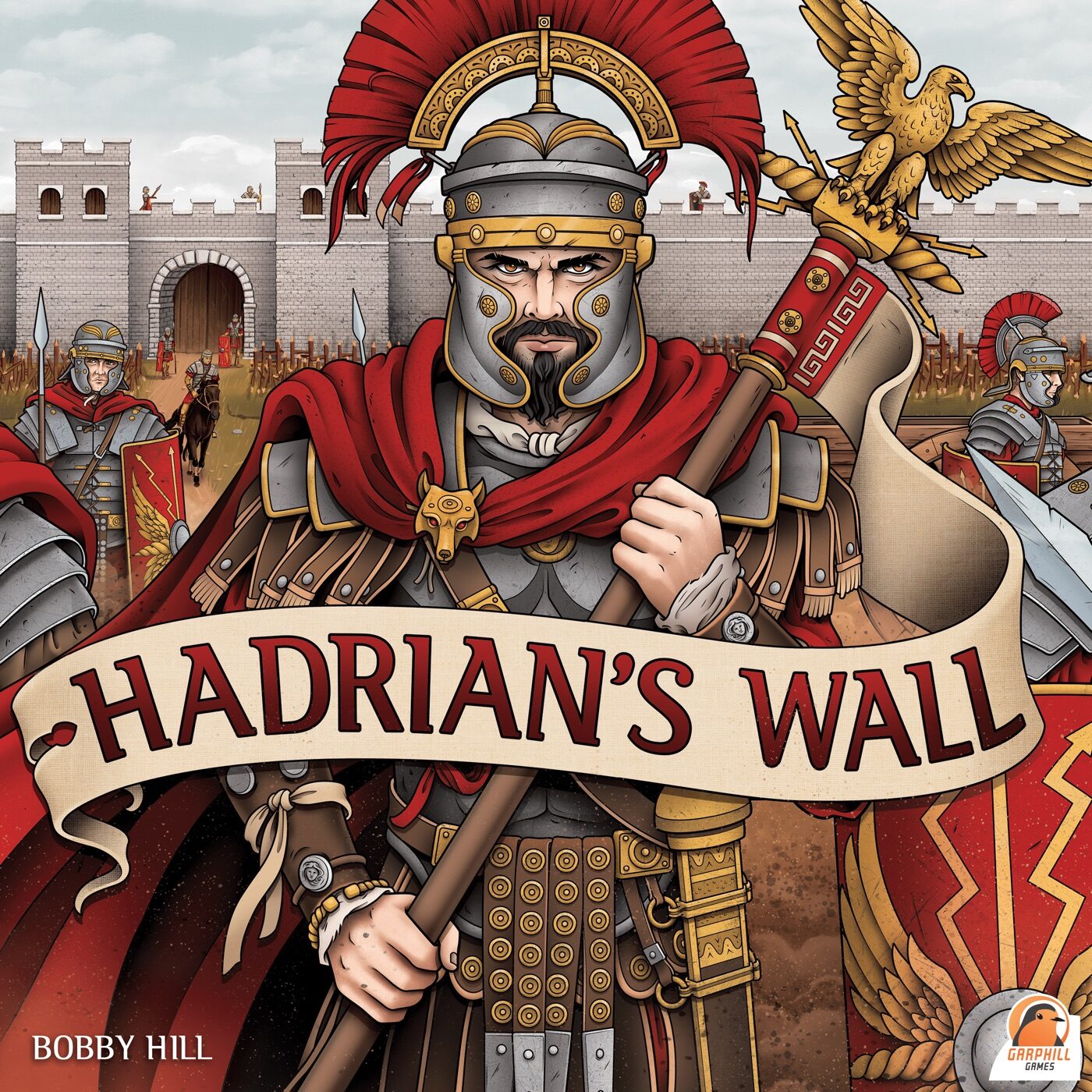
There’s a specific kind of solo game that makes you look at the clock, realise ninety minutes have passed, and wonder where they went. Hadrian’s Wall is that game - except once you know what you’re doing, it only takes forty.
Designed by Bobby Hill and published by Garphill Games / Renegade Game Studios in 2021, Hadrian’s Wall sits at #169 on BGG with a 7.88 average rating and a weight of 3.17. It plays 1-6, runs 30-60 minutes, and has one of the most lopsided solo polls on the entire site: 315 votes for Best at 1, 35 Recommended, and just 4 Not Recommended. That’s 89% Best - not “works fine solo” territory, but “this is fundamentally a solo game that tolerates multiplayer” territory.

What you’re actually doing
You’re a Roman general building a milecastle along Hadrian’s Wall over six rounds (years). Each round you flip cards from a Fate deck to receive workers and resources, then spend them marking boxes on two enormous sheets of paper - one for the wall and its military infrastructure, the other for the civilian settlement growing behind it.
The left sheet covers soldiers, builders, wall sections, the fort, granaries, guard towers. The right sheet handles traders, performers, priests, baths, theatres, temples, gladiators, scouts. Every section feeds into others through cascading combo chains: fill a box in the wall section, gain a worker, spend that worker on a temple, trigger a piety mark, unlock a landmark. Six rounds. Dozens of interlocking systems. One pencil.
At the end of each round, Pict attacks test your defences. Repelled attacks earn Valour; breakthroughs earn Disdain (negative points). After six rounds, you tally four scoring tracks - Renown, Piety, Valour, Discipline - plus end-game bonuses from cards you tucked under your player board throughout the game.
The solo mode
Here’s the thing about Hadrian’s Wall’s “solo mode”: it barely changes anything. The multiplayer game is already a parallel efficiency puzzle with almost zero interaction. In solo, you simply flip two cards from a neutral deck each round to simulate neighbours - giving you access to trade goods and scout locations you’d otherwise get from adjacent players. That’s it.
As The Dice Tower’s Mike DiLisio put it in his solo review: “So much of it involves head down efficiency planning out your turns so that you can trigger those combos. I think that as a solo game it shines particularly well.”
The solo game also offers three difficulty levels, scaling the number of Pict attacks per round. The rulebook includes a scoring matrix so you can measure your performance - though most experienced players set their own benchmarks. Clearing 60 points on Normal difficulty is a solid win. Pushing past 80 means you’ve started to see the combos properly.
And if the base solo game isn’t enough, there’s a free downloadable solo campaign that chains scenarios together with restrictions, bonus objectives, and rewards that carry between plays. It’s where many solo players say the game truly shines.
Setup and table footprint
This is where flip-and-writes earn their keep over bigger solo games. Setup is: tear off two sheets, shuffle two small decks, grab a pencil. Done. You’re playing in under two minutes.
Table footprint is modest - you need space for two A4-ish sheets side by side, a player board above them, and a few small card decks. It’ll fit on a hotel desk or a small coffee table. No sprawling token economy, no enemy AI deck to manage, no board to assemble.
Teardown is even faster: recycle your sheets (or file them if you’re the type who tracks scores), stack the cards, box it. Compare that to something like Mage Knight or Spirit Island where setup alone can take fifteen minutes.
Decision density - the real selling point
The weight rating of 3.17 undersells this game. For context, Cartographers - another popular solo flip-and-write - sits at 1.89, and Welcome To… is at 1.84. Hadrian’s Wall is almost double the complexity of its genre peers, landing in medium-heavy euro territory despite being, mechanically, a game about marking boxes with a pencil.
That density comes from the combo chains. Every resource you spend opens new paths. A single yellow worker placed in the Traders section might unlock a Precinct, which gives you access to the Market, which lets you buy a Good, which scores end-game points from a tucked card, which also triggers a mark on the Renown track. One worker, five consequences. And you had seven other workers you could have spent differently.
Your first game will take 60-90 minutes as you read and re-read sections, trying to understand what feeds into what. By game three, you’re down to 40 minutes. By game eight, you’re making decisions instinctively - and that’s when you start seeing the real game underneath: not “what can I do?” but “which combo chain produces the most value from the resources I was dealt this round?”
As one BGG reviewer described it, the early games feel like “Hadrian’s Plinko” - you drop a worker in and watch the chain reactions tumble out. The later games feel like engineering.
The multiplayer question
The box says 1-6. The BGG poll paints a clearer picture:
| Players | Best | Recommended | Not Recommended |
|---|---|---|---|
| 1 | 315 | 35 | 4 |
| 2 | 48 | 180 | 38 |
| 3 | 24 | 137 | 72 |
| 4 | 8 | 70 | 136 |
| 5 | 6 | 48 | 153 |
| 6 | 5 | 43 | 158 |
The numbers don’t lie. At 4+ players, more people recommend against it than for it. The reason is simple: there’s almost no interaction. Everybody stares at their own sheets, occasionally someone trades a good or sends a scout, and at the end you compare scores. The dominant multiplayer experience is, as multiple reviewers put it, “multiplayer solitaire with a constant chorus of ‘are you done?’”
This isn’t a criticism - it’s a feature. The game was designed to be a rich efficiency puzzle, and that puzzle doesn’t need opponents. It needs you, a pencil, and forty minutes.
Who this is for
You’ll love it if you:
- Want a crunchy, decision-heavy solo game with minimal setup
- Enjoy combo-building and efficiency optimisation (think Terraforming Mars vibes in a fraction of the time)
- Like beat-your-own-score challenges with clear difficulty scaling
- Want something portable - this fits in a backpack and works on a plane tray table
- Are drawn to the “one more game” loop that flip-and-writes do well
You might bounce off it if you:
- Need narrative or thematic immersion from your solo games - this is a puzzle in Roman clothing
- Get overwhelmed by open-ended optimisation without guidance (the first game will paralyse you)
- Prefer solo games with an AI opponent or dynamic threat (the Pict attacks are random, not reactive)
- Want meaningful multiplayer - buy this for solo; anything above 2 players is a compromise
The verdict
Hadrian’s Wall is the rare flip-and-write that punches above its component weight class. Two sheets of paper and a pencil shouldn’t deliver this much depth, but Bobby Hill threaded the needle: every section of those sheets connects to every other section in ways that take games to discover and dozens more to optimise.
The solo community figured this out immediately - 315 Best votes at 1 player is one of the strongest solo endorsements on BGG. If you play solo games and you don’t own this, it’s the easiest recommendation I can make. Rip off a sheet, shuffle the decks, and lose an evening. You won’t notice it’s gone.
Hadrian’s Wall is designed by Bobby Hill, published by Garphill Games and Renegade Game Studios (2021). Plays 1-6, 30-60 minutes, BGG weight 3.17. Available from your local game store or BoardGameGeek.