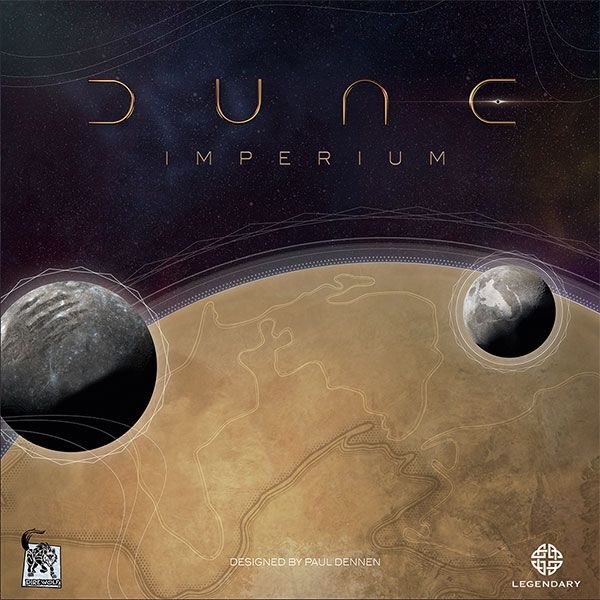
Dune: Imperium sits at #6 on BoardGameGeek with a rating of 8.41 from over 60,000 players. That’s an extraordinary position for any game, and it earns it: the marriage of worker placement and deck building over a Dune-licensed conflict board is one of the most elegantly designed hybrid mechanisms in modern hobby gaming.
What’s less talked about is the solo mode. Dune Imperium supports 1-4 players right on the box, and the solo system - built around a dedicated House Hagal AI deck and two autonomous Rival factions - ships in the base game without needing any app or expansion.
This is a complete breakdown of what that solo experience actually delivers.
The Numbers (Verified via BGG)
| Stat | Value |
|---|---|
| BGG Rank | #6 |
| BGG Rating | 8.41 |
| BGG Weight | 3.08 / 5 |
| Players | 1-4 (solo supported) |
| Play Time | 60-120 min |
| Solo Play Time | 60-90 min |
| Publisher | Dire Wolf |
| Designer | Paul Dennen |
How Solo Works Mechanically
Solo Dune Imperium is a 1-versus-2 scenario. You control one Great House; two AI Rivals - each assigned a Leader card from the base game - play against you using the House Hagal deck, a 22-card AI brain that ships with the base game.
The key distinction: the Rivals don’t think. They react. Each Rival card in the House Hagal deck specifies a board space priority list - the AI works down the list until it finds an unoccupied space, then places its Agent there. You know the deck exists, you can track what’s been played, and over time you develop a read on what the AI is likely to do next. That predictability is both a feature and a flaw.
The turn structure is essentially unchanged from multiplayer:
- You take an Agent turn (play a card, send a worker to a board space, collect resources)
- First Rival takes a turn, drawing a House Hagal card to determine placement
- Second Rival takes a turn
- Repeat until everyone passes to the reveal phase
- Combat resolves: all parties reveal Intrigue cards and Swords from their hands
- Conflict card awards go to whichever faction committed the most strength
- Resources convert: Rivals automatically cash in accumulated spice, solari, and water for victory points at specific thresholds
The Rivals’ Victory Point engine is the soul of the solo mode. They aren’t just blocking board spaces - they’re actively generating VP through resource conversion (3 Water = 1VP, 7 Solari = 1VP, 7 Spice = 1VP, 3 influence from one faction = 1VP). Win the race to 10 VP first, or lose. It’s clean.
Difficulty is set at game start by adjusting the Rivals’ starting troops, your starting resources, and whether the Mentat board space costs 2 Solari or 5:
| Difficulty | Rival Starting Troops | Your Bonus Resources | Mentat Cost |
|---|---|---|---|
| Novice | 3 | +1 Solari, +1 Spice | 2 |
| Mercenary | 4 | None | 2 |
| Veteran | 5 | None | 5 |
| Expert | 5 | None | 5 + Rivals’ Swordmasters enter earlier |
Most experienced players land at Veteran for a genuine challenge. Novice is genuinely winnable on your first solo game, which is the right design call - it lets you learn the system before getting crushed.
Setup and Teardown Time
Setup for solo Dune Imperium takes around 12-15 minutes the first few times, dropping to 8-10 minutes once you know the flow. The solo-specific work is minimal: remove the 2-player-specific cards from the House Hagal deck (marked with “2P” in the corner), choose two Leaders for your Rivals, set Rival garrisons based on difficulty. Everything else is standard game setup.
Teardown is the same as multiplayer - roughly 8 minutes if you’re organised.
One note: the House Hagal deck, once sorted, lives in a small bundle. Some players keep it rubber-banded or sleeved separately so it’s always ready to pull. That small prep habit shaves meaningful time off the setup.
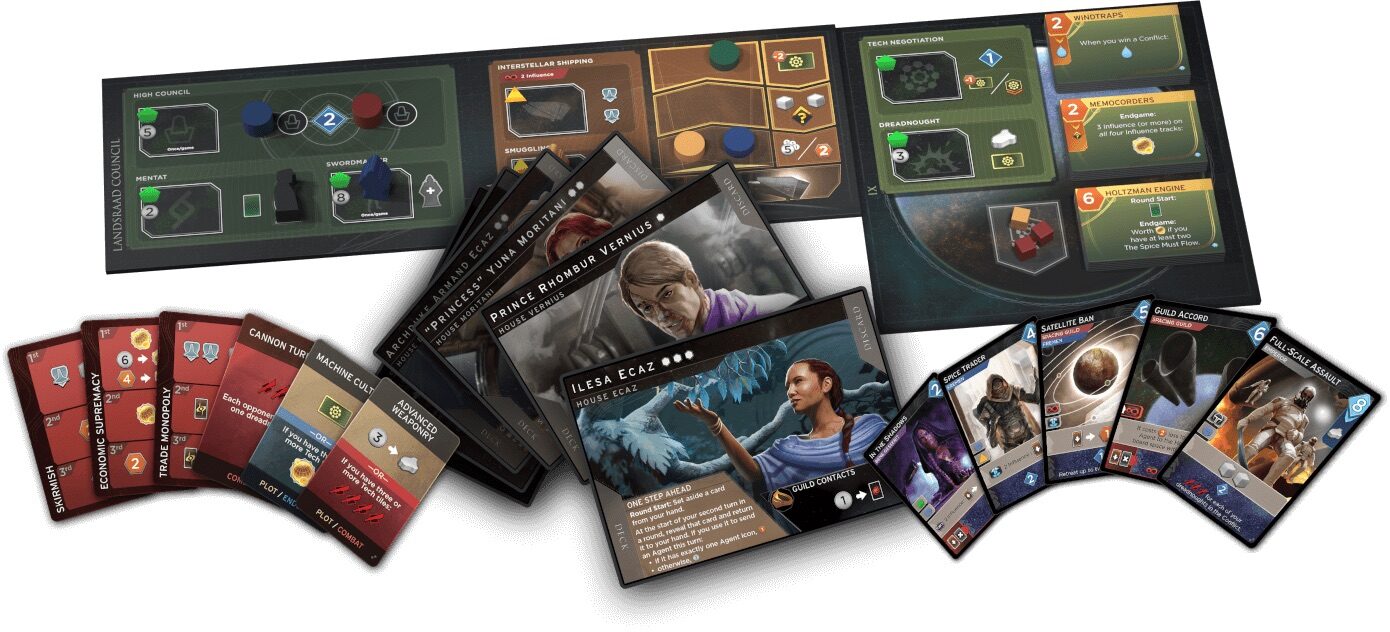 The main board in action - influence tracks, the Mentat space, and the conflict area. Solo play uses the same board with all spaces in play.
Table Footprint
The Dune Imperium board is standard large (roughly 70×70 cm fully laid out), and solo adds two Rival player areas. In practice, those Rival areas are modest - just a garrison tray, Leader card, score tracker, and agent tokens. You can run a full solo game on a standard dining table without the Rivals’ areas encroaching on your space.
If you’re table-limited, it’s one of the more manageable heavy games to play alone. The full footprint lands somewhere between Spirit Island (huge, sprawling) and Viticulture (compact). Comparable to Arkham Horror LCG in terms of desk playability.
Decision Density
This is where solo Dune Imperium shines hardest, and also where it draws the most criticism.
The density is high. Every Agent turn involves a meaningful decision: which card do I play? Which board space does it unlock? What does playing this card cost me in the reveal phase? Am I blocking a space the AI wants, or am I racing toward VP by a different route? The dual-function of every card in your hand - Agent action on one side, combat/reveal power on the other - creates constant tension.
What differs from multiplayer: the political layer collapses. In a 3-4 player game, board spaces get congested fast, timing becomes critical, and reading opponents adds an entire dimension. The AI fills spaces based on priority lists, not strategy. It won’t pivot based on reading your deck. It won’t negotiate with you over the Mentat. The cognitive load is real, but it’s largely internal - optimising your own engine rather than reacting to human judgment.
r/soloboardgaming’s candid verdict: the subreddit has players logging 30+ solo games who love it, and players who bounce off it after five because it feels like playing a puzzle against a passive wall. The AI is a constraint, not an adversary. If you want an AI that feels like it’s trying to beat you, this isn’t that. If you want a lean, thinky puzzle with Dune flavour, it delivers.
Replayability
The base game includes eight Leaders, each with a different ability. You choose one for yourself, and the Rivals use two of the remaining seven (Signet ability only - the main ability is ignored for AI Rivals). Between your leader choice and the random Imperium Row card spread each game, no two solo sessions play identically.
What drives reuse:
- Different leader combinations change what lines you want to pursue
- The randomised conflict deck means the rewards available each round vary
- Different difficulty settings genuinely alter the game’s feel
- The House Hagal deck’s priority lists mean board-space competition is somewhat predictable, but your deck-building path is not
What limits it: the AI’s behaviour is fully learnable. Veteran players on BGG forums note that once you understand the House Hagal priority structure, you can start gaming it - knowing which spaces the AI will take and steering around them deliberately. That’s engaging for a while, then starts to feel mechanical.
The practical ceiling for most players is probably 20-30 satisfying solo games before wanting to add the Ix expansion (which adds complexity and new board spaces) or move to Uprising.
Dune Imperium Uprising
Worth flagging: Dune: Imperium - Uprising (2023) is a standalone sequel with revised solo rules and an expanded House Hagal deck. The solo mode is considered a meaningful improvement over the base game - slightly tighter AI decision structure, more board space variety, and better-integrated solo-specific Intrigue cards.
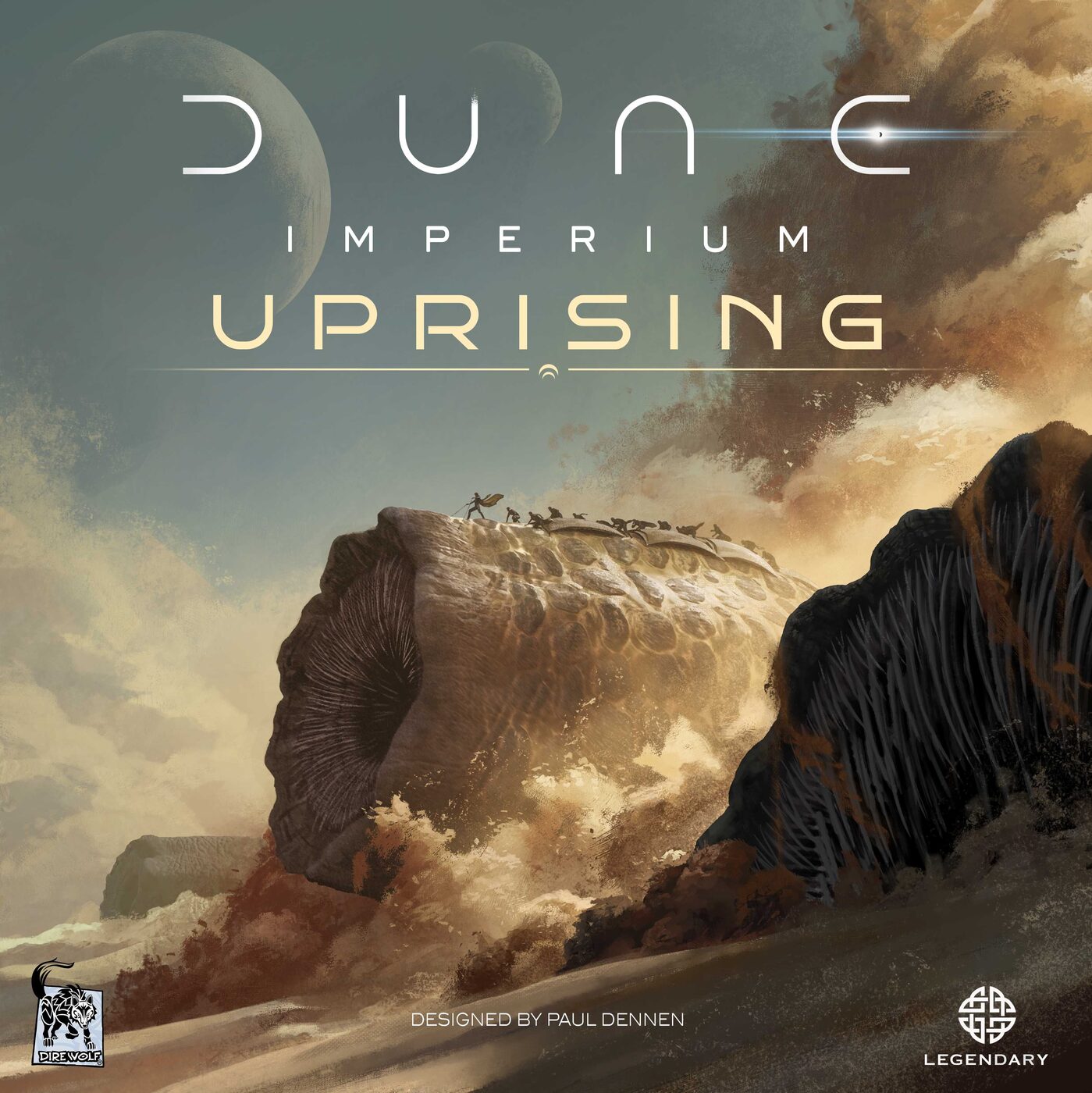 Dune Imperium Uprising (2023) - the standalone sequel with an improved solo mode.
If you’re solo-first and starting fresh, Uprising is worth considering as your entry point. If you already own the base game, the Rise of Ix expansion is the most commonly recommended addition for solo variety, adding new board spaces and mechanisms that make the AI’s priority lists feel fresher.
BGG Solo Poll - Community Verdict
BGG’s solo poll for Dune Imperium shows strong “Recommended” votes for solo play, with the community consensus sitting clearly in the worth playing solo camp - not in the solo-first category. The 1Player Guild on BGG rates it highly, and it’s appeared in multiple BGG Best of Year lists for solo games.
The spread roughly reflects what you’d expect: this is a game designed for 1-4 that delivers a solid solo experience without being solo-native. It’s the distinction between “plays well solo” and “was designed to be played solo.”
For comparison: Spirit Island (done for solo-first) and Mage Knight (designed around solo) sit in a different tier. Dune Imperium occupies valuable middle ground - serious enough to scratch the complex-solo itch, accessible enough to teach multiplayer at the same table.
Multiplayer vs Solo: What You Give Up
The solo mode is good. It’s also not the full game. Here’s what genuinely changes:
What you lose:
- Political tension. The board-blocking arms race in 3-4 player games creates moments of visible frustration and triumph that the AI can’t replicate.
- Negotiation. Reading another player’s hand state, timing your Conflict all-in against their reveal - that’s gone.
- The traitor arc. Watching someone you thought was chasing spice suddenly emerge in combat with a full hand is a multiplayer feeling.
What you keep:
- All the deck-building tension. Your hand management decisions are unchanged.
- The VP race. Resource conversion for VP is still a live clock.
- The card drafting from the Imperium Row. Still tactical, still reactive.
- The full board geography. Every space matters.
Solo strips the social read and leaves the puzzle. If the puzzle is enough for you on a given evening, it holds up well.
Is Dune Imperium Worth Buying for Solo Play?
If you already own the base game: yes, the solo mode is worth exploring properly. Set it to Veteran, read the House Hagal rules carefully (they’re on a single separate sheet, mercifully), and commit to two or three games before judging it. It opens up.
If you’re buying specifically for solo: you’d be paying for a premium multiplayer game that happens to include a good solo mode. That’s not a bad deal - the multiplayer is excellent and you’ll likely have it on the table with others too. But if you need a pure solo experience, something like Spirit Island, Gloomhaven, or Arkham Horror: The Card Game is purpose-built for it.
If you’re considering Uprising instead: the solo mode is a genuine improvement. New players should look at Uprising first. Existing base game owners should add Rise of Ix before considering a full Uprising purchase.
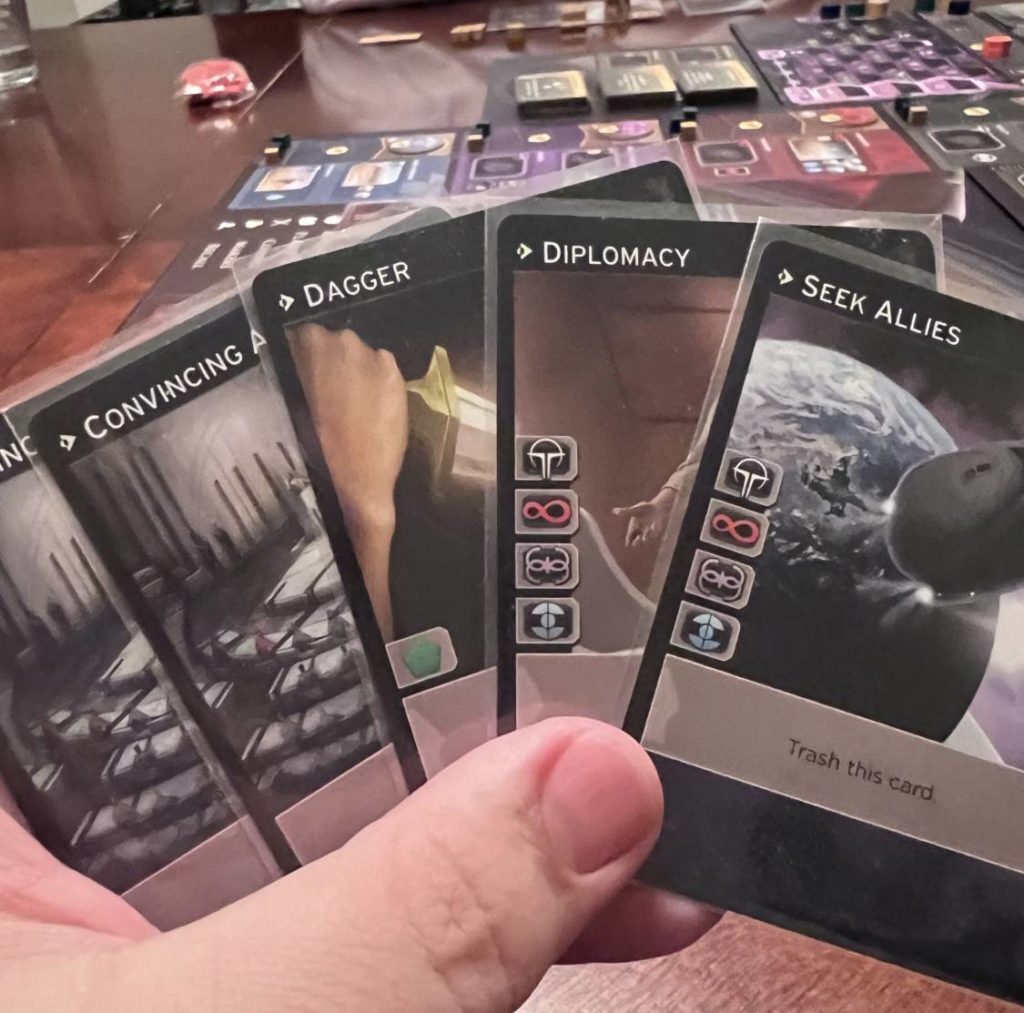 Cards in Dune Imperium do double duty: they grant Agent actions when played, and contribute to the combat reveal at end of round. Solo play preserves this tension.
The One-Evening Test
Can you play Dune Imperium solo tonight?
Yes, if:
- You’ve played multiplayer before and know the base rules
- You have a clear table and 90 minutes
- You’ve pre-sorted the House Hagal deck from the rest of the cards
You’ll need one read-through of the solo sheet first (about 10 minutes). The AI rules are genuinely well-written - compact, clear, unambiguous. This isn’t a game where the solo rules are buried in an appendix. It’s designed to be picked up.
Set it to Mercenary for your first game. Get a feel for the AI’s patterns. Move to Veteran once you’ve won once. The game doesn’t punish curiosity.
BGG stats verified at time of publication. Dune: Imperium is published by Dire Wolf Digital. Image credits: Dire Wolf Digital via BoardGameGeek.