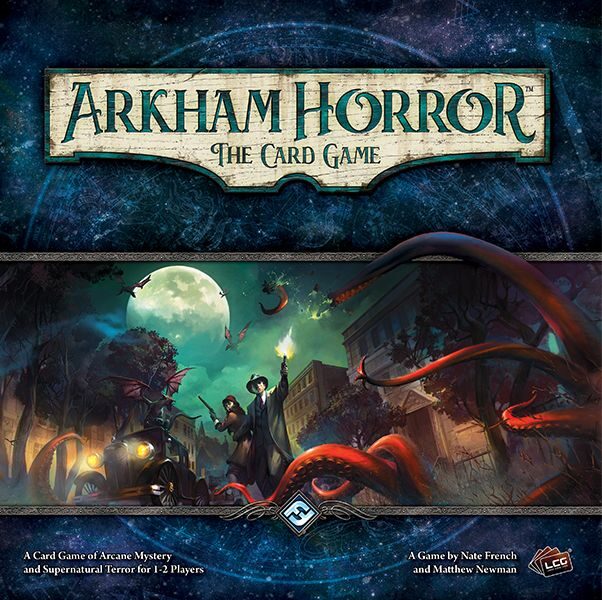
Arkham Horror: The Card Game sits at #33 on BoardGameGeek with a rating of 8.12 from over 48,000 players - one of the highest-rated games in the hobby. The more important number for this article: it’s a 1-2 player game, and the solo experience isn’t bolted on. It’s central to how the game was designed.
Most games in this series get covered for what they offer solo compared to multiplayer. AHLCG inverts that. The question worth asking isn’t “does the solo mode hold up?” - it’s “what does multiplayer add that solo doesn’t already give you?”
That distinction matters. Let’s get into it.
The Numbers (Verified via BGG)
| Stat | Value |
|---|---|
| BGG Rank | #33 |
| BGG Rating | 8.12 |
| BGG Weight | 3.57 / 5 |
| Players | 1-2 (original); 1-4 (Revised Core Set) |
| Play Time | 60-120 min per scenario |
| Publisher | Fantasy Flight Games |
| Designers | Nate French, MJ Newman |
| Year | 2016 (original); 2021 (Revised Core Set) |
How Solo Works Mechanically
Arkham Horror: The Card Game is a Living Card Game (LCG) - you build decks from a pool of cards, then run those decks through story-driven scenarios. Each scenario is a self-contained mystery within a larger campaign, and your choices carry forward from one session to the next.
There is no traditional AI. Instead, the scenario works against you through two mechanisms:
The Encounter Deck
Each scenario comes with an encounter deck - a shuffled stack of cards that spawns enemies, inflicts horror and damage, places obstacles, and creates location-specific threats. At the end of every round, you draw one encounter card per investigator and resolve it. The encounter deck is the “opposition.” It doesn’t think; it reacts to the situation on the table based on fixed rules printed on each card.
What gives it tension is unpredictability. You can’t anticipate which enemies will emerge, which locations will be revealed as dangerous, or what horror effect will land on your investigator this turn. The chaos is designed - encounter sets are curated per scenario to match the narrative.
The Act and Agenda Decks
Running alongside the encounter deck are two separate card stacks placed in the centre of the table:
- The Act deck is yours. It tracks your progress through the scenario. You advance it by collecting clues from locations and spending them on the Act’s threshold. Advance the Act deck far enough and you complete the scenario.
- The Agenda deck is the enemy’s clock. It advances each round when doom tokens accumulate. If the Agenda advances too far, the scenario escalates - enemies power up, bad effects trigger, and eventually you lose.
The interplay between these two clocks creates the game’s core tension: you’re racing to progress your Acts before the Agenda spirals out of control, all while the encounter deck throws obstacles at you every single round.
The Chaos Bag
Every skill test in the game draws a token from the chaos bag - a physical bag of numbered and symbol tokens that determines the difficulty modifier applied to your test. The bag’s contents shift across difficulty levels and some tokens trigger effects beyond a simple number (Elder Signs grant bonuses; Tentacle tokens often cause automatic failure with extra consequences).
This is the randomness engine. It makes every skill test feel precarious, even when you’re statistically favoured. That tension stays fresh across dozens of sessions in a way that dice rolling often doesn’t.
True Solo vs 2-Handed Solo
This is the most important distinction for new players, and it’s often skipped over.
True Solo: You control one investigator. You draw one encounter card per round. The scenario’s difficulty is calibrated for one investigator - enemy health values, clue requirements, and threat levels all scale. This is the leanest, most focused way to play.
2-Handed Solo: You control two investigators simultaneously. You draw two encounter cards per round. You manage two hands, two action pools, and two sets of decisions. The scenario plays at its standard scale, designed for two investigators cooperating.
The BGG forums and r/soloboardgaming broadly agree: 2-handed solo is the more popular approach for experienced players. It gives you a richer deckbuilding space (two different investigator classes to build for), better resource synergy, and access to scenarios balanced for two that can feel punishing at true solo difficulty.
True solo, however, is not a lesser experience. Several investigators - notably the “Guardian” and “Seeker” class archetypes - are specifically well-positioned for solo play. Running a single tight deck through a campaign with permanent consequences is genuinely compelling.
The practical answer: start with true solo to learn the system. Move to 2-handed once you’re comfortable managing two investigator states simultaneously.
Setup and Teardown Time
Setup for a solo AHLCG session runs 20-30 minutes your first few campaigns, dropping to 12-15 minutes once the process is routine. What you’re doing in that window:
- Shuffle and place scenario-specific location cards
- Build the encounter deck from specified encounter sets
- Assemble and shuffle your player deck(s)
- Set up the chaos bag with appropriate tokens for difficulty
- Place act and agenda decks, set starting threat levels
- Distribute starting clues per location per setup instructions
The most time-consuming part is the encounter deck assembly - each scenario specifies 2-4 encounter sets to combine, and you need to find those cards in your collection. Organised storage (dividers, sorted by encounter set) cuts this to under two minutes. Disorganised storage can add 10+ minutes per setup.
Teardown is 10-15 minutes. Separating encounter sets back out is the main task; experienced players keep sets sorted in labelled dividers for this reason.
Fair comparison: this is one of the more involved setups in the hobby for a solo game. Mage Knight is comparable. Spirit Island is faster. If setup friction is your main concern, AHLCG is not the easiest entry into solo gaming - but the payoff per session justifies it for most players who commit.
Table Footprint
AHLCG at true solo needs a 60×80 cm area comfortably - locations spread across the table, act/agenda decks in the centre, encounter deck to one side, your investigator sheet and player deck in front of you. The chaos bag sits nearby.
At 2-handed solo, add another investigator’s play area. You’re looking at roughly a 80×90 cm footprint minimum.
This is manageable on a standard dining table but dense. Unlike Dune Imperium, which has a single fixed board to orient around, AHLCG’s table state is partially organic - locations are placed as you discover them, which can spread unpredictably. Some players use a tray or organiser to keep location cards in a fixed grid. Others embrace the sprawl.
It’s absolutely solo-desk playable. It’s not a game you want on a folding card table.
Decision Density
Very high - arguably the highest of any game in its weight class.
Every investigator has 3 actions per round. Each action can be: move, investigate (collect a clue), fight an enemy, evade an enemy, engage an enemy, activate a card ability, draw a card, gain a resource, or play a card. Action economy is everything. Wasting an action - especially at true solo - can mean one fewer clue collected, which cascades into an un-advanced Act, which means one more round of doom accumulation, which means a tighter endgame.
On top of action decisions: you have constant card management questions. Cards in hand are resources, and playing them at the wrong time is genuinely costly. Each scenario creates moments where you must decide between playing a card now versus holding it as a skill boost for a critical test. Mulligan decisions at the start of each scenario carry weight.
What this means in practice: you’re making 8-12 meaningful decisions per round in a 10-15 round scenario. Most of those decisions have multi-turn consequences. There’s no downtime. Even waiting to draw encounter cards is charged with anticipation.
Replayability
Extremely high - both within a campaign and across campaigns.
Across campaigns: Fantasy Flight Games has released roughly 10 full campaigns (each with 6-8 scenarios and a narrative arc), plus standalone scenarios. That’s 60+ unique scenarios available if you go deep. Each campaign is a distinct story in a different Lovecraftian setting - Dunwich, Carcosa, the Forgotten Age, the Dream-Eaters, and others. You can run any campaign multiple times with different investigator combinations and make different narrative choices, leading to branching outcomes.
Within a campaign run: branching paths matter. Scenarios often have multiple possible resolutions, and which path you took changes which scenario comes next. A campaign can unfold differently across two runs even if you use the same investigators.
Investigator variety: the current card pool has dozens of investigator archetypes across five classes, each with distinct deckbuilding constraints and playstyles. Building a Guardian-Seeker team plays nothing like a Rogue-Mystic combination. The deckbuilding is its own game between sessions.
The ceiling: genuinely high. Players on r/soloboardgaming regularly log 50-100+ sessions across the game’s campaign library. The active community still creates new content, and FFG continues releasing material.
The LCG Cost Question
This is the one thing to address plainly before recommending the game.
Arkham Horror: The Card Game is a Living Card Game. The base set (now the Revised Core Set, BGG ID 359609, $49.99 MSRP) gives you two full investigator decks and one complete campaign. To access additional campaigns and expand deckbuilding options, you buy Investigator Expansion boxes (full investigator card pools by class, ~$30-45 each) and Campaign Expansion boxes (full campaigns with all scenario and encounter cards, ~$45-60 each).
The “full collection” cost is several hundred dollars. There is no way around that if you want everything.
The practical entry point: the Revised Core Set alone gives you 30+ hours of solo play across its included campaign. You do not need to buy anything else to decide whether you love it. Many players run the included campaign multiple times with different investigators before buying a single expansion.
The LCG model is a long-term investment, not a one-purchase deal. If the ongoing cost structure puts you off, that’s a completely reasonable position. If you’re the type of player who gets 200+ hours from a game, it’s one of the best per-dollar values in the hobby once you go deep.
BGG Solo Poll - Community Verdict
BGG’s solo poll for Arkham Horror: The Card Game places it firmly in “Best” for solo play - not merely “Recommended.” This reflects the game’s design: with a player count of 1-2, solo is genuinely the primary intended mode rather than a secondary option.
The r/soloboardgaming community rates it among the top five solo games in the hobby, consistently appearing alongside Gloomhaven, Spirit Island, and Mage Knight as the canonical “if you play solo games seriously, you’ll own this eventually” titles.
The knock from the same community: the ongoing expansion cost and the setup overhead. Those aren’t design flaws - they’re real constraints of the LCG model. If you account for them upfront, they rarely become unexpected frustrations.
Multiplayer vs Solo: What You Give Up (And What You Don’t)
AHLCG at 2 players is a genuine cooperative experience - and a good one. But solo brings some things multiplayer doesn’t.
What you gain going solo:
- Complete control over both investigators’ decisions (no down-time waiting for your partner)
- The campaign narrative is entirely yours - your investigator’s trauma and mental scars are your story
- No coordination overhead; fast, focused play
- Easier campaign scheduling - no need to align two people’s calendars for every session
What you lose:
- Organic social problem-solving (“should I move or hold for your reaction?”)
- The tension of watching your partner fail a test you thought they’d pass
- Shared excitement at a scenario’s narrative payoff
The gap between multiplayer and solo AHLCG is narrower than almost any other game in this series, because the game was built for 1-2 from the start. The scenario design assumes small investigator counts.
Can You Play Tonight?
Yes, if:
- You own the Revised Core Set (or the original Core Set)
- You have 90-120 minutes clear
- You haven’t sleeved the cards yet - sleeve first, it’s worth the 20 minutes
Read first: the Learn to Play booklet (12 pages, well-structured) covers true solo clearly. Don’t attempt to learn from the Reference Card alone. The scenario setup guide is in the Campaign Guide, a separate book in the box.
Your first scenario - The Gathering - is the game’s tutorial. It’s short (45-60 min), focused, and designed to introduce encounter cards and skill tests without overwhelming you. Choose one investigator. Read their deckbuilding rules. Build the starter deck as suggested. Don’t optimise. Just play it.
The game’s opening scenario has a well-earned reputation for memorable first plays. Let it land on its own terms.
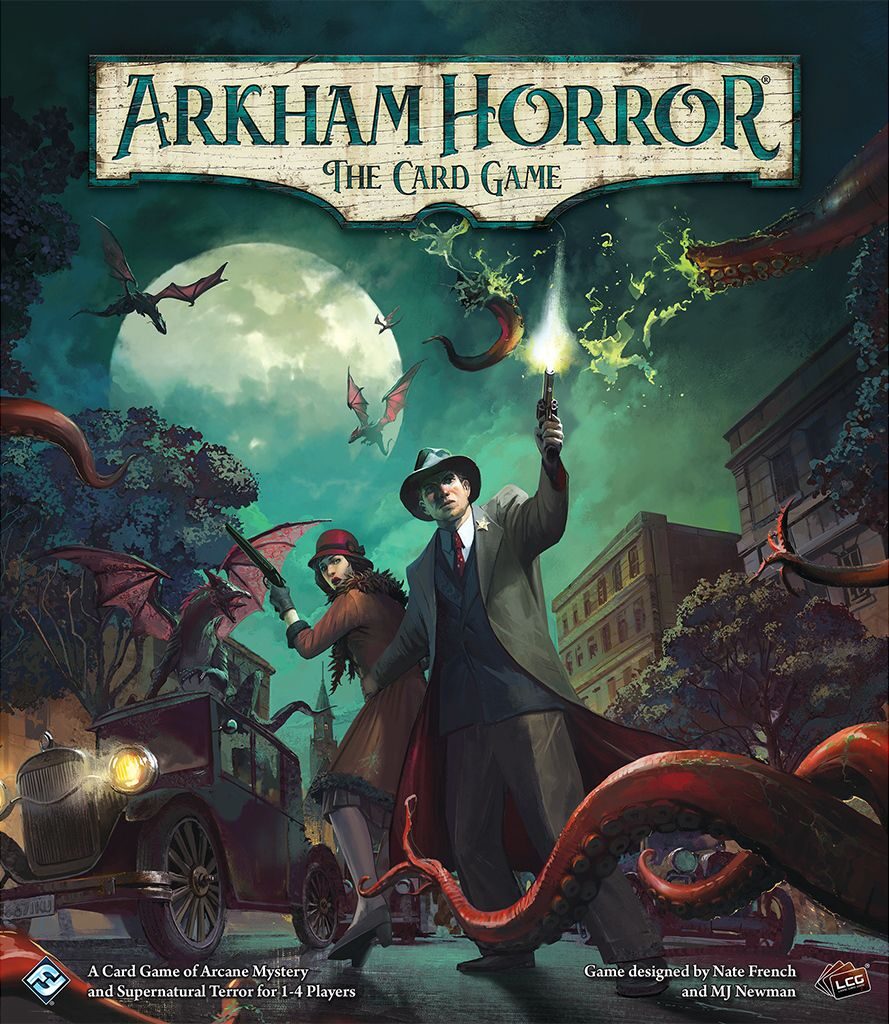 The Revised Core Set (2021) - the recommended entry point for new players, with updated card borders, rules, and two-campaign content.
BGG stats verified at time of publication. Arkham Horror: The Card Game is designed by Nate French and MJ Newman and published by Fantasy Flight Games. Image credits: Fantasy Flight Games via BoardGameGeek.