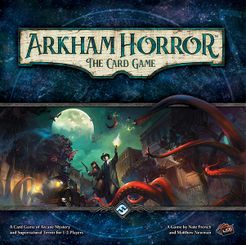
If you’re into solo board gaming, you’ve heard about Arkham Horror: The Card Game. It comes up in every “best solo games” thread. It sits at #33 overall on BGG with an 8.12 rating from nearly 48,000 users. Over 370,000 plays have been logged on the site - an enormous number for a card game that needs no randomised booster packs.
But you’ve also probably heard the warnings: it’s expensive to collect, the learning curve is steep, true solo is harder than two-handed. Those are all true. This article doesn’t soft-pedal any of that.
What it does is give you a clear, grounded picture of what solo play actually looks and feels like - mechanically, practically, and in terms of long-term value.
The Numbers (Verified via BGG)
| Stat | Value |
|---|---|
| BGG Rank | #33 Overall / #2 Customizable / #13 Thematic |
| Rating | 8.12 / 10 |
| Weight | 3.57 / 5 |
| Players | 1-2 (Community: 1-2+, Best: 2) |
| Playtime | 60-120 min |
| Publisher | Fantasy Flight Games |
| Released | 2016 |
| Logged Plays | 370,000+ |
| Own It | 83,000+ BGG users |
Solo poll (BGG community votes): The community recommendation shows 1-2+ as “Recommended” with Best at 2 players - meaning the game is solidly endorsed at 1 player, but the experience your deck is really optimised for involves 2. More on why in a moment.
How the Solo Mode Actually Works
Arkham Horror: The Card Game isn’t a board game with a solo mode bolted on. The game is a co-operative investigation experience - and at one player, that investigation simply falls to a single investigator carrying everything alone.
Each scenario unfolds in two phases:
The Investigation Phase: You take actions with your investigator - moving between locations, discovering clues, fighting monsters, drawing cards, playing events. Your deck is your toolkit. Every skill test (shooting a monster, picking up a clue, resisting a terrible vision) pits your stat against a difficulty number you reveal randomly. Success and failure both push the story forward, just in different directions.
The Mythos Phase: After your actions, the game strikes back. You draw a chaos token to resolve an effect, advance the Doom track (the apocalypse clock), spawn new enemies, and reveal encounter cards that throw narrative obstacles at you - curses, trauma, location-based hazards. The game is an active antagonist, not a passive puzzle.
In solo, all of this is handled by one deck, one investigator, one set of hands. The narrative engine stays the same. The stakes are identical. The difference is mechanical.
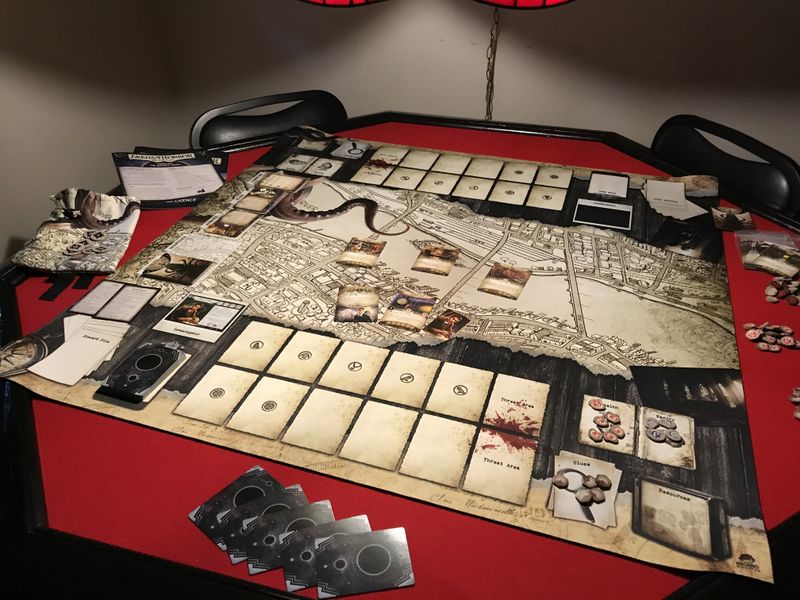
Solo setup for a Dunwich Legacy scenario. One investigator, full layout. Photo via BoardGameGeek.
True Solo vs Two-Handed Solo
This is the most important distinction for new players considering the game.
True Solo: One player, one investigator, one deck. You are a single human being in a world that scales threats by investigator count. Many scenarios ask you to discover N clues across multiple locations, fight X enemies that spawn based on player count, or survive Y rounds. Most of this scales down for true solo - but the action economy doesn’t. You still only get 3 actions per turn, and you need to handle enemies, find clues, and manage your own sanity/health all at once, with no partner to cover your weaknesses.
The result: true solo is harder and demands tighter deck construction. Versatile investigators who can flex between combat and investigation - Roland Banks, Nathaniel Cho, Lola Hayes, Winifred Habbamock - thrive. Specialists who rely on a partner to cover their blind spots struggle. Action-efficient cards become essential. Setup-heavy combo decks punish you.
Two-Handed Solo: One player running two investigator decks simultaneously. You make decisions for both characters, handling the full investigator synergy - a Fighter and a Seeker, say - that the game was designed around. You get the best narrative experience and the game balance the designers intended, at the cost of cognitive overhead: you have to context-switch between two different decision spaces in the same turn.
Most people who invest in this game long-term end up playing two-handed. True solo is viable and has a dedicated following, but it’s the harder path.
Setup and Teardown: The Realistic Picture
This is where Arkham Horror: The Card Game earns its “living card game” reputation - for better and worse.
First-time setup: If you’re punching out the core set and sorting components for the first time, budget 45-60 minutes. There are a lot of tokens, multiple investigator decks, and scenario-specific encounter decks to assemble. This is a one-time cost.
Per-session setup for a returning campaign: Once your collection is organised (and most serious players build custom storage solutions - look up the ArkhamDB community), setup for a solo session is 15-25 minutes. You’re laying out location cards, building the encounter deck for the scenario, setting your investigator’s deck, and placing tokens. This isn’t a game you pull out casually on a whim.
Teardown: Similar - 10-20 minutes. If you’re mid-campaign, cards accumulate trauma tokens, upgrade cards get swapped in, and you record your investigator’s physical and mental state on paper or an app. The campaign tracking is part of the experience.
Table footprint: Meaningful. A solo session with the core setup takes up roughly the area of a large dinner tray - location cards in a grid, investigator area, act/agenda decks, encounter deck, chaos bag, token pools. You can play on a standard coffee table if you’re careful with the layout.
Decision Density: What Solo Play Actually Feels Like
Arkham Horror: The Card Game is a high-decision game. Every action in the Investigation Phase is a choice with narrative and mechanical weight:
- Move toward the monster that’s about to become a hunter, or grab that crucial clue first?
- Commit that last card to boost this skill test, or save it as an icon for the next round?
- Spend resources to play the asset now, or bank them and risk running out of cards?
- Evade the Deep One or fight it, knowing fighting costs an extra action?
At one investigator, you don’t have a partner to bounce decisions off. You’re the full decision-making unit. For some players - the kind who love puzzle-mode concentration - this is the appeal. For others, it’s exhausting.
The chaos token bag adds meaningful randomness: you know the probability of drawing a bad token, but not which one. Experienced players learn to read their odds, but Arkham will always have moments where the bag simply ruins your plan. Learning to build decks that absorb bad luck rather than collapse under it is a major skill curve.
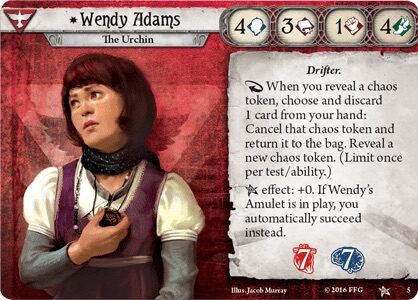
Each investigator has a unique stat spread, ability, and deckbuilding constraint. Photo via BoardGameGeek.
Replayability: The Real Selling Point
If there’s one area where Arkham Horror: The Card Game is simply unmatched in the solo space, it’s replayability.
The campaign structure: The core set includes three scenarios linked into a mini-campaign (Night of the Zealot). Beyond that, FFG has released dozens of full campaigns - Dunwich Legacy, Path to Carcosa, The Forgotten Age, The Innsmouth Conspiracy, Edge of the Earth, and more - each with six to eight interconnected scenarios, branching story paths, and permanent consequences. Your investigator’s physical and mental wounds carry forward. NPCs you meet in act one matter in act six. Choices that seem minor loop back later.
The investigator roster: Across all released content, there are over 60 unique investigators, each with different stats, special abilities, and deckbuilding constraints. Running the same campaign with a different investigator is a genuinely different experience.
The difficulty system: The campaign difficulty scales not via a rulebook mode but via the chaos bag - you add more punishing tokens to the bag at higher difficulties. The same scenario can be a manageable challenge or a brutal gauntlet depending on your bag composition.
The meta-progression: As you complete scenarios, you earn experience points to upgrade your deck. Starter-level cards get replaced with more powerful versions. Your deck at campaign’s end looks nothing like your deck at the start.
The floor is a single core set and a handful of hours. The ceiling is essentially limitless - people have been playing Arkham campaigns on rotation for eight years and still haven’t exhausted the content.
The Multiplayer Comparison (Straight Talk)
The BGG community votes “Best at 2” for a reason.
At two players - whether with a real partner or two-handed - the game hits its ideal design point. The synergy between investigator roles (one fights, one investigates; or one buffs, one tanks) creates the puzzle-within-a-puzzle that the card design leans into. Weakness mitigation via shared resources, asset-sharing between investigators, dividing roles to cover each other’s stat gaps - this is where the depth lives.
Solo strips the synergy layer away. What remains is still excellent: tight resource management, narrative tension, the chaos bag as antagonist, the campaign as long-form storytelling engine. But you’re not experiencing the full breadth of the design.
Solo is not a second-class experience. It’s a different one. Put plainly: if you had a reliable two-player partner who was equally interested in this type of game, you’d play it with them. Most people don’t, and Arkham solo is still the best narrative puzzle you can run at a solo table.
Who This Game Is NOT For
Players who want a set-collection game with no ongoing cost. The core set alone gives you three scenarios. To play the major campaigns, you’re buying expansions. An entry-level campaign (six scenarios, one cycle box) will run you £35-45. A “full collection” across all campaigns is easily £200+. This is the LCG model and it’s the price of admission for sustained content.
Players who want to sit down and play in 10 minutes. Setup is real work. If you want something you can pull out and play in ten minutes with zero mental effort, look at Sprawlopolis, Under Falling Skies, or Friday.
Players who dislike semi-narrative randomness. The chaos bag will sometimes wreck a well-constructed plan. Some scenarios have punishing encounter cards that feel unfair on a first (or second, or third) play. The game is not always fair. That’s by design - it’s Lovecraftian horror. If you need clean, predictable puzzle logic, this will frustrate you.
True solo players who hate extra-hard difficulty. The game’s scaling was built for 2+ investigators. True solo is a legitimate choice, but it demands more of the player: tighter deckbuilding, more efficient play, better resource management. If you want a relaxed, immersive narrative experience without the extra crunch, two-handed is the right entry point.
The Verdict
Arkham Horror: The Card Game is the deepest narrative solo experience in the hobby. Nothing else - not Mage Knight, not Spirit Island, not Gloomhaven - gives you the same combination of story branching, character progression, and sustained replayability across dozens of campaigns with over sixty investigators.
It earns its weight rating of 3.57 fair and square: this is not a light game, and solo play requires real cognitive investment. But for the right player - someone who wants a deep ongoing solo puzzle with stakes, stories, and long-term character investment - there is nothing else like it.
If you’re still on the fence: start with the Revised Core Set (not the original - it includes a much better Night of the Zealot campaign and enough cards to build two proper investigator decks). Play the included campaign on Standard difficulty, two-handed. If you’re still thinking about it a week later, you’re already in.
BGG data verified June 2026. Stats sourced from BoardGameGeek listing. Box art courtesy of Fantasy Flight Games.