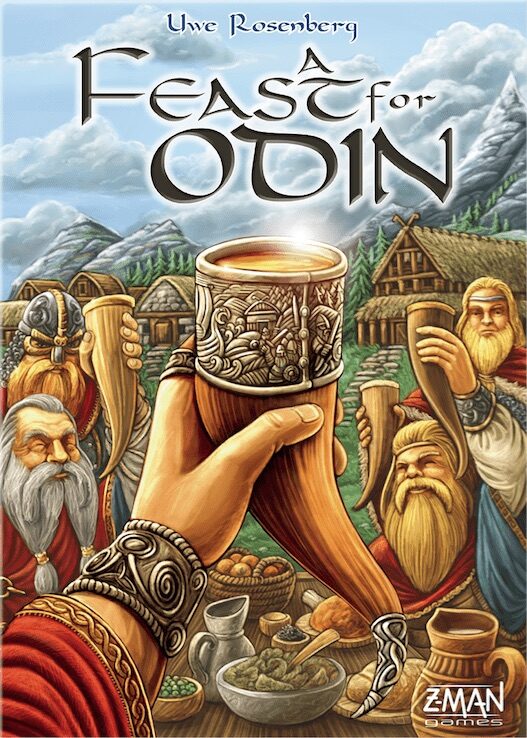
You bought A Feast for Odin because it’s one of the highest-rated games on BoardGameGeek, because you love Vikings, because you love Uwe Rosenberg, or because someone told you it’s the ultimate worker placement game. Maybe all four.
And then you opened the box.
Hundreds of tiles. A player board covered in negative points. An action board with sixty-one action spaces spread across thirteen columns. Weapon cards. Occupation cards. Island boards. Mountain strips. A feeding phase. An income phase. Something called a “Thing Square.”
You punched out the tiles, maybe bagged them, put the lid back on, and it’s been sitting there ever since. You’re not alone - A Feast for Odin is one of the most commonly owned, least commonly played games in the hobby. It’s the poster child for “I’ll learn it this weekend” weekends that never come.
Let’s fix that. Tonight.
The Numbers
| Stat | Value |
|---|---|
| BGG Rating | 8.16 |
| BGG Rank | #27 overall |
| Weight | 3.87 / 5 |
| Players | 1-4 |
| Play Time | 30-120 minutes |
| Designer | Uwe Rosenberg |
| Year | 2016 |
A 3.87 weight is genuinely heavy, but here’s the thing - most of that weight comes from the breadth of options, not the depth of rules. The core rules are surprisingly simple. The intimidation comes from the action board, not the rulebook.
Diagnosing the Real Barrier
It’s not the rules - it’s the action board
This is the critical insight that most people miss. A Feast for Odin’s rules are actually quite straightforward: place workers, take actions, fill your board with tiles, feed your Vikings. That’s the game. The problem is that when you look at the action board, you see sixty-one spaces across thirteen columns and your brain short-circuits.
But here’s what nobody tells new players: you don’t need to learn all sixty-one actions before you play. Most of them follow simple patterns. The columns are organised by theme - hunting, raiding, trading, crafting, exploring - and within each column, the actions scale predictably: more workers = better version of the same thing.
The setup myth
“It takes an hour to set up” is the other common excuse. It doesn’t. The game comes with a setup guide that organises components by their upgrade paths. Once you’ve bagged everything properly (one session of organisation, 20 minutes), setup takes about 10 minutes. That’s comparable to any medium-weight Euro.
As one reviewer put it: “The game provides a handy guide for setting these pieces up that follows their in-game trading and upgrade paths, so setup and teardown never actually suffers despite the huge scale of the game.”
The solo paradox
Here’s the irony: A Feast for Odin is one of the best solo games ever made, and solo is the easiest way to learn it. But the people most likely to buy it are often group gamers who keep waiting for the right game night to debut it. That night never comes because they haven’t learned it, and they haven’t learned it because they’re waiting for that night.
Break the cycle. Play it solo first.
Your Rescue Plan
Step 1: The 20-Minute Solo Setup (Tonight)
Forget teaching it to anyone else for now. Set up a solo game using these steps:
- Grab your player board, 12 Vikings, and starting weapon cards (snare, spear, bow)
- Set out the action board - yes, the big one. Don’t panic.
- Grab the goods trays - four colours: orange (food), red (food), green (trade goods), blue (luxury goods)
- Set out islands and buildings - just put them nearby, you’ll learn what they do as you play
- Shuffle the occupation cards - for your first game, use only the ones marked with an “A” in the corner (these are simpler)
The solo game uses a clever two-colour Viking system: you alternate between two sets of workers each round, and you can’t revisit actions from the previous round. It creates natural variety without needing another player.
Step 2: Ignore Half the Board (Seriously)
For your first game, focus on just three columns:
- Hunting - spend workers to get food tiles (you need these to feed your Vikings)
- Crafting/Trading - upgrade tiles to more valuable colours
- The tile placement puzzle - this is the actual game. Cover negative points on your player board with the tiles you collect
That’s it. You’ll discover raiding, exploring, emigration, and the other systems naturally over subsequent plays. The game is designed so that even inefficient play is satisfying - you’re still placing polyomino tiles on your board, watching the negative points disappear, and that tactile satisfaction carries the experience.
Step 3: The Tile Placement Epiphany
This is where A Feast for Odin transforms from “overwhelming Viking spreadsheet” to “why didn’t I play this sooner.” The entire game is essentially Patchwork on steroids (also by Rosenberg - he clearly has a type).
The key rules for tile placement:
- Green tiles can’t touch other green tiles (orthogonally). Everything else can go anywhere.
- Fill from bottom-left - to increase your income, you need to cover everything below and to the left of the next income threshold
- Bonus spaces - surround them (don’t cover them) to earn recurring bonuses each round
Once this clicks, you stop seeing the action board as sixty-one overwhelming choices and start seeing it as sixty-one ways to get the specific tile you need for the specific gap on your board. The action board isn’t the game - the player board is.
Step 4: Bring in a Friend
After one or two solo plays, you’ll know the game well enough to teach it. And here’s the good news: A Feast for Odin is best at 2-3 players.
BGG’s player count poll (764+ votes) is clear:
| Players | Best | Recommended | Not Recommended |
|---|---|---|---|
| 1 (Solo) | 132 | 314 | 52 |
| 2 | 242 | 299 | 13 |
| 3 | 279 | 197 | 24 |
| 4 | 72 | 253 | 127 |
At four players, it drags - too much downtime between turns. At two or three, the action board has just the right tension: enough competition for key spaces that you can’t autopilot, but enough options that you’re never locked out.
Teach it like this: “You’re Vikings. Place workers, take actions, get tiles, fill your board. Green tiles can’t touch. Feed your people at the end of each round. Most points wins.” Then let them discover the rest as they play.
The “Tonight Test”
Can you realistically play A Feast for Odin tonight? Let’s be real:
- First solo game: 20 minutes setup + 60-90 minutes play (with rulebook reference) = about 2 hours total. That’s a commitment, but it’s a single evening, and you’ll learn the game.
- Second game onwards: 10 minutes setup, 45-60 minutes solo, 60-90 minutes at 2-3 players.
- What you need: A table big enough for the action board and one player board. A dining table works fine.
The plain answer: yes, if you start at 7pm, you can finish a solo learning game by 9pm and go to bed knowing you finally played the #27 game on BGG. It’s been sitting on your shelf long enough.
Why It’s Worth Rescuing
A Feast for Odin isn’t just a good game - it’s Uwe Rosenberg’s magnum opus. It takes everything he learned from Agricola, Caverna, Le Havre, and Patchwork and combines it into a single, sprawling, deeply satisfying package. The action board that terrified you is actually a gift - it means every game unfolds differently, every strategy is viable, and you’ll still be discovering new approaches fifty plays in.
The Vikings who’ve been waiting in that box deserve their feast. Give them one tonight.
A Feast for Odin is designed by Uwe Rosenberg and published by Z-Man Games (Feuerland Spiele in Europe). It retails for around £50-65. The Norwegians expansion adds more islands and a revised action board, but play the base game first - there’s more than enough here to keep you busy for months.