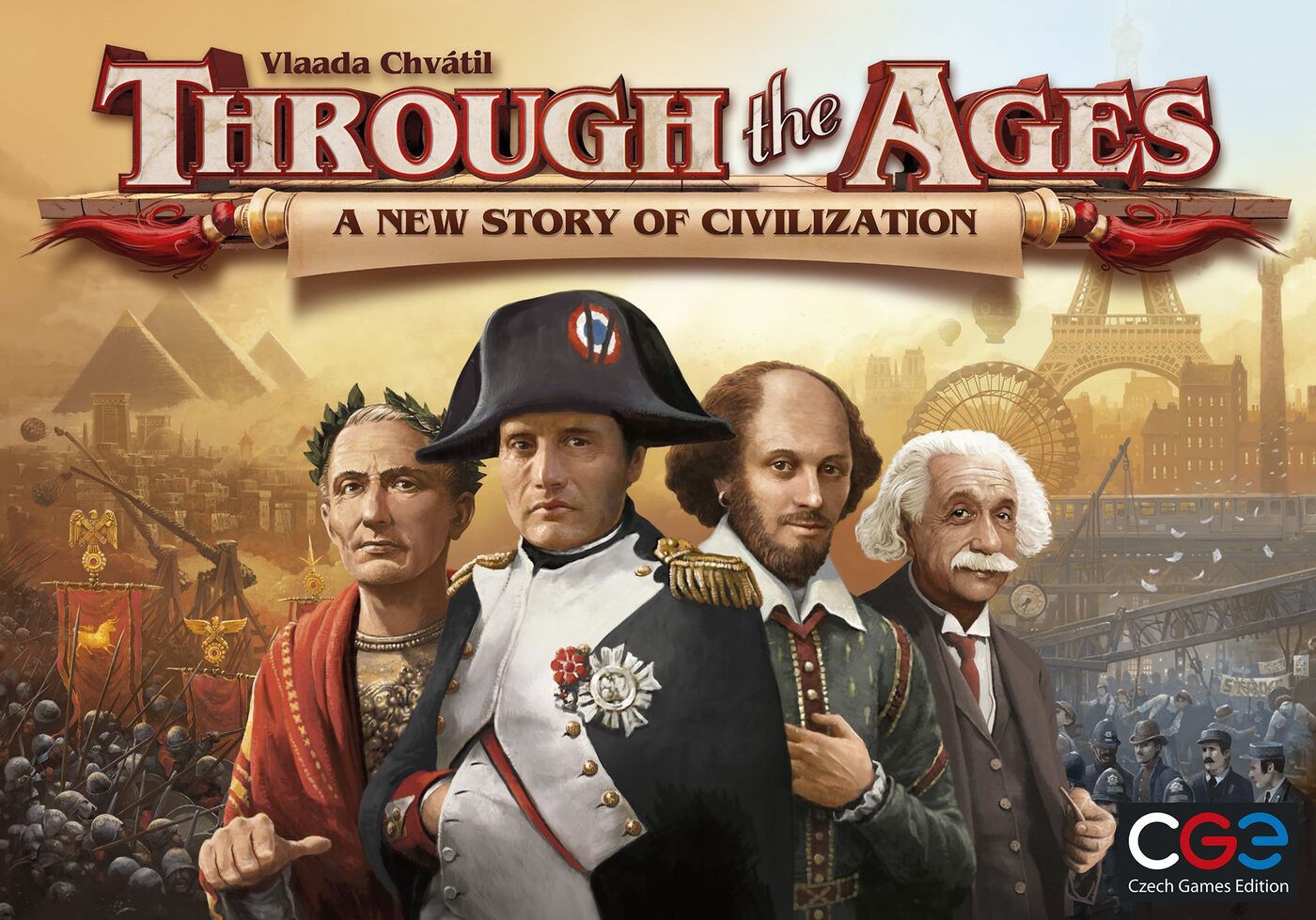
There’s a specific kind of defeat that belongs exclusively to Through the Ages. You spend three or four hours building farms, mines, and temples. You draft Napoleon and feel good about it. You upgrade your bronze-age workers toward iron and feel your civilization beginning to hum. And then the final scores hit, and you’re at 60 culture points while the winner is sitting on 280. You didn’t just lose. You were playing a different game entirely.
That’s the Through the Ages first play. And it’s so reliably disorienting that the game has developed a reputation it arguably doesn’t deserve: deeply rewarding for committed players, structurally hostile to everyone else.
Through the Ages: A New Story of Civilization currently sits at #19 on BoardGameGeek with a rating of 8.24 from over 35,000 players. Weight: 4.44 out of 5 - putting it firmly among the heaviest games in the entire top 20. Vlaada Chvátil designed it. Czech Games Edition publishes it. And it remains one of the most singularly punishing first experiences in modern board gaming.
That’s not a warning to stay away. It’s the setup for understanding what the game actually is - and why play three feels like an entirely different experience.
The Bad First Play: What Actually Went Wrong
Most first plays of Through the Ages share the same autopsy report.
You got hit by military you didn’t see coming. Through the Ages has no map, no territory, no direct combat. So when new players hear “military,” they mentally file it under “optional.” It isn’t. Military in TTA works through aggression cards - players with stronger armies play cards that steal your resources, kill your leaders, drain your population, or force you to discard technologies. You can’t fight back. You can only have built the army before the attack landed. If you didn’t, the card resolves and you absorb the loss.
The brutal part is timing. Aggression cards are cheap to play. Building military takes civil actions and resources. A player who neglects their army entirely can look completely fine on the board - until they’re not.
You ran out of civil actions and didn’t understand why. Civil actions are Through the Ages’ core currency. They govern everything: drafting cards from the card row, playing leaders, building structures, upgrading technologies. You start each age with a fixed number, and the game’s entire action economy is a puzzle about spending them efficiently.
On a first play, civil actions feel abundant until they suddenly don’t. You draft a wonder. You play a leader. You upgrade a farm. And then the turn ends and you’ve accomplished nothing cohesive because you spent your action budget on things that don’t connect.
Age A lasted forever and felt like nothing. The ancient age is Through the Ages at its most administrative. You’re building population, establishing a minimal production base, laying the groundwork for everything that follows. The problem: when you don’t know what you’re building toward, Age A doesn’t feel like foundation-laying. It feels like four players spending 45 minutes drawing cards and moving tokens before the game starts.
One Reddit user described their first play bluntly: “I remember my first two games making some bad early choices and just being way behind for the next few hours. Not the best first impression.” That’s the polite version. The unpolite version involves arriving at Age III with an economy that can’t support the technologies your opponents drafted twenty cards ago.
The Actual Game: What You Were Missing
Through the Ages is fundamentally a game about compounding returns. The technologies and buildings you establish in Age A create the population base for Age I upgrades, which create the production engine for Age II, which determines your culture output in Age III. The game’s entire arc is one long compound-interest problem - and like any compounding system, small differences at the start produce enormous differences at the end.
This is why military isn’t optional. It’s not that you need to win with military. It’s that you need to maintain parity. A player who outpaces you militarily will drain your resources repeatedly, disrupting your compounding chain. The 60-point culture deficit at the end isn’t usually from one dramatic loss. It’s from ten small disruptions that cascaded.
The second layer is the card row. TTA’s card row fills from the right and ages from left to right - older cards cost fewer civil actions to draft. On a first play, most people draft what looks good right now. By play three, you’re watching the card row as a tempo system: what’s going to age into cheap-draft territory soon? What’s your opponent eyeing? What can you afford to let slide?
Then there’s the leaders. On a first play, Napoleon looks incredible - build him, get military bonuses, feel powerful. Experienced players know that leader selection is about synergy with your civilization’s direction, not about what the card says in isolation. Napoleon in the wrong civilization is a wasted civil action. Napoleon in the right one is a game-defining advantage.
The Turning Point: Play Three
The game clicks in a specific sequence. It almost always happens this way.
Play two: You understand the military situation before you start. You track the army tokens throughout. You probably still lose, but now you understand the mechanism that beat you.
Play three: The card row becomes legible. You start watching your opponents’ technologies and reading what they’re building toward. You realize that not every card is equally valuable to every civilization - that drafting the right card at the right time is the core skill, not just grabbing the highest-value option.
At some point in that third play, your production chain actually fires. Farms feed population. Population mans mines. Mines produce ore. Ore builds upgraded structures. The whole engine accelerates. And then you understand why the game is rated where it is.
One player in an r/boardgames thread described it with striking precision: “Through the Ages is one of my few 9+ ratings on BGG. I’ve played about 80 games.” The gap between the first play and that rating isn’t mysterious. It’s just the gap between not understanding compounding returns and seeing them execute.
Worth noting: many players find the digital implementation on Board Game Arena dramatically shortens this learning curve. The app handles bookkeeping automatically, speeds up Age A considerably, and lets you play asynchronously - meaning you can think through your turns without holding up a table. If the first physical play was rough, a few BGA sessions often provide the clarity that a second physical play doesn’t.
The Numbers in Context
BGG weight 4.44/5 means Through the Ages is heavier than Twilight Imperium (4.22), heavier than Gloomhaven (3.86), heavier than Mage Knight (4.35). For reference, it’s sitting alongside games like Food Chain Magnate (4.32) and Pax Pamir (3.89) in the complexity tier.
That weight is accurate - but it’s worth understanding what the weight represents. The rules themselves aren’t especially complicated. Turns follow a clean structure. The cards are largely self-explanatory. The complexity is in decision density: the sheer number of meaningful choices available every turn, and the downstream consequences of each one. First-time players aren’t confused by the rules. They’re overwhelmed by the options.
The player count poll on BGG tells its own story: 3 players is rated Best with 507 votes, 2 players gets Recommended from 453 voters, and 4 players drops significantly (only 131 Best votes). The game runs cleanest at 3. At 4, downtime becomes a genuine concern, and new players staring at a complex card row for 20-minute stretches is a real risk.
Who Through the Ages Still Isn’t For
The second chance framing only makes sense if the investment is worth it for you specifically. For some people, it genuinely isn’t.
If you want a map game, this will feel wrong at its core. There’s no territory to control, no geographic strategy, no expansion arc. The game’s spatial element is entirely abstract - your civilization exists on cards and player boards, not on a shared map. If the appeal of civilisation games is the expansion and conflict over land, you’ll find TTA hollow at the thematic level regardless of how many plays you put in.
If your group can’t commit three to five hours, the maths doesn’t work. Even with experienced players, Through the Ages runs long. With one new player, Age A alone can consume an hour. This isn’t a “once you know it, it’s quick” game - it’s a commitment for every session.
If you want direct drama, the military system may always feel unsatisfying. Attacking someone in TTA feels like submitting a report - you play an aggression card, they absorb the consequence, you move on. There’s no back-and-forth, no reactive defense, no dramatic reversal. The tension is all in preparation, not in execution.
If analysis paralysis ruins your day, the card row in Ages II and III is a genuine source of it. Experienced players can move quickly, but the number of viable options on any given turn is large. If you find heavy decision spaces exhausting rather than engaging, that won’t change with more plays - it’ll just become more familiar exhaustion.
The Verdict
Through the Ages does not apologise for what it is. It’s a four-hour card-driven civilisation simulation that punishes early misalignment severely and rewards dedicated players with one of the most satisfying compounding systems in board gaming.
The first play will probably feel bad. That’s not a bug - it’s the gap between not understanding the game and understanding it. The question is whether you’re willing to cross that gap.
If the compounding engine appeals to you - if the idea of building something across three ages that either fires magnificently or crumbles visibly sounds rewarding rather than exhausting - play it again. This time, track your civil actions deliberately. Maintain military parity before anything else. Watch the card row as a tempo system, not a shopping list.
By play three, you’ll have your answer. Either the engine fires and you understand exactly why this game sits where it does on BGG - or it doesn’t click, and that’s fair information about which direction to look instead.
Most people who gave it a real second chance did not stop at three plays.
Through the Ages: A New Story of Civilization (2015) | Designed by Vlaada Chvátil | BGG #182028 | 2-4 players | ~120-360 min | Weight: 4.44/5 | BGG Rating: 8.24 | BGG Overall Rank: #19