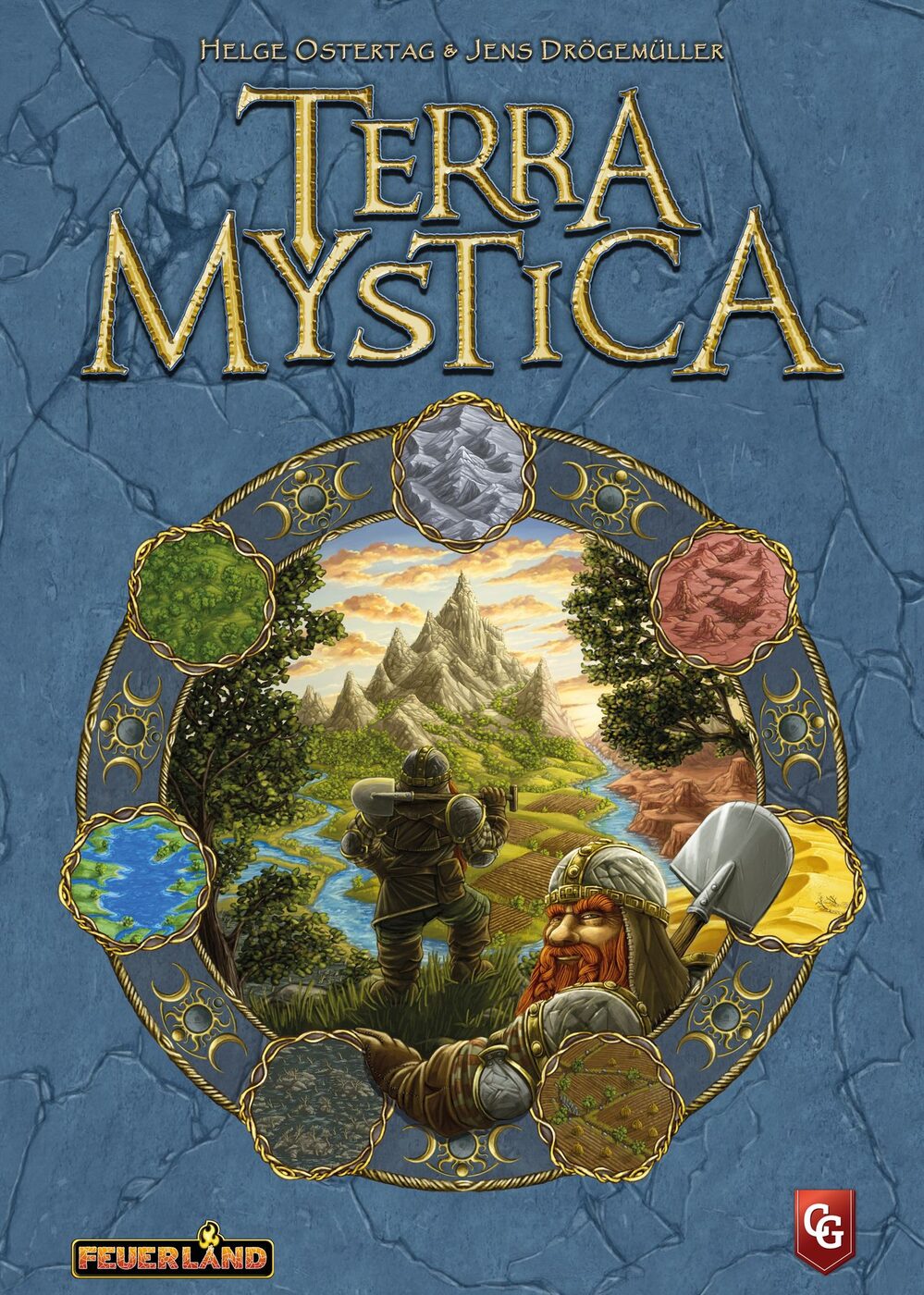
Your first game of Terra Mystica probably ended something like this: you picked a faction because the name sounded cool, spent forty-five minutes unsure whether your terraforming wheel was facing the right direction, accidentally formed a town in round five without meaning to, and finished with a score you could not explain. Someone at the table said “I think we misread the cult track.” You all nodded. Nobody was sure.
Then someone asked if you wanted to play again.
Terra Mystica sits at #36 on BoardGameGeek with a rating of 8.03 from over 46,000 votes. It has a weight of 3.97/5 - heavier than Brass: Birmingham, heavier than Viticulture, heavier than almost everything most groups play regularly. It was released in 2012 and has never left the top 50. The people who love this game really love it.
Play one will not tell you why. Play three will.
The First Play Is Genuinely Confusing
Let’s be clear about something: Terra Mystica’s first-play problems are not you misreading an edge case. The game front-loads an enormous amount of complexity and gives you almost no scaffolding to process it.
You start by choosing from 14 asymmetric factions. Each has different home terrain, different income structures, different special abilities, and different starting resources. For a new player, this choice is paralysing. There’s no “easy faction” label. The rulebook offers no guidance on who to pick first. You either read every faction sheet in detail (adding 25 minutes to setup) or you pick based on which name sounds good and discover mid-game that you’ve been ignoring your faction’s core mechanic.
Once the game starts, the terraforming system creates the next wave of confusion. Each faction can only build on their home terrain. Expanding requires transforming adjacent spaces, which costs shovels, which cost workers or power. The terraforming wheel tells you how many shovels you need to transform one terrain type into another - and it rotates per faction. New players routinely under-terraform (starving their expansion) or waste resources transforming terrain they don’t actually need.
Then there’s the cult track. Four tracks - Fire, Water, Earth, Air - that generate end-game bonuses, unlock priests to advance further, and award points for reaching the highest position in each cult. In a first game, it reads as a side system, something you half-heartedly advance when you have nothing else to do. Seasoned players know it’s actually a tempo race with significant point implications. First-timers learn this during scoring.
The round scoring tiles stack on top of everything else. Each round scores a specific action differently - building dwellings, upgrading to trading houses, advancing on the cult track. These tiles are visible from the start but rarely integrated into a beginner’s plan. Most first games produce a player who spent the whole game building shipping infrastructure on a round that never scored shipping.
By the time end-game scoring kicks in - points for largest connected territory, highest cult track positions, remaining resources - new players are totalling a number that feels detached from every decision they made.
The Turning Point: What Changes on Play Three
The shift isn’t gradual. It’s a specific moment of recognition, and it tends to happen around the third game.
You choose a faction with intent. Instead of picking arbitrarily, you actually read the faction sheet and ask: what is this faction for? The Dwarves tunnel through terrain cheaply - their strategy is low-cost expansion into isolated pockets. The Mermaids advance on the water cult almost for free and build shipping lanes nobody else can match. The Darklings convert workers to priests efficiently, making them cult-track specialists. Each faction has a designed identity. Play one, you ignore it. Play three, you build around it.
The terraforming wheel stops being an obstacle and becomes your edge. Your faction’s home terrain placement on the map isn’t random - it’s a starting position in a spatial puzzle. You’re not just building where you can; you’re choosing where to build based on where your opponents can’t efficiently terraform. Blocking becomes deliberate. Clustering your buildings for town formation becomes a plan, not an accident.
The round scoring tiles become your skeleton. Instead of reacting to what scores, you build backwards from them. Round three scores trading houses? You need to be positioned to upgrade by round two. Round five scores towns? You need three or four buildings clustered and a town tile ready. This is the moment the game’s architecture becomes visible - it was always there, but it takes a few full runs to read it.
The cult track transforms from afterthought to timer. Once you understand that the player who reaches position 10 first gets the highest bonus, and that those bonuses compound, you start planning priest placement. Cults you’ve been ignoring become contested. Suddenly there’s a whole layer of racing and denial you’ve never engaged with.
What the BGG Community Says
The “play three revelation” is one of the most documented phenomena in the Terra Mystica community. BGG forums are full of players who nearly gave up.
One reviewer with 200+ plays described their first game as “a mechanical soup where I knew I was doing things but couldn’t tell if they were good things.” Their second game, they said, felt slightly less opaque. Their third: “Everything snapped into focus. I could see the shape of what I was supposed to be doing.”
The r/boardgames community has a recurring pattern of posts titled “finally got Terra Mystica” - people who played once at a game night, dismissed it, bought a used copy because it was cheap, and played three times in a weekend. Almost universally, play three is where the language changes from “confusing” to “incredible.”
A BGG thread from 2024 titled “Why does TM take so many plays to get?” collected 60+ responses. The consensus: the game requires you to fail at the spatial puzzle before you can understand what the spatial puzzle is. You have to build roads to nowhere before you understand why roads need destinations.
Who It’s Still Not For
More than a decade in, Terra Mystica still has a legitimate audience of people who shouldn’t play it. Being fair about this matters.
If your group plays each game once, Terra Mystica will never pay off. The game’s depth is front-loaded with confusion and back-loaded with mastery. A single play produces one of the weakest board game experiences you can have at that complexity level. It genuinely requires the investment.
If you dislike spatial reasoning, the core loop won’t satisfy you regardless of play count. Almost every meaningful decision in Terra Mystica is geographic - where to build, where to block, where your faction can and cannot go efficiently. Players who prefer economic engines or abstract card sequencing often find the map puzzling in the wrong way.
If analysis paralysis ruins games for your group, 14 asymmetric factions plus variable round scoring plus cult track racing produces a game that can crawl. At 4-5 players with a mix of experience levels, a single game can stretch well past three hours. With experienced players it’s tighter, but the decision space never shrinks.
If you need one right answer, Terra Mystica will frustrate you indefinitely. The optimal faction choice depends on player count, the map configuration, and who else is sitting at the table. There is no evergreen best strategy. That’s the point - but it’s also a dealbreaker if you want a game where mastery produces a reliable path to victory.
A Note on Gaia Project
If Terra Mystica keeps bouncing you off but the concept appeals - asymmetric factions, spatial expansion, heavy strategy - Gaia Project is worth serious consideration. It’s the same designers’ follow-up (BGG #13, weight 4.40), built on a refined version of the same engine with a science-fiction theme. Many players find it slightly more approachable because the research tracks give clearer direction each turn. It’s not simpler, but the feedback loop is more legible early.
Some people play Gaia Project first, then come back to Terra Mystica and find the original clicks faster for having the framework.
The Verdict
Terra Mystica is a game that treats play one as a tutorial you have to discover yourself. The rulebook will teach you the rules. It will not teach you how the systems interact, why the cult track matters, or how faction selection shapes everything that follows. That knowledge costs three plays - and you won’t feel like you’re learning during those plays. You’ll feel like you’re confused, doing it wrong, and vaguely losing.
Then play three arrives. The map makes sense. Your faction makes sense. The cult racing makes sense. The round tiles become a framework you can plan around. And you’ll understand, finally, why nearly 50,000 people have rated this game highly enough to keep it in the global top 40 for over a decade.
It’s worth the three plays. Just don’t expect play one to tell you that.
Terra Mystica is published by Feuerland Spiele and Z-Man Games. BGG data current as of August 2026: Rating 8.03/10, Rank #36, Weight 3.97/5, 2-5 players, 60-150 minutes.