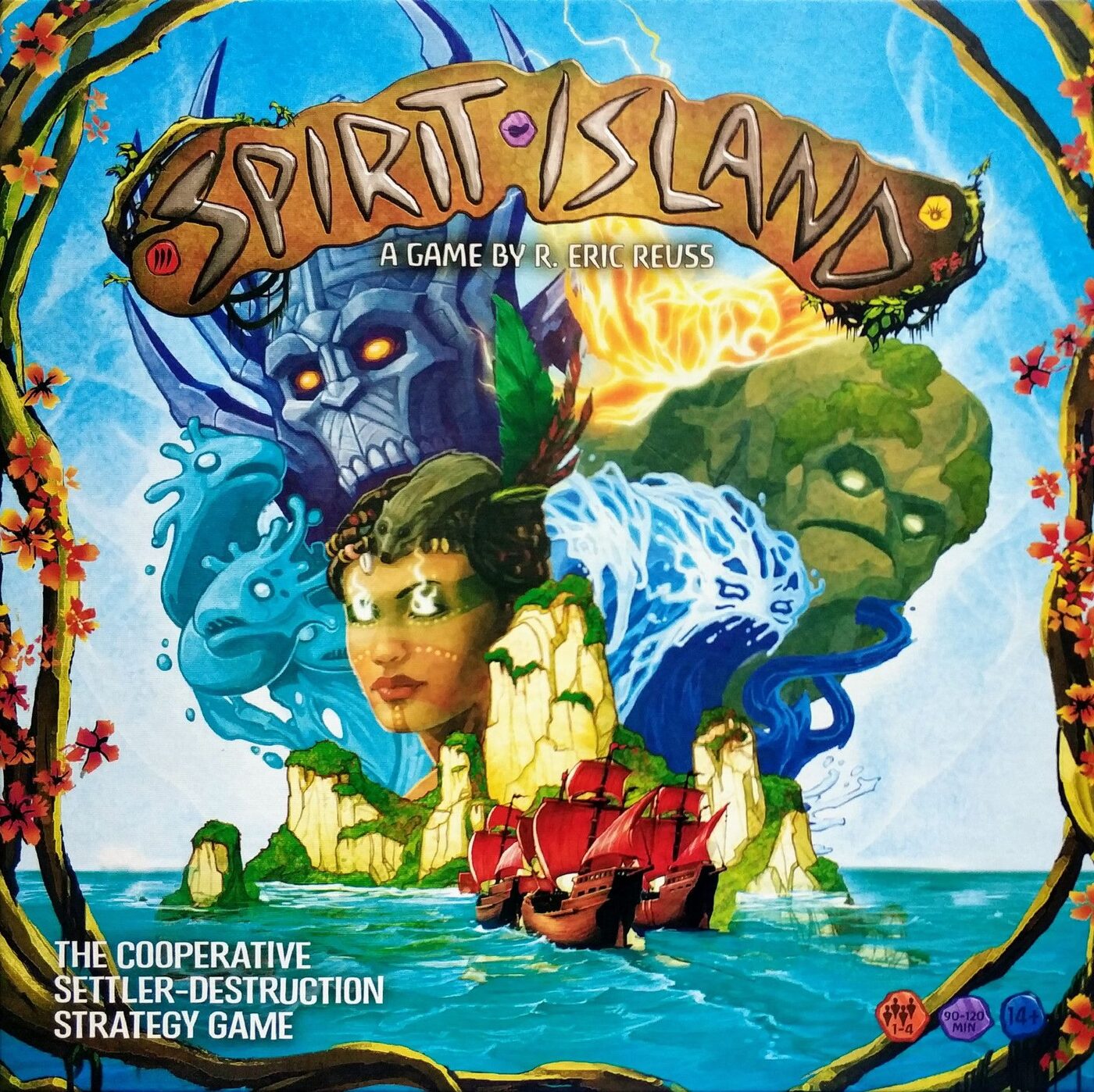
BGG Rank: #11 | Rating: 8.34 | Weight: 4.07/5 | Players: 1-4 | Time: 90-120 min | Age: 13+
Your first game of Spirit Island will probably end in defeat. Not narrow defeat - total, bewildering collapse. The Invaders will spread faster than you expected, your Power cards will feel like they don’t quite connect, and somewhere around the third Ravage phase you’ll realise you’ve been misreading a key rule for the past forty minutes.
You’ll put everything back in the box (which itself takes fifteen minutes), think something along the lines of “well that’s a very complicated game”, and wonder whether the hundreds of BGG users calling this a masterpiece are all just stubborn sunk-cost enthusiasts who refuse to admit they spent £60 on a very hard puzzle.
They’re not. Spirit Island is, on current BGG numbers, the eleventh-highest-rated board game ever published. More tellingly, it earns those ratings from people who have played it a lot - the median Spirit Island owner has played it far more than they play most games in their collection.
But it takes roughly three plays before that picture snaps into focus. This article is about what changes - and whether it’s worth getting there.
The Bad First Play: What’s Actually Happening
Spirit Island is a cooperative game where 1-4 players each control a Spirit - an elemental deity defending a Pacific Northwest island from colonial Invaders. Your job is to drive the Invaders off the board (or destroy them entirely) before they cause too much Blight (environmental damage) or reach certain score thresholds.
That summary makes it sound straightforward. The experience is not.
The rulebook
The base rulebook runs to 36 pages of dense text, and it’s not badly written - R. Eric Reuss is clearly trying to be thorough. But thorough and learnable are different things. The first-play problem isn’t that Spirit Island is poorly explained; it’s that you need to understand the entire system before any individual rule makes sense. The Invader phase (Explore, Build, Ravage) references Blight, which references the Blight card, which references the island setup, which references the Invader deck, which is tied to scenario and difficulty rules you haven’t read yet.
Many veteran gamers describe their learning experience the same way: “I read the rulebook twice, understood about 60% of it, started playing, and spent the first three turns constantly flipping back to sections I’d already read.”
The pace
The island goes wrong faster than first-timers expect. The Explore phase drops new Invader pieces every round. The Build phase grows existing Invader presence. The Ravage phase deals damage to land and Dahan (indigenous people). By round two, sections of the board that looked fine an hour ago are suddenly cascading out of control.
New players almost universally under-respond in the early game. They hold cards, build up Energy, and plan carefully - while the Invaders establish themselves in four different territories simultaneously. Spirit Island punishes caution in a way that feels unjust the first time and obvious the third.
The Spirits don’t obviously connect
Each Spirit comes with a unique power set, a growth pattern, and a set of innate powers that trigger based on the Elements you generate. In theory this is elegant. In practice, your first Spirit feels like you’re playing a game you don’t understand with a ruleset written in a language you’re still learning.
The Innate powers in particular - which fire automatically when you generate enough of the right Elements - seem like bonuses you’ll never consistently trigger. They’re not. By play three, you’ll be building your whole strategy around hitting specific Innate thresholds. But on play one, they’re largely invisible.
The Turning Point: What Changes on Play Three
Most Spirit Island converts pinpoint the same moment: somewhere between plays two and four, the Invader phase goes from “something bad that happens to me” to “a system I can read and manipulate”.
The Explore/Build/Ravage cycle becomes predictable
This is the central mechanical insight Spirit Island doesn’t spell out clearly: the Invader phase runs on a three-turn delay. A Town Explored in round one Builds in round two and Ravages in round three. Once you internalise this, you stop reacting to damage and start preventing it.
The game transforms. Instead of scrambling, you’re looking at the Invader deck, seeing what’s coming, and asking: “which territories will be Ravaged in two turns, and what do I need to place there now to either push Invaders out or reduce the damage?”
BGG forums are full of “it clicked” posts that describe exactly this moment. One of the most common: players realising that Fear cards (which accrue from killing Invaders and certain powers) aren’t just a score tracker - they’re an alternate win condition that shapes how you approach the entire mid-game.
You find your Spirit’s shape
Each Spirit has a natural tempo. Vital Strength of the Earth is slow to build but enormously powerful in the late game. Lightning’s Swift Strike is aggressive and punishing early. Ocean’s Hungry Grasp can drown Invaders before they even land.
On play one, you’re just reading what your cards say. By play three, you’re thinking about how your Spirit’s growth pattern interacts with what the Invader deck is doing - and what your co-op partner’s Spirit can cover that yours can’t.
This Spirit synergy is what experienced Spirit Island players describe as the game’s deepest pleasure. A well-paired pair of Spirits genuinely feel complementary in a way that’s satisfying to discover over multiple plays.
Difficulty becomes a dial you control
The Fear difficulty system - ranging from Intro through to Scenario 6 - means the game scales precisely to where your group is. Struggling? Drop to Intro with two Invader difficulty adjustments removed. Ready for more? Add Scenario rules or a harder Invader deck. Spirit Island veterans often describe having a richer experience at moderate difficulty with a well-understood Spirit than at high difficulty with a new one.
This is invisible on play one, when you’re just trying to survive. By play three, it becomes a genuine source of longevity - you can play the same game for years and still be challenged.
What the Community Says
Spirit Island has an unusually active BGG forum, and the “it finally clicked” thread pattern is remarkably consistent.
The most upvoted summary in the r/boardgames “Recommend Spirit Island?” megathread comes from a user who played five times before loving it: “The rulebook is a wall and the first game is chaos. But I’ve never played anything that makes you feel like you’re actually coordinating with another player’s capabilities rather than just sharing a board.”
BGG’s own session reports show the same pattern. Low initial ratings of 6-7, posted after one or two plays, that get edited upward to 9s and 10s after a run of plays. The game’s BGG rating of 8.34 - extremely high for something this complex - reflects what the long-term player base actually thinks rather than first impressions.
On the solo front, Spirit Island has consistently received Best or Recommended votes in BGG’s solo polls, which is unusual for a game this complex. The solo experience scales down cleanly to one Spirit without feeling like a diminished version of the multiplayer game.
The Counter: Who Spirit Island Isn’t For
The game genuinely earns its reputation, but it’s also genuinely not for everyone. Here’s where it falls flat even for people who give it a real chance:
If you can’t dedicate 2-3 hours, Spirit Island is the wrong game. Setup takes 20-25 minutes for newcomers. Teardown is another 10-15. The game itself runs 90-120 minutes at two players when you know what you’re doing, longer with new players. This is a full evening.
If your group dislikes analysis paralysis, Spirit Island will frustrate them. The decisions are genuinely complex - not artificially so - and some players find that stressful rather than stimulating. The game is not forgiving of rushed choices.
If you want player-vs-player tension, there is none. Spirit Island is purely cooperative. The tension is the board state versus the players. If your group’s favourite moments come from negotiating, bluffing, or direct competition, this doesn’t scratch that itch.
If the theme doesn’t engage you, that matters here more than in most games. Spirit Island is unusually thematic for a game this mechanically complex - the Spirits feel distinct and characterful, the Invader pressure has a specific colonial-resistance narrative that some players connect with strongly. Players who want pure mechanics without a thematic lens sometimes find the game’s 90-minute commitment harder to justify.
The Numbers at a Glance
| Stat | Value |
|---|---|
| BGG Rank | #11 |
| BGG Rating | 8.34 |
| Weight | 4.07 / 5 |
| Players | 1-4 |
| Play Time | 90-120 min |
| Solo | Best/Recommended (BGG polls) |
| Year | 2017 |
| Designer | R. Eric Reuss |
| Publisher | Greater Than Games |
Weight 4.07 is in the top tier of complexity for modern board games. For comparison: Brass: Birmingham sits at 3.86, Ark Nova at 3.80. Spirit Island is heavier than both. That weight is not accidental or poorly designed - it’s load-bearing. The game couldn’t deliver its payoff at weight 2.5.
Is the Climb Worth It?
That depends on one question: do you want a cooperative game you’ll still be exploring after twenty plays, or do you want one you can teach and enjoy immediately?
Spirit Island is firmly the former. It has no business being in the same conversation as Pandemic or Forbidden Island as an entry-level cooperative. It’s a game for people who have already played cooperative games and want one that treats them like adults.
If you gave Spirit Island one play, found it overwhelming, and shelved it - the case for giving it two more is strong, provided you have the right group. The right group means: at least one player who will thoroughly read the full rulebook before the second play, access to the learn-to-play video on Greater Than Games’ YouTube channel (which covers the learning curve far better than the rulebook), and a group willing to start on Intro difficulty without ego.
Play two will still be bumpy. Play three is when the system starts to reveal itself. Most people who clear that bar don’t regret it.
If you’ve played three times and still don’t feel a click - the game might not be for your table. Not every highly-rated game is for every player, and Spirit Island’s demands are real. But if play one was rough and you haven’t gone back: the game you remember is not the game Spirit Island actually is. The first play is the tutorial. The tutorial is hard. The game is worth it.
Spirit Island is published by Greater Than Games. BGG data: Rank #11, Rating 8.34, Weight 4.07 - verified July 2026 via BGG XML API.