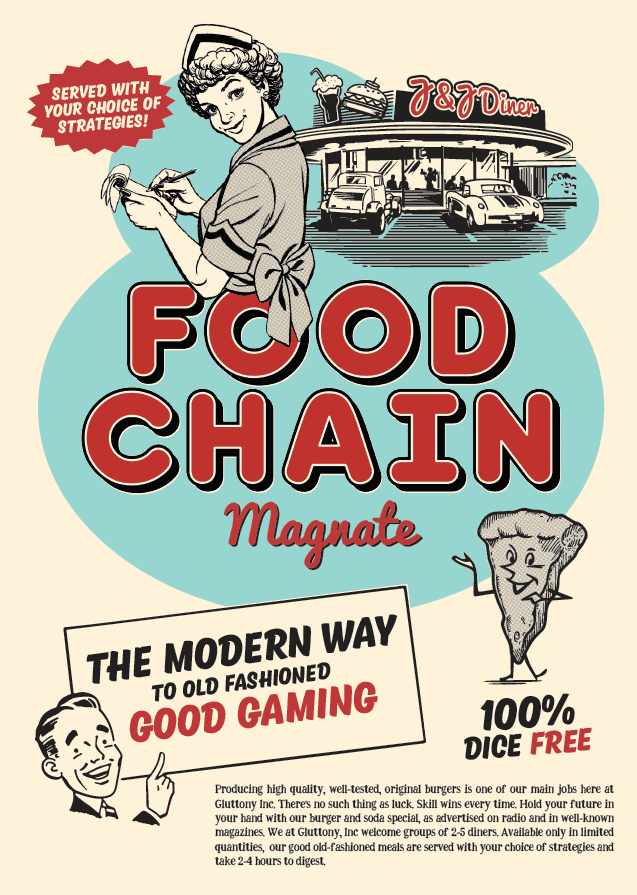
BGG Rank: #51 · Rating: 8.03 · Weight: 4.18/5 · Players: 2-5 · Time: 120-240 min · Designer: Jeroen Doumen & Joris Wiersinga
There’s a very specific kind of board game story that people share in hushed, slightly ashamed tones.
“We played Food Chain Magnate. I ran out of money by round four. My friend had six restaurants up and running. I had one. It was serving nobody. I offered to concede but we didn’t even know if that was allowed.”
This story has happened to thousands of people. The game went back on the shelf. Some sold it. Others kept it out of stubbornness or sunk cost.
Here’s what those people need to hear: your first game of Food Chain Magnate was not the real game. It was a gauntlet you were never meant to survive. And the actual game - the one that has kept it in BGG’s top 60 for a decade - begins when you understand why you lost.
The Bad First Play (What Actually Happened)
Food Chain Magnate drops you into a modular city board where you’re competing to build a fast food empire. You hire staff from a shared pool of trainee cards. You build restaurants. You advertise. Customers materialise and spend money. Last one with money wins.
On paper: clear. In practice: you’re bleeding out by turn three and you don’t know why.
Here’s what actually kills new players, systematically:
The income delay is invisible. There’s no money until customers actively want food AND can reach one of your restaurants AND you have staff to serve them. New players build a restaurant, then wait. Nothing happens. They hire more staff. Still nothing. Meanwhile an experienced player has seeded demand on turn one by training a Marketing Intern immediately, and their first restaurant opened into a city already hungry for burgers.
The payroll is ruthless and immediate. Every employee on your org chart draws salary at the end of every round - whether they did anything or not. A bloated org chart with no revenue isn’t a “growth investment.” It’s a financial death spiral you’ve locked yourself into with no emergency exit.
The rules are clear but the interactions are not. FCM’s rulebook is actually quite good. The problem is that the emergent complexity - what happens when multiple mechanics collide - is learned through pain, not explanation. Experienced players carry a mental model built through 5-10 games. You don’t have it yet. You’re navigating by instruments you don’t know how to read.
Opponents are playing a completely different game. While you’re figuring out how to get a single customer to buy a burger, a veteran FCM player is already executing a known opening sequence, reading your org chart to predict your strategy, and planning a marketing campaign designed to create demand in exactly the neighbourhoods where they have restaurants and you don’t.
The result: a 2-3 hour game where you spend the last hour mathematically irrelevant. Not just losing - structurally eliminated while still technically playing.
That feels bad. It is bad. And it’s also the only way to learn this game.
Why People Don’t Give It a Second Chance
The problem isn’t the losing. Heavy gamers absorb losses. The problem is that Food Chain Magnate shows you almost none of what makes it special during that first game.
The economic warfare. The knife-fight tension when two players are advertising in the same district. The satisfaction of reading an opponent’s org chart and knowing - knowing - they’re about to be stuck with six employees and no customers for two rounds. The genuinely brilliant bank-breaking finale where the entire game’s arc converges on a single cash moment.
None of that exists in game one. Game one is: build thing, generate no revenue, watch money disappear, realise you should have hired a different card on turn one but it’s too late.
The game’s reputation for brutality isn’t wrong. It’s just incomplete. The brutality is the tutorial. The question is whether you’re willing to spend another session learning the actual game hidden inside it.
The Turning Point (Usually Game 3)
The specific moment FCM clicks is different for everyone, but it almost always involves the same realisation: this game has opening theory.
Like chess. Like competitive TCGs. There are known-good first moves in Food Chain Magnate that experienced players execute almost automatically. The marketing intern. The positioning of that first restaurant relative to the board’s residential zones. The specific order in which you build your org chart.
You don’t need to memorise openings - but you need to understand why they exist. And that understanding reframes everything.
Once you see that the game’s first few rounds are a race to establish viable infrastructure before the cash crunch hits, the whole shape of the game changes. You start making decisions differently. You read the board before you place anything. You watch what your opponents hire, because their org chart tells you exactly what they plan to do this round.
The second major click is the demand system. Food Chain Magnate generates customer demand through advertising - planes, radio spots, flyers, TV - and that demand flows across the city grid toward restaurants that sell the advertised item. When you understand that demand creation is the first job, and restaurant placement is the second job, you stop wasting early turns on construction that serves nobody.
The third: the bank. The game ends when the central bank runs out of money. This means the endgame is partially dictated by how fast players are earning. A dominant player who’s hoovering up cash can inadvertently accelerate the ending before slower players can catch up. Managing this - knowing when to push for income and when to let the game breathe - is genuine strategic depth that only emerges once you’re past the basics.
When all three of these things land? Food Chain Magnate becomes one of the most intense economic games ever made. The player interaction is brutal and direct. The reading of opponents is visceral. The satisfaction of a correctly-timed advertising blitz that starves a rival’s restaurant of customers is deeply, specifically satisfying.
What the Community Says
The BGG forums are full of the same pattern. “I almost sold this after the first play.” Then: “We played it three more times and now I understand why it’s ranked so high.”
r/boardgames has a running joke that FCM reviews from first-time players are basically tributes to the dead. The survivor reviews - from players who made it to game three or four - are uniformly, almost suspiciously enthusiastic.
One long-running BGG thread dedicated to FCM first-play disasters ends with the same advice every time: “Don’t judge it. Just play it again.”
Tom Vasel famously published mixed first-play impressions, then walked them back significantly after more time with the game.
Who This Game Is Still Not For
Let’s be direct about the counter.
If your group hates asymmetric outcomes, FCM will leave someone devastated every session. Games where one player is eliminated from contention by the midpoint are a feature here, not a bug. If your table values close outcomes and “everyone has a chance,” this game is structurally incompatible with that.
If you can’t commit to multiple sessions, don’t start. One play tells you almost nothing. If your group can only get together occasionally and every session needs to be a great experience, the FCM learning curve is too steep to justify.
If analysis paralysis is a problem in your group, be cautious. FCM’s decision space is enormous and gets larger as the game progresses. With a slow thinker at the table, a 3-player game becomes a 4+ hour session.
If you want elegance and minimalism, look elsewhere. FCM is deliberately dense and maximalist. The rules are numerous. The interactions are deep. This is a game that rewards players who want to master something, not players who want to sit down cold and have a good time.
The Tonight Test
Can you realistically play Food Chain Magnate tonight?
Only if: everyone at the table has played at least once, you have 3-4 hours free, you’re prepared to play a second game within the next two weeks to consolidate what you learn, and nobody at the table expects a close finish.
If you’ve played once and quit: give it one more session. Brief everyone beforehand about the demand system and the payroll reality. Play faster, accept the chaos, and pay attention to what the person who’s winning is actually doing. That session will be different.
If you’ve never played: find someone who has. FCM benefits enormously from having even one experienced player at the table who can narrate what’s happening and why. Cold starts are recoverable. They’re just slower.
Food Chain Magnate is one of the few games where the gap between “first impression” and “actual quality” is genuinely enormous. The game that crushed you is not the game you’re being invited to play. The real game starts when you understand why you lost.
That’s worth two more hours to find out.
Food Chain Magnate is available directly from Splotter Spellen and select specialist board game retailers. BGG ID: 175914.