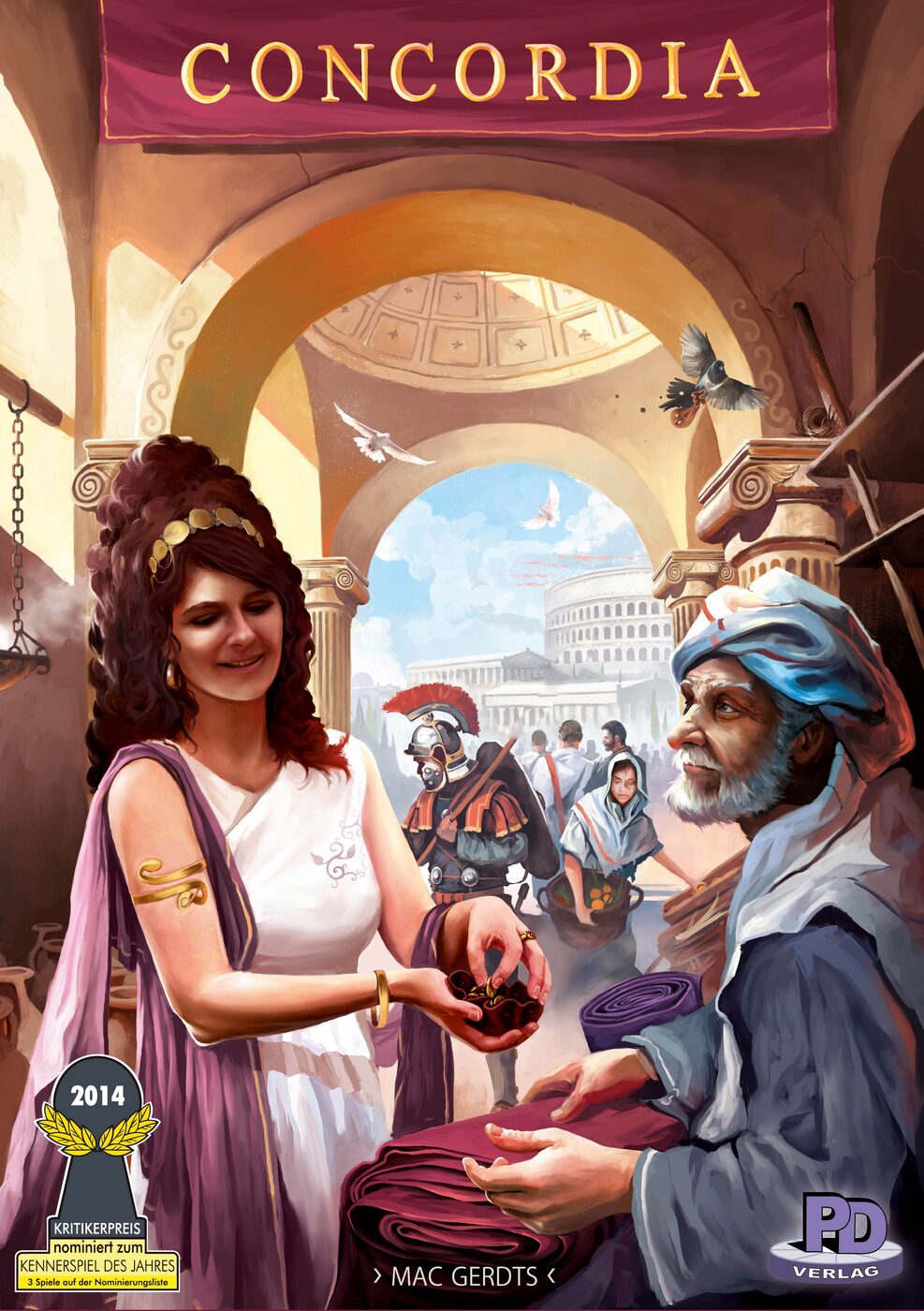
There’s a very specific kind of defeat you can experience with Concordia. You place colonists across the Mediterranean. You build houses in cities. You trade resources. The game ends. Someone announces the scores - and you realise you were last, by a distance, and you have no idea why.
That’s the classic Concordia first play. Not confusing exactly, but hollow. You followed the rules. You did things. And yet the game felt like it was happening around you rather than to you.
Concordia currently sits at #29 on BoardGameGeek with a rating of 8.07 from over 46,000 players. That’s not a niche cult hit. That’s one of the most respected strategy games ever made. So why does the first play leave so many people cold?
The answer is worth understanding - because Concordia is genuinely one of the best games of the last decade. You just have to let it explain itself properly.
The Bad First Play: What Actually Happened
Here’s what the first game of Concordia typically looks like for a new player:
You get dealt five starting cards. Someone explains that each card is an action - you play a card, do what it says, move on. Simple enough. You start building houses and colonists around the Roman empire. You pick up resources. You buy new cards from the board.
And then… it doesn’t feel like much. Your turns are short. Other players seem to be doing similar things. No one is attacking anyone. There’s no obvious score track. The game ends when someone places their last colonist or house - seemingly at random - and then a sudden avalanche of scoring happens that you didn’t see coming at all.
The Concordia card (which you hold in your starting hand) scores 2 points per unique good you’ve produced. The Minerva card scores points per card type you’ve purchased. The Saturnus card scores per city on specific territories. The Venus card is worth points per trade good type you hold at game end. None of this was obvious while you were playing, because the points are invisible until the final tally.
So your first play of Concordia wasn’t a failure of execution. It was a failure of model. You were playing a movement and resource game. Concordia is actually a card portfolio game with a movement and resource system sitting on top.
The Actual Game (What You Were Missing)
The key insight is this: every card you buy does two things. It gives you an action you can play repeatedly. And it shifts your scoring multiplier for the end game.
Take the Mercator card (for example). It lets you trade goods. But it also adds to the count of cards scored by Minerva. The moment you buy a second Mercator, you’re not just getting another trading action - you’re potentially changing whether Minerva is worth buying later. Every card purchase is simultaneously a strategic action and a commitment to a scoring direction.
This is why Concordia punishes conventional Euro thinking. In most games, you take the action that moves you forward right now. In Concordia, you take the action that moves you forward right now and builds the scoring engine you want to have when the game ends. Those two things are often pulling in different directions.
The second invisible layer is hand management. Your hand starts at five cards. When you play a card, you can’t reuse it until you play Tribune (a specific card that retrieves your discard pile). So the question isn’t just what action do I take - it’s what action do I take right now, given that I’ll need to Tribune in three turns, and I want my remaining hand to be useful until then.
Once you see both of these systems, the game snaps into focus. Other players’ moves stop looking random. You can see why someone bought a fourth Colonist card (building towards a Saturnus score), why someone is staying near the western map (Venus goods are clustered there), why someone Tribuned early even though they had cards left. The whole board becomes legible.
The Turning Point: When It Clicks
Most players report the game clicking somewhere between play two and play four. The turning point isn’t learning the rules better - you already knew the rules. The turning point is shifting how you observe the game state.
Play two: you start noticing other players’ card portfolios. You’re not reading them as a threat (there’s minimal direct conflict), but as a signal. What scoring path are they building toward? What’s their Tribune rhythm? Is there tension on Saturnus-scored cities?
Play three: you stop evaluating cards by their actions and start evaluating them by their scoring contribution. A Senator (which lets you buy a card from the board) becomes the most flexible card in the game - it’s not just a shopping action, it’s a late-game pivot tool. You can wait to see what scoring direction becomes viable, then buy into it.
BGG user Kniziaholic put it well in a forum thread: “I thought Concordia was a dry, mechanical euro where nothing happened. Now it’s one of my top five games. The game is the same. I changed.” That sentiment - embarrassingly common in Concordia’s community - is the whole story.
Another frequent observation on r/boardgames: “I felt like I was in last place the entire game, then somehow came second. And I still don’t understand how.” That’s not a sign the game is broken. That’s a sign the scoring is genuinely multi-dimensional - what looks like a lead on the board isn’t necessarily a lead in the portfolio.
What Changes on Each Play
Play 1: You follow the rules correctly and feel vaguely disconnected from the outcome. The scoring announcement at the end is a surprise - probably an unpleasant one.
Play 2: You understand the scoring structure before you start. Now you’re trying to execute it - but probably too rigidly. You pick a scoring path (Saturnus cities, say) and tunnel-vision toward it, missing better opportunities.
Play 3: You start reading the game state. You notice card portfolio conflict with other players. You start thinking about the Tribune rhythm - when to recall, how much to extend before you need to cycle. You feel like you’re actually playing Concordia for the first time.
Play 4+: The game opens up completely. You can evaluate map tension, card board states, and scoring trajectories simultaneously. The deceptively short turns start feeling rich with decision space. This is where Concordia reveals itself as a genuine masterwork.
The Numbers Say Something Important
BGG weight: 2.98 out of 5. That’s medium-heavy - heavier than Wingspan, lighter than Brass: Birmingham. But the experience weight on the first play is much higher than the mechanical weight suggests, because the game’s scoring system doesn’t reveal itself incrementally. There’s no VP track. There are no intermediate scoring rounds. The entire payoff is deferred to the final tally.
This is pedagogically unusual. Most modern euros give you feedback loops - you score points, you see the scoreboard, you adjust. Concordia gives you almost no mid-game feedback. Your moves might be brilliant or terrible, and you won’t know for 90 minutes. For players conditioned by games with visible progress, this feels wrong. For players who learn to read the board state instead of the score track, it’s the whole appeal.
The 46,000+ ratings at 8.07 represent one of the most favourable review distributions on BGG - very few 1s and 2s from people who understood the game, and very few 8s and 9s from people who bounced off it entirely. Almost everyone who got Concordia loves it. Almost everyone who didn’t get it stopped playing.
Who Concordia Still Isn’t For
The second chance framing only makes sense if the game is worth giving a second chance to. For some people, it genuinely isn’t.
If you need conflict and drama, Concordia will disappoint you structurally. There’s area pressure (two people can’t colonise the same city space), but no combat, no attack actions, and minimal direct blocking. The tension is about resource efficiency and card portfolio divergence, not confrontation.
If you find the theme thin, fair point. The Roman Mediterranean setting is aesthetic backdrop, not integrated story. The cards depict Roman gods as action-enablers. There’s no narrative arc. Concordia is pure mechanical puzzle wearing a toga.
If you want fast feedback, the deferred scoring is a feature for some and a genuine flaw for others. If you like knowing where you stand as you go, Concordia’s opacity isn’t a learning curve - it’s a permanent characteristic.
If you’re a 2-player household, Concordia plays fine at two, but the map pressure and card board competition are meaningfully different from 3-5. The higher player counts are where the game shines. At 2, you’re almost playing a different game.
The Verdict
Concordia is a game that asks for patience it doesn’t announce upfront. On first play, it looks like a pleasant but shallow trading euro. By play three, it’s revealed as one of the most elegantly constructed strategy games in the hobby.
The specific things that make the first play awkward - invisible scoring, deferred feedback, short turns with no obvious impact - are exactly the things that make it profound once you understand them. The game isn’t hiding what it is. It’s just waiting for you to look at it properly.
If you played it once and felt nothing, that’s the most common Concordia experience there is. Give it a second play with the scoring structure written on a reference card in front of you. Watch the other players’ card portfolios. Count the Tribune cycles.
By game three, you’ll understand why it’s ranked #29 in the world.
Concordia (2013) | Designed by Mac Gerdts | BGG #124361 | 2-5 players | ~100 min | Weight: 2.98/5 | BGG Rating: 8.07