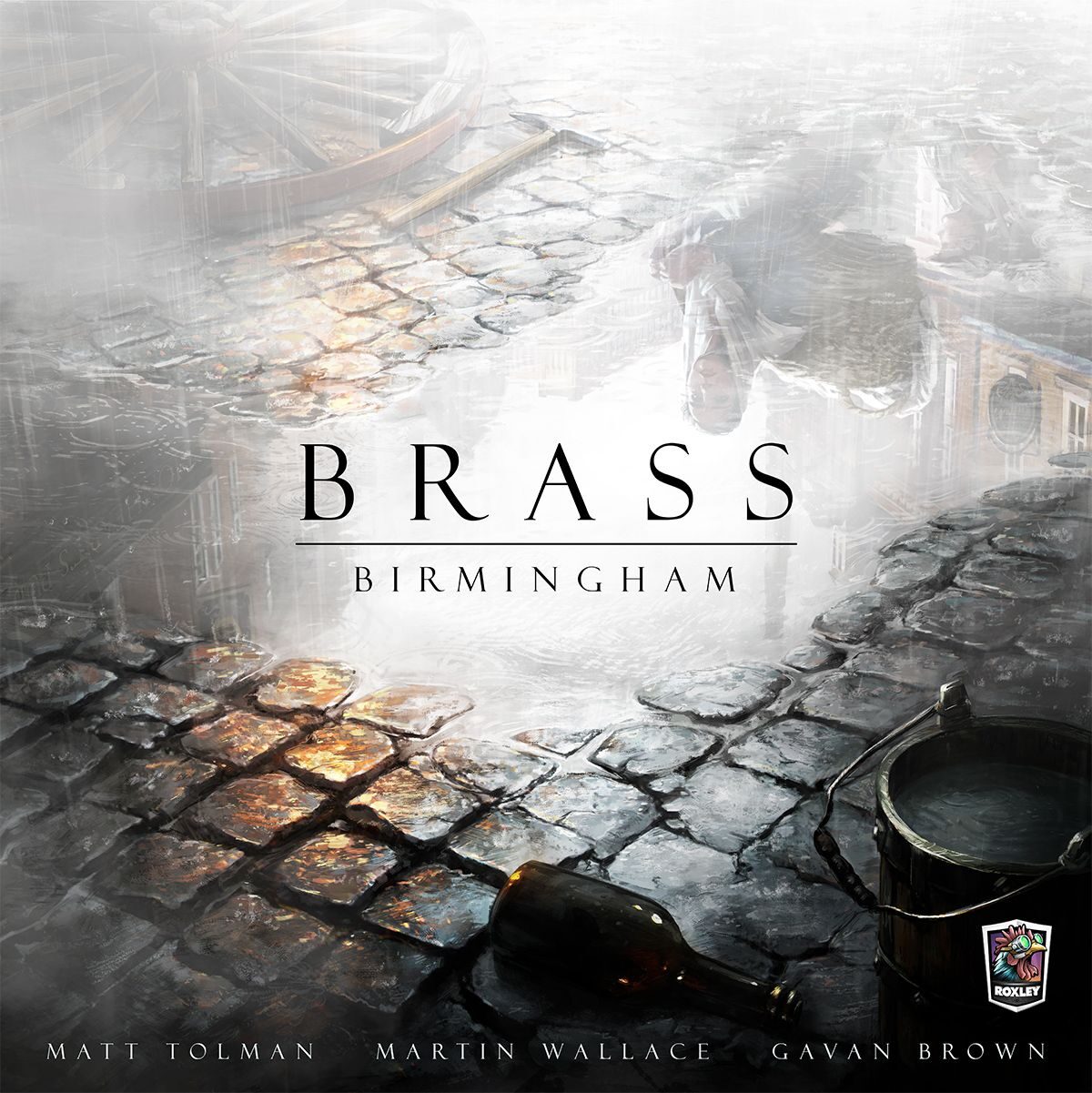
You sit down to play Brass: Birmingham for the first time. Someone reads the rules. You build something. It gets removed. You try to connect to a city. Someone else already took it. You end the game with no idea what you did, what your score means, or why the winner is smiling like they just solved a proof.
You probably never want to play it again.
Then a friend convinces you to try it one more time. And again. And somewhere around play three, the whole board shifts into focus - and you realise you’ve been playing the best game of your life.
This is the Brass: Birmingham experience. And it is remarkably common.
The Stats First
| BGG Rank | #1 overall |
| Players | 2-4 |
| Time | 60-120 minutes |
| Weight | 3.86 / 5 |
| Rating | 8.56 / 10 |
| Designer | Martin Wallace (original Brass), reimplemented by Gavan Brown, Matt Tolman, and Lynden Sadler |
| Year | 2018 |
Brass: Birmingham is the reimplementation of Martin Wallace’s 2007 Brass, set in the industrial English Midlands during the 18th and 19th centuries. You’re building a network of industries - cotton mills, coal mines, iron works, breweries, potteries, and manufacturers - over two distinct historical eras. The Canal Age. Then the Rail Age.
At the end, the player who most cleverly invested in connected, high-value industries wins.
Simple enough in concept. Ferocious in practice.
Why the First Play Is Genuinely Awful
Let’s be clear about what actually goes wrong, because it’s specific and diagnosable.
1. You Don’t Know What the Board Is Telling You
The Brass: Birmingham board is dense. There are merchant tiles at cities, connection links, city slots, industry spaces, merchant demand icons, and coal/iron supply tracks all competing for your attention. First-timers stare at it like a map of somewhere they’ve never been and can never visit.
The rules explain every element correctly. They just don’t explain why you’d care. New players often spend their first game building things without understanding the scoring geometry that makes one industry placement worth triple another.
2. The Two-Card Discard Rule Feels Punitive and Arbitrary
Every turn, you spend two cards to build or connect - one to identify a city you can act in, one to pay for the action. You can also discard a card to take an action in any city you’re already connected to. This dual-use card system is elegant. On turn one, it feels like your hand is constantly wrong.
Players routinely end their first game convinced the card system is broken. It isn’t. It’s one of the cleverest hand management mechanics in the hobby. But it takes repetition before that registers.
3. You Don’t Realise You’re Playing Two Separate Games
The Canal Era and the Rail Era aren’t just “phase 1 and phase 2.” They are fundamentally different games on the same board, scored separately, and requiring almost opposite strategic thinking. In the Canal Era, you can only connect to your own networks. In the Rail Era, you share links. Players who don’t understand this spend the Canal Era building for the Rail Era. That’s a catastrophic misread that torpedoes the game before it starts.
4. Coal and Iron Dependencies Are Invisible Until They Hurt You
Building an iron works requires coal. Building rail links requires coal and iron. These resources come from board tiles - yours or your opponents’. The dependency web isn’t complicated once you see it. But on a first play, players routinely plan two actions ahead only to discover the coal they expected to use was consumed by someone else’s build. The resulting paralysis is real.
The BGG Forum Verdict on First Plays
The Brass: Birmingham forums on BGG are full of “help, I hated this game” posts - followed by a wave of replies from converted fans who felt exactly the same.
“After our first play my group said never again. We played again three weeks later because one person wanted to try. Now it’s our most played heavy game.”
“First play I scored about 40 points and had no idea what I was doing. Third play I scored 140 and could see the whole board at once. I can’t explain what changed except that something just clicked.”
“The canal era is the tutorial, even if it doesn’t feel like one. By game three you start to see it.”
Over on r/boardgames, the game’s second-impression reputation is practically its own meme:
“Brass B is the game most people quit before they get good at it. Those who push through all seem to describe the same moment - when the board stops being confusing and starts being a puzzle they can actually solve.”
This isn’t just confirmation bias from fans. It reflects something structural about how Brass teaches itself - or rather, how it doesn’t. The game has no entry ramp. It drops you into the deep end and waits.
The Turning Point: What Clicks and When
Most players report the shift happens somewhere between game two and four. Here’s what actually changes:
You start reading the merchant tiles correctly. Those demand icons at merchant cities - cotton, pottery, manufactured goods - tell you where industries score when they sell. Players who understand this in game one are already playing a different game. Once you read demand before placing anything, your opening turns transform.
You stop building for building’s sake. Every tile you place costs cards. Every link you build costs cards and resources. Beginners over-build because placing things feels like progress. Experienced players are ruthlessly selective. The shift is from “what can I do?” to “what should I do, and what should I let my opponents do for me?”
You start using your opponents’ coal. This is the mental model that separates beginners from intermediate players. Their coal mines exist to fuel your builds. Consuming their resources depletes their tiles faster, accelerating your scoring. It’s not a trick - it’s a core mechanic. But it requires a kind of lateral thinking that first plays rarely reach.
The Canal Era stops feeling like a throwaway. Experienced players treat the Canal Era as a precision instrument: build exactly what you need, develop tiles to level 2 for higher-value replacements in Rail, leave the board positioned for your best opening in Era 2. Beginners treat it as a confusing warm-up. Once it becomes deliberate, the whole game changes texture.
Who Should Still Give Up
This section matters. Brass: Birmingham is not for everyone, and the “just try it again” advice has limits.
If you dislike heavy cognitive load for its own sake, the game won’t convert you. There’s no narrative cushion, no theme-based luck, no catch-up mechanism. It’s a pure optimisation puzzle. If that isn’t inherently fun to you, play four times and it will still feel like homework.
If your group has one player who doesn’t want to engage with the ruleset, the group experience degrades significantly. Brass requires all players to understand the board state. A disengaged player blocks city slots, misconsumes coal, and collapses the strategic depth that makes the game excellent. No amount of replays fixes a group mismatch.
If you’re exclusively a 2-player household, be warned: Brass: Birmingham plays well at 2, but it’s a different (and many would say lesser) game than at 3 or 4. At lower counts the board is more open, resource denial matters less, and the competitive tension loosens. If 2-player is your primary format, Brass: Lancaster or 7 Wonders Duel might be a better investment.
If setup and takedown time are genuine constraints - young kids, limited gaming windows, a group that wants to play two games in a night - this probably isn’t your jam. Setup is not especially long, but the game demands mental engagement that makes it feel like a commitment. It earns that. It’s just not a casual drop-in.
How to Make Your Next Play Better
If you’re going back in, try these before you sit down:
Watch a 15-minute teach video, not a full playthrough. The specific concepts to understand before play: merchant demand tiles (what triggers scoring), the two-era structure (why Canal strategy and Rail strategy are different), and the card-spend rule (why you spend two cards per turn). You don’t need to know combos - just these three things.
Play your first game as a learning game. Say it out loud. “We’re going to play this wrong in interesting ways.” Remove the pressure and you’ll absorb far more.
Read the board before your first action. Where are the merchant demand tiles? What cities connect to which merchants? What does your hand of cards tell you about where you can actually build? Two minutes of reading at game start replaces two hours of confusion.
Don’t race into the Rail Era. Beginners rush their Canal builds to “get to the good bit.” Canal Era positioning is the good bit. Every high-value Rail Era play is seeded by Canal decisions.
The Verdict
Brass: Birmingham is a game that trusts players to meet it halfway. It offers no tutorial, no training wheels, no narrative hand-holding. In exchange, it delivers one of the most satisfying strategic experiences in the hobby - the sensation of a complex system clicking into place, move by move, until you’re reading three turns ahead and placing tiles with precision.
The first play is often bad. Sometimes genuinely off-putting. That’s not a flaw in the game’s design - it’s a feature of its depth. Games this rich can’t be simple on arrival.
If you bounced off Brass: Birmingham once, it almost certainly deserves another shot. The players who pushed through almost unanimously land on the same side of the fence.
BGG #1 for a reason. It just takes a few plays to find out why.
Weight: 3.86 / 5 · Players: 2-4 · Time: 60-120 mins · BGG Rank: #1
View on BGG