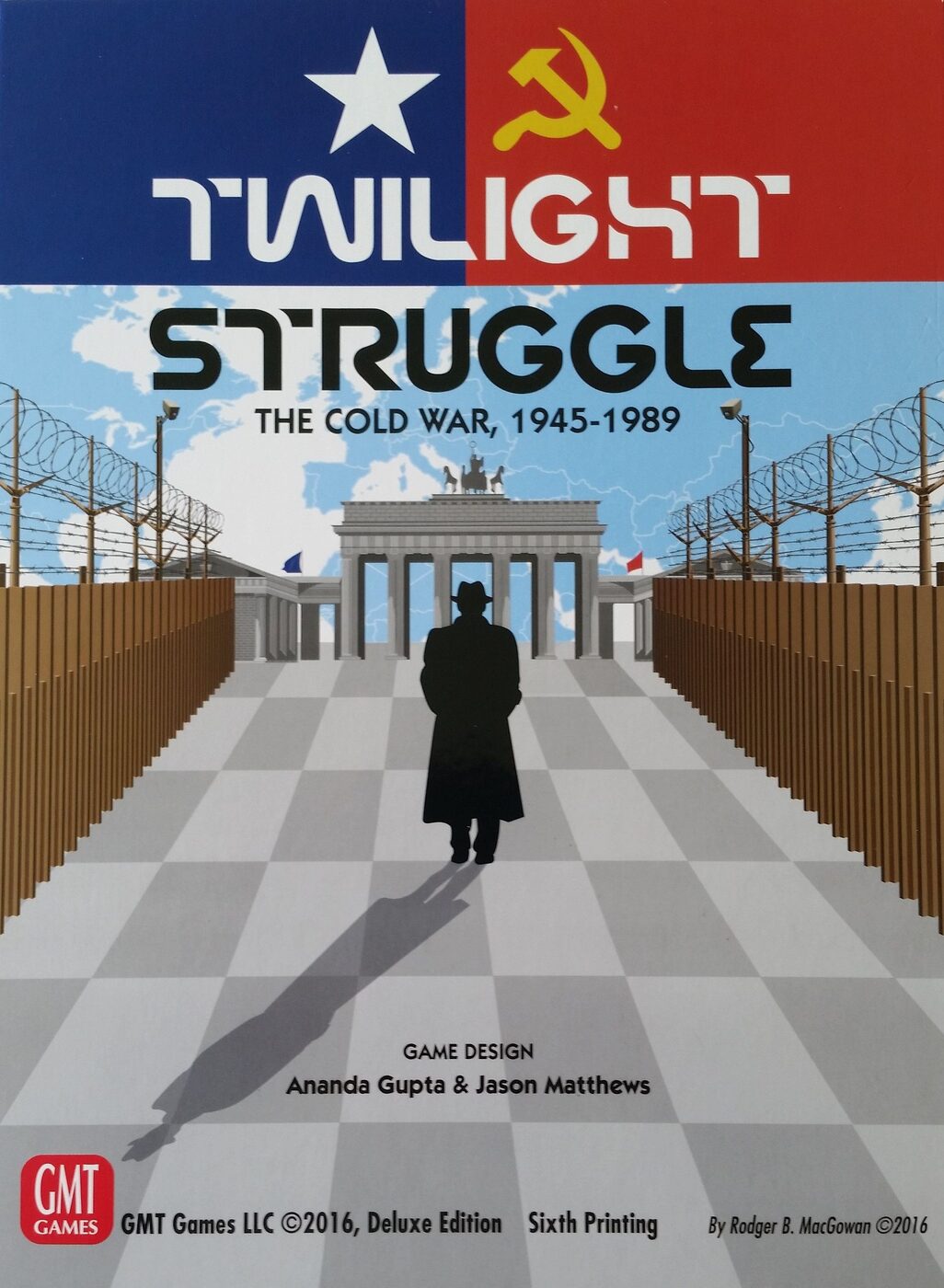
There is a specific kind of board game reverence reserved for Twilight Struggle. Ask a serious hobbyist which games changed how they think about design, and it almost always comes up. Ask them when they last played it, and the answer is usually a long pause followed by “a few years ago.”
That gap between reputation and table presence is worth examining. Twilight Struggle was published in 2005 by GMT Games. It sat at the top of the BGG rankings for the better part of six years - from around 2010 to 2016, it was literally the highest-rated board game on the planet. In 2026 it ranks #16 with an 8.22/10 from 52,429 ratings. That is not a game people have forgotten. That is a game people still respect enormously, just play slightly less often.
So does it still hold up? And if you have never played it, should you bother?
The answers are: mostly yes, and emphatically yes - with the right partner.
What it actually is
Twilight Struggle is a two-player card-driven game simulating the geopolitical struggle between the US and USSR from 1945 to 1989. One player leads the Americans. The other leads the Soviets. You are fighting for influence across regions - Europe, the Middle East, Asia, Central America, South America, Africa - without ever going to open war. Because open war means nuclear annihilation, and the whole DEFCON track is there to remind you that pushing too hard can literally end the game (and the world) in your own defeat.
The game lasts 10 rounds divided into three historical eras: Early War, Mid War, and Late War. Each round, players draw a hand of cards and choose their actions carefully, because every card in the deck has two faces: an Operations value (which you use to place influence, coup unstable countries, or attempt realignments) and a historical Event (which triggers its described effect, for whichever side it belongs to). Use your opponent’s card for its Operations value and you trigger their Event anyway. It is a constant, grinding negotiation with your own hand.
That is the core tension that makes Twilight Struggle special. No card is simply good or simply bad. Every decision about what to use and when ripples outward.
The mechanics that still sing
The headline phase deserves particular credit. At the start of each round, both players secretly choose one card to play as the Headline - these resolve simultaneously, higher Ops value going first, before the actual turns begin. It is a deceptively simple mechanism that creates enormous pre-turn calculation and the odd devastating ambush. You think you have read the board correctly. Then their headline fires and everything shifts.
The DEFCON track is similarly brilliant for what it does to player behaviour. Nuclear war is a loss condition for whoever caused it, so pushing the world toward crisis is a weapon - but only up to the point where you can no longer control the escalation. Coups in battleground states lower DEFCON. Low DEFCON restricts where coups are even legal. By Late War, both players are often tiptoeing around mutual destruction while trying to tip decisive regions their way. The political simulation embedded in that single six-step track is remarkable.
The historical cards themselves are a third source of the game’s appeal. The events are real: Truman Doctrine, Korean War, Suez Crisis, Cuban Missile Crisis, the Space Race, SALT Negotiations. Playing through a game of Twilight Struggle is a compressed, sometimes uncomfortably recognisable tour through the 20th century’s great anxieties. You stop thinking of influence in purely abstract terms. The map starts to feel like a map.
What has aged less gracefully
Two things, and both are worth flagging clearly.
First, the setup time and rules overhead. Twilight Struggle sits at a BGG weight of 3.62 out of 5, which feels right. It is not the heaviest game on the shelf, but the learning curve is front-loaded in a particular way. The card knowledge matters enormously. A new player will frequently play into their opponent’s hands simply because they do not know what events are in the deck. This does not make the first game bad, but it does mean the first game is partly a tutorial - and a 2-3 hour tutorial with a new opponent is a real commitment.
The Deluxe Edition, which added clearer components and slightly revised cards, softened some of the friction. But the fundamental reality is that Twilight Struggle rewards expertise. The tenth game is a richer experience than the first by a significant margin.
Second, there are occasional card-driven “feel bad” moments where your hand is simply poor and your options are all bad trades. Card-driven games live or die by how players frame variance, and Twilight Struggle’s variance can occasionally feel punishing rather than tense. Experienced players tend to manage this through tighter scoring timing and knowing which battles to abandon early. New players sometimes just feel stuck.
Neither of these is fatal. Both are real.
The digital version
It would be slightly negligent to review Twilight Struggle in 2026 without mentioning the digital edition, which is available on PC, iOS, and Android. For most people, this is where Twilight Struggle lives now.
The digital version is genuinely good. The AI provides a reasonable introduction, the async multiplayer is well-suited to a game with this much deliberation per turn, and the app handles the bookkeeping (influence tracking, DEFCON, card resolution) cleanly. If the idea of a 3-hour physical setup puts you off, the digital version removes that obstacle entirely. It also removes the card-knowledge gap somewhat, since the app lets you view all events and their effects without shuffling through the deck.
The trade-off is that you lose the table presence - the feel of pushing influence markers around a physical Cold War map with another person across from you. That particular experience is part of what made Twilight Struggle a generational game for many players. The app is convenient; the physical game is an event.
The verdict
Twilight Struggle is one of the few games that can credibly claim to have changed what board gaming is capable of. Its combination of card management, historical grounding, and mutual deterrence created a template that still influences design twenty years later. The BGG rank of #16 - maintained across two decades - is not nostalgia. It reflects a game that delivers a genuinely distinctive experience unavailable elsewhere.
Who should play it: Two-player households with a taste for historical strategy and the patience to learn together. People who enjoy negotiation, card management, and geopolitical tension. Anyone curious about card-driven games and looking for the most celebrated entry point. The digital version is excellent for getting started before committing to the physical edition.
Who might want to pass: Groups wanting something that works cold with no prior knowledge and delivers immediate satisfaction. Anyone put off by 2-3 hour two-player games. Players who find variance in card games frustrating rather than challenging.
The core question of every retro-review is whether the game deserves its reputation or merely coasts on legacy. Twilight Struggle deserves it. It is demanding, occasionally pitiless, historically evocative in a way few games manage, and still capable of producing genuinely tense moments after decades in the hobby’s memory.
The Cold War ended in 1989. The game that simulates it still has life in it.
Twilight Struggle - BGG #12333 · 2 players · 120-180 min · Weight 3.62/5 · Rating 8.22/10 (52,429 ratings) · Rank #16
Box art © GMT Games, via BoardGameGeek.