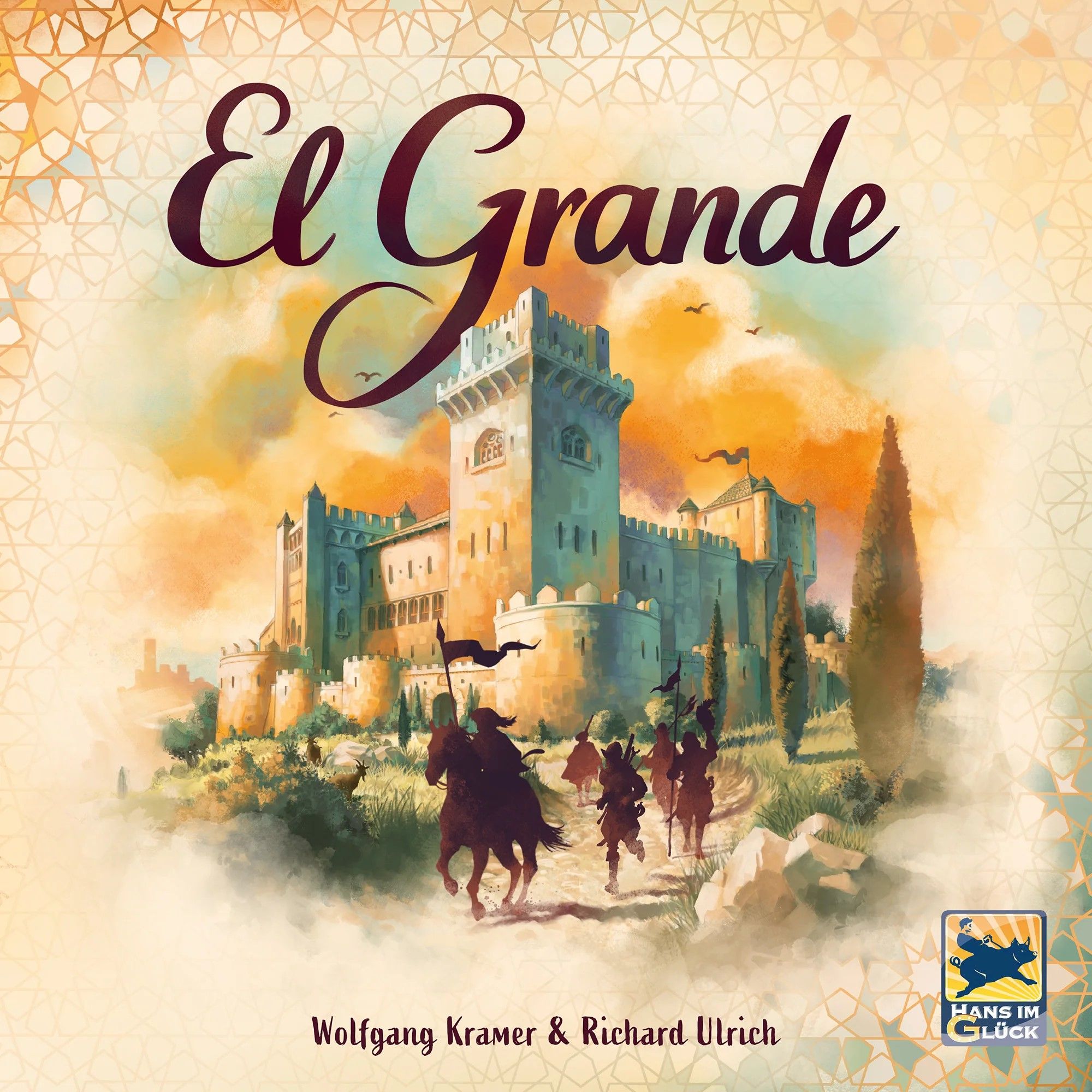
Some games age like fine wine. Others age like milk someone forgot in the back of the fridge. And then there’s El Grande - a game that somehow ages like stone. It was a monument when it arrived in 1995, and thirty years later, it’s still standing.
Wolfgang Kramer and Richard Ulrich’s masterwork didn’t just win the Spiel des Jahres in 1996. It didn’t just sit in the BGG Top 10 for over a decade. In 2025, it was inducted into the BoardGameGeek Hall of Fame - a recognition that this isn’t just a good game, it’s a historically important one.
But does historically important mean actually fun to play in 2026? Let’s find out.
The Pitch
Medieval Spain. The king’s power is fading. You’re a Grande - one of the powerful lords fighting for control of nine regions across the Iberian Peninsula. You draft caballeros into your court, deploy them to regions, and try to outnumber everyone else when scoring rounds hit.
That’s it. That’s the game.
No combat dice. No card combos that chain for fifteen minutes. No asymmetric player powers. No miniatures. Just pure, crystallised area control. You put your people in places, and you try to have more people in more places than anyone else.
At a Glance
| Category | Details |
|---|---|
| BGG Rating | 7.77 (#102 overall) |
| Strategy Rank | #78 |
| Weight | 2.93 / 5 |
| Players | 2-5 (best with 5) |
| Play Time | 60-120 min |
| Designers | Wolfgang Kramer & Richard Ulrich |
| Year | 1995 |
| Awards | Spiel des Jahres 1996, BGG Hall of Fame 2025 |
A weight of 2.93 puts it squarely in “medium” territory - heavier than gateway games, lighter than the Lacerda shelf. This is significant. Modern area control games tend to pile on complexity (looking at you, Twilight Imperium). El Grande proves you don’t need it.
How It Works
Each round follows a beautifully simple rhythm:
1. Bid for turn order. Everyone simultaneously plays one of their 13 numbered power cards (1-13, each used only once across the entire game). Higher numbers go first but recruit fewer caballeros from the provinces into your court. Lower numbers go later but fill your reserves. It’s a constant tug-of-war: do you want priority or resources?
2. Pick an action card. Five action cards are revealed each round. In turn order, you choose one, execute its action, and deploy caballeros from your court to regions on the board. The catch: you can only place into regions adjacent to wherever the king currently stands. One permanent card always lets you move the king - often the most powerful play in the game.
3. Scoring. After rounds 3, 6, and 9, every region scores. First place gets the big points. Second gets less. Third gets scraps. And then there’s the Castillo - a literal tower on the table where you secretly stash caballeros, revealed during scoring and deployed to a region you’ve selected on your hidden dial.
That’s three mechanics interacting - bidding, card selection, and area majority - and from them, an enormous decision space emerges.
Why It Still Works
The Power Card System Is Genius
The 13 power cards are the engine of the entire game. You start with all 13, and each is single-use. Spend your 13 early for a dominant first round, and you’ll be picking last for the rest of the game. Hoard your high cards, and others will control the early tempo.
This creates a meta-game that evolves naturally. In a five-player game, everyone’s tracking who’s played what. “She still has her 12 and 13.” “He burned his 11 on round two - he’s running on fumes.” It’s hidden information that becomes deducible, and it generates tension without any randomness.
The King Constraint Is Brilliant
You can only place caballeros adjacent to the king. Moving the king - via the ever-present action card - isn’t just a tactical choice, it’s a political one. Move the king to your stronghold and you lock others out. Move it to a contested region and everyone piles in.
This single rule prevents the game from devolving into pure calculation. You can’t just optimise in isolation. You’re constantly reacting to where the king is and scheming about where he should go next.
The Castillo Creates Suspicion
The tower is the game’s secret weapon. Caballeros go in, but nobody knows how many each player has contributed. During scoring, the tower is tipped, cubes spill out, and players reveal where they’re sending them. It’s a moment of beautiful chaos in an otherwise deterministic game - and the mind games around it are exquisite.
“Is she bluffing strength in Aragon? Or did she dump ten caballeros into the Castillo for a scoring-round ambush?” You’ll never know until the tower tips.
Where It Shows Its Age
Time to name the rough edges.
Two players doesn’t work. BGG’s community poll is brutal: 487 votes for “Not Recommended” at two players, versus just 4 for “Best.” This is a five-player game that tolerates four and barely functions with three. If your regular group is two, look elsewhere.
The action card luck. Five cards flip randomly each round, and sometimes the available options just don’t suit your position. Modern games have moved toward drafting or market systems that give players more agency over card availability. El Grande’s randomness is manageable but occasionally frustrating.
The scoring is math-heavy. Scoring nine regions plus the Castillo three times across a game means a lot of counting. The 2024 Hans im Glück remaster improved this with cleaner graphics and scoring aids, but it’s still the slowest part of the game.
No solo mode. This was standard for 1995, but worth noting for the growing solo gaming community. If you need a game that works alone, El Grande offers nothing.
The 2024 Remaster
Hans im Glück released a modernised edition in 2024, and it’s the definitive way to play. The box is smaller, the art is updated (controversially - some miss the original’s chunky king pawn), and three small modules add variety without bloating the core design. The rules have been tightened and clarified.
If you’re buying El Grande today, this is the version to get. The original Big Box with all expansions is a collector’s item, but the base game in the new edition is where the magic lives.
Who This Is For
You’ll love El Grande if you:
- Want pure strategy with minimal luck
- Enjoy reading other players and playing politically
- Like your games lean - no fat, no filler
- Regularly play with 4-5 people
- Appreciate games that reward repeated play as you learn the power card rhythms
Skip it if you:
- Mainly play solo or two-player
- Want flashy miniatures, narrative arcs, or asymmetric powers
- Find area majority scoring tedious
- Prefer shorter games (this runs 90-120 minutes at five)
The Verdict: Still the King
There’s a reason El Grande is the only area control game to win the Spiel des Jahres, sit in the BGG Top 100 for over two decades, and earn a Hall of Fame induction. It’s not a museum piece. It’s not a “you had to be there” classic. It’s a genuinely excellent game that happens to be thirty years old.
Modern area control games - Blood Rage, Rising Sun, Root, Inis - have all expanded the genre in exciting directions. But they’ve also added complexity, asymmetry, and chrome that El Grande deliberately avoids. If anything, El Grande’s restraint is more impressive with time. It does one thing - area control - and does it better than almost anything since.
As one BGG commenter put it after the Hall of Fame induction: “El Grande did it first in 1995, and it’s still the yardstick for all area control games out there.”
Thirty years on, the grandfather still rules the kingdom.
Rating: 8.5 / 10 - A timeless classic. Best at five players, still great at four, and one of the purest strategy games ever designed. If you haven’t played it, the 2024 remaster is the perfect excuse.