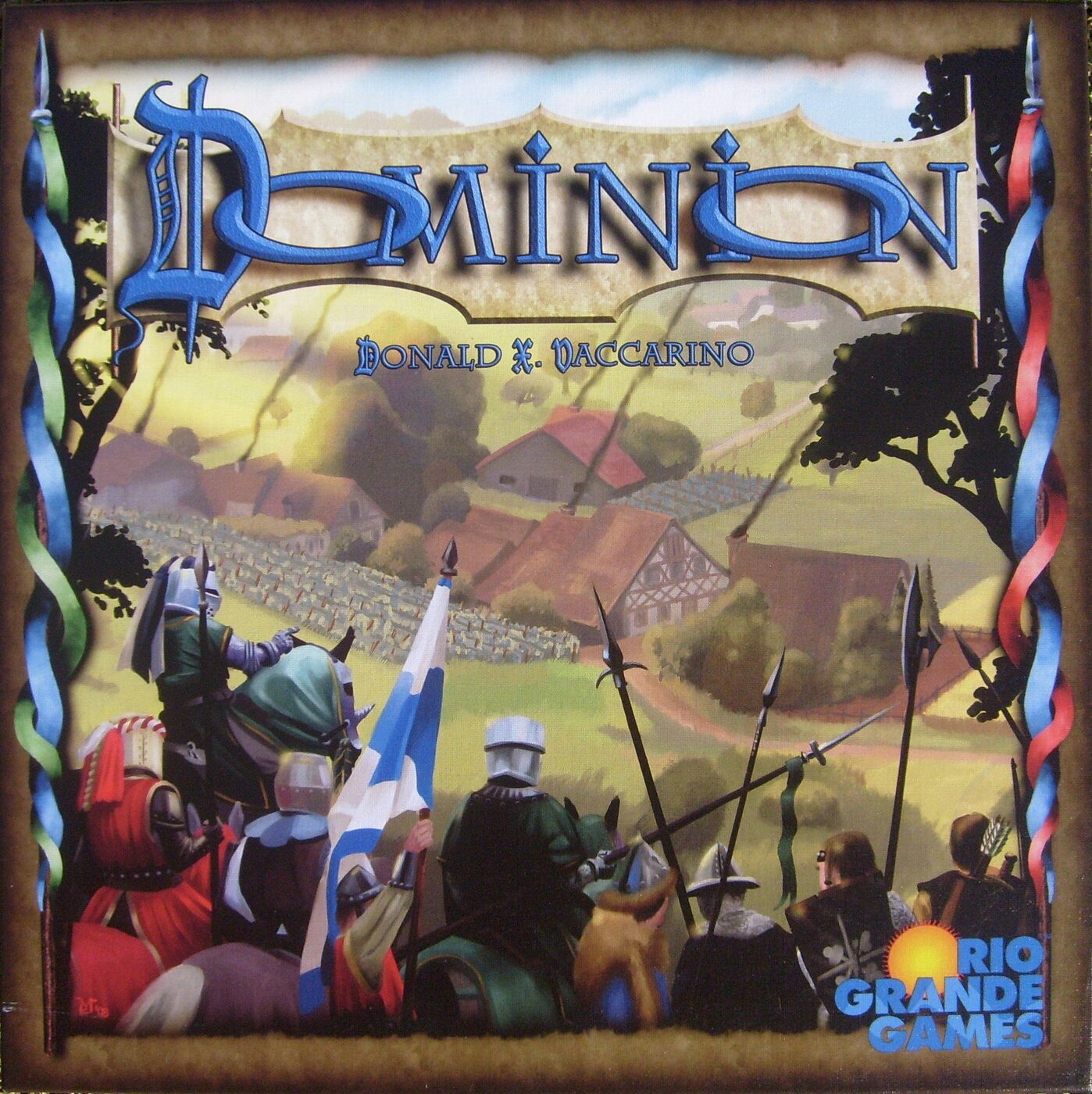
Dominion | 2-4 players | 30 min | Weight: 2.34 | BGG Rating: 7.60 (97,000+ ratings) | Rank: #146 | Published: 2008
Before Dominion, building a deck of cards was something you did before you sat down to play. You constructed your Magic: The Gathering deck at home, bought the best cards you could afford, and brought it to the table. The deck was your equipment, not the game itself.
Donald X. Vaccarino changed that in 2008 with one deceptively simple idea: what if building the deck was the game?
That insight launched an entire genre. Eighteen years later, deck-building mechanics appear in everything from Clank! to Aeon’s End to Legendary to Slay the Spire on a screen. Every one of them has Dominion’s fingerprints on it. So the question for a retro review isn’t just “is Dominion good?” - it’s “does it still deserve a place on the table when so many of its children have outgrown it?”
The answer is more nuanced than you might expect.
What Made Dominion Revolutionary
The setup is elegant in a way that’s easy to underestimate. You start with a tiny ten-card deck: seven Copper (basic money) and three Estate (worth one victory point each, but useless during play). Each turn: draw five cards, play some, buy one card from the shared market, discard everything, reshuffle when needed.
The market is where the magic happens. From a set of Kingdom cards - ten randomly selected from Dominion’s 25 base kingdom cards - you spend money to buy better cards and fold them into your deck. Those cards generate more money, trigger special actions, allow you to draw extra cards, attack opponents, or score more points. By the game’s end, your deck is a personalised engine that plays nothing like your neighbour’s.
This sounds obvious now. In 2008, it was startling. The game won the Spiel des Jahres in 2009 - the highest honour in German-style gaming - and the Deutscher Spiele Preis the same year. It sold millions of copies. It launched a publishing dynasty: Dominion currently has 16+ expansions, each adding new kingdom cards and mechanics.
The brilliance is in the economy of the design. Every turn is a chain of decisions: which cards to play, in what order, what to buy. The deck-building loop is intensely satisfying - you feel the engine hum as a late-game deck starts reliably producing big money or long action chains. And it all happens in 30 minutes.
How Does It Play Today?
With clear eyes in 2026: Dominion is excellent, but it shows its age in specific ways.
What still works:
The core loop remains among the best in the hobby. The decision density is high - you’re making meaningful choices on every card play, not just once per turn. The randomised kingdom setup means each game is a different puzzle: some kingdoms reward big money strategies, others reward terminal actions or trashing cards. The game is still actively supported with expansions that introduce genuinely new mechanics (duration cards, night cards, debt, events).
A clean game of Dominion - two experienced players, a mid-complexity kingdom - takes 25 minutes and is deeply satisfying. It’s one of the fastest-to-table euros of its era.
What feels dated:
There’s almost no player interaction beyond Attack cards. Most of the time, you are in your own world, optimising your engine, barely glancing at opponents except to count Province piles. Modern deck-builders have largely moved toward more meaningful interaction - card theft, shared board states, PvP combat - precisely because Dominion showed what the pure engine-building form looks like and players wanted friction added back.
The base set’s kingdom cards are also, by modern standards, slightly conservative. The base game’s 25 kingdom cards were balanced for introduction rather than maximising strategic depth. If you only ever play base Dominion, you’re playing the least interesting version. The game really opens up with Intrigue (the first expansion) or later sets like Prosperity or Seaside.
The graphic design and art are functional at best. Dominion has never been a looker. Cards are text-heavy with small illustrations, and the box organisation system is famously annoying for anyone who owns multiple sets. These are minor complaints but worth noting against a hobby that has become far more visually ambitious.
The Turning Point: When Players “Get It”
First plays of Dominion often feel disconnected. You buy cards, your deck grows, you cycle through it, you buy more cards. The victory point economy - buying estates and provinces late, when your money engine is ready, not early - is counterintuitive until you’ve felt the sting of buying too many victory points too soon and finding your deck clogged with dead weight.
The “aha” moment typically arrives in play two or three, when you deliberately avoid buying victory cards until your engine is ready, and you watch your money snowball past an opponent’s cluttered early-green deck. Suddenly the game reveals itself: Dominion is about tempo. When to switch from building to scoring is the core strategic question, and it’s a genuinely interesting one.
More experienced players discover a second layer: the value of trashing cards. The three starting Estates and extra Coppers are dead weight once your engine is running. Cards like Chapel (trash up to four cards per turn) or Remodel (trash a card and gain one worth up to two more) allow you to surgically remove weak cards and make your deck leaner and faster. A deck of 12 powerful cards outperforms a bloated 30-card pile, and players who grasp this often win comfortably.
The Legacy: Everything Dominion Built
A partial list of games that owe their existence to Dominion:
- Star Realms (2014) - streamlined two-player deck-builder with faction synergies
- Trains (2012) - deck-builder on a board with a genuine spatial layer
- Clank! (2016) - deck-builder with push-your-luck dungeon crawling
- Legendary: A Marvel Deck Building Game (2012) - cooperative deck-builder with thematic card sets
- Aeon’s End (2016) - cooperative with no reshuffling (a direct inversion of Dominion’s loop)
- Thunderstone (2009) - deck-builder with a dungeon raid layer
- Dominion-style mechanics in digital games - Slay the Spire, Inscryption, Monster Train, and dozens more
Every one of these games takes Dominion’s skeleton and adds a twist. Clank! adds a board. Aeon’s End removes reshuffling. Star Realms adds direct combat. Aeon’s End adds cooperative play. In each case, Dominion is the point of departure.
This is both Dominion’s legacy and its modern challenge: for a player coming to the hobby in 2026, many of its children offer more immediately striking experiences. Clank! has exploration. Star Realms has drama. Aeon’s End has tension. Dominion’s pure form can feel almost serene by comparison - satisfying, but quiet.
Who Should Play Dominion in 2026?
Still absolutely worth it if:
- You’re new to deck-building and want to learn the mechanic at its purest
- You enjoy mathematical optimisation without board complexity
- You want a 30-minute game that rewards repeated plays and skill growth
- You’re happy to invest in expansions - the game grows enormously with Intrigue, Seaside, or Prosperity
- You have two players who enjoy tight, competitive games
Consider a modern alternative if:
- You want player interaction beyond occasional attack cards
- You’re drawn to thematic immersion and narrative tension
- Table presence and art direction matter to you
- You want to play with more than four players
The best modern deck-builder for Wingspan fans: Cascadia and Wingspan fans often enjoy Clank! for its sense of adventure, or Aeon’s End for cooperative play. Star Realms is the fastest-to-table competitive option.
Should You Buy It?
If you’ve never played Dominion: yes, buy the Second Edition (BGG: Dominion: Second Edition, weight 2.17, rating 7.82). The second edition (2016) replaced the weakest base kingdom cards with stronger, more interesting ones and reorganised the box. It’s a meaningfully better starting point.
If you already own it: dig it out. Open the box, randomise ten kingdom cards, and remember what made this game singular. Then pick up Intrigue or Prosperity and see how far the design has come.
Dominion isn’t the most exciting game at the table in 2026. But it is, without question, one of the most important. Playing it is a bit like watching the film that launched a genre: you can see every modern version of the idea in its bones. That’s not a slight - it’s a tribute. The game still plays well. The ideas still hold. The 30-minute game clock still impresses.
Eighteen years on, Donald X. Vaccarino’s deck-building blueprint remains the clearest articulation of what the mechanic is for. Every card you buy, every deck you thin, every Province you grab at precisely the right moment - you’re playing the original.
BGG data verified August 2026. Dominion (2008) data from BoardGameGeek.