You’re three spaces from winning your column in Can’t Stop. You’ve already rolled twice. The probability gods are against you. Everyone at the table knows you should stop.
You roll again.
This is push-your-luck - board gaming’s most primal mechanic, the thing that separates the cautious from the reckless, and the single best argument that games don’t need complex rules to create genuine tension. When it’s good, push-your-luck is almost physically uncomfortable. When it goes wrong, it’s somehow funnier than anything else at the table.
What Push-Your-Luck Actually Is
The mechanic has a deceptively simple structure: you have the option to stop taking a risk at any point, but each time you continue the potential reward grows and so does the chance of losing everything.
That’s it. The entire mechanic in one sentence. But within that structure lives an enormous range of games - some individual, some simultaneous, some deeply strategic, some purely reckless. What they all share is that central moment of decision: take what you have, or risk it for more?
This is different from randomness alone. In a dice game where you simply roll and accept results, there’s no agency. Push-your-luck insists on agency. The outcome is still uncertain, but you chose this. That’s what makes losing sting and winning sing.
The Three Flavours
Push-your-luck tends to come in one of three forms:
Individual decisions - each player manages their own risk independently. You stop when you want; others continue if they like. Can’t Stop and Quacks of Quedlinburg work this way.
Simultaneous group decisions - everyone decides at once whether to keep going. Diamant is the textbook example. The tension comes from trying to read what others will do.
Bluffing-inflected - the push isn’t just about random outcomes but about reading opponents, as in Perudo. Here the risk is partly hidden information, not just probability.
Why Your Brain Can’t Stop
Push-your-luck works because it exploits two deep psychological tendencies that game designers love to weaponise.
Loss aversion - behavioural economics tells us that losing something already gained hurts roughly twice as much as not gaining it in the first place. Push-your-luck creates a constant escalating series of things to lose. Every roll you survive becomes something you’re now attached to and afraid to sacrifice.
The gambler’s fallacy - even people who know better fall for it. You’ve rolled well three times; surely the bust roll is due. Or conversely: you’ve already busted twice today, you’re clearly in a streak now. Neither is true. Push-your-luck doesn’t care about your personal narrative.
Good push-your-luck games understand both tendencies and design around them - building up accumulated progress that feels painful to lose, and keeping each individual probability clear enough that you know you’re making a bad call even as you make it.
The Five Essential Push-Your-Luck Games
1. Can’t Stop
Can’t Stop | 2-4 players | 30 min | Weight: 1.14 | BGG Rating: 6.95
© Gryphon Games / BGG
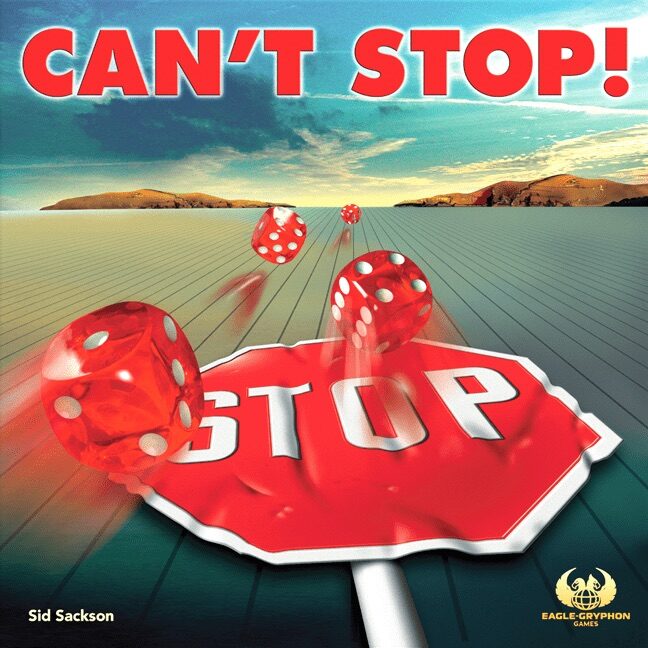
Sid Sackson designed Can’t Stop in 1980 and it remains the cleanest expression of the mechanic in existence. The premise: roll four dice, form two pairs, advance your three temporary markers up columns numbered 2-12. Columns are different lengths (column 7 is the longest, matching its probability), and you need to claim three columns to win. Each turn you keep rolling as long as at least one valid pair exists - but the moment you can’t pair the dice, you lose every temporary marker placed that turn.
The genius is in the columns. You only have three markers active per turn, so as those get locked onto valuable columns, the odds of being able to keep rolling gradually narrow. You’re not just deciding when to stop - you’re managing which columns to contest, knowing that some are much harder to finish than others.
What makes Can’t Stop genuinely special is how little randomness actually determines outcomes over a full game. The decisions are real: aggressive column selection, knowing when to bank progress, reading when an opponent is about to lock a column you need. But it wears its strategy so lightly that it works as a pure family game too.
Play if: You want the mechanic in its purest form. No frills, no clutter, just the decision laid bare.
2. The Quacks of Quedlinburg
The Quacks of Quedlinburg | 2-4 players | 45 min | Weight: 1.94 | BGG Rating: 7.80 | BGG Rank: #79

© Schmidt Spiele / BGG
Quacks is the game that reminded the hobby that push-your-luck doesn’t have to feel like a toy. Ranked #79 on BGG overall, it’s pulled off something rare: become genuinely beloved among casual players and experienced gamers simultaneously. The explanation is in the design.
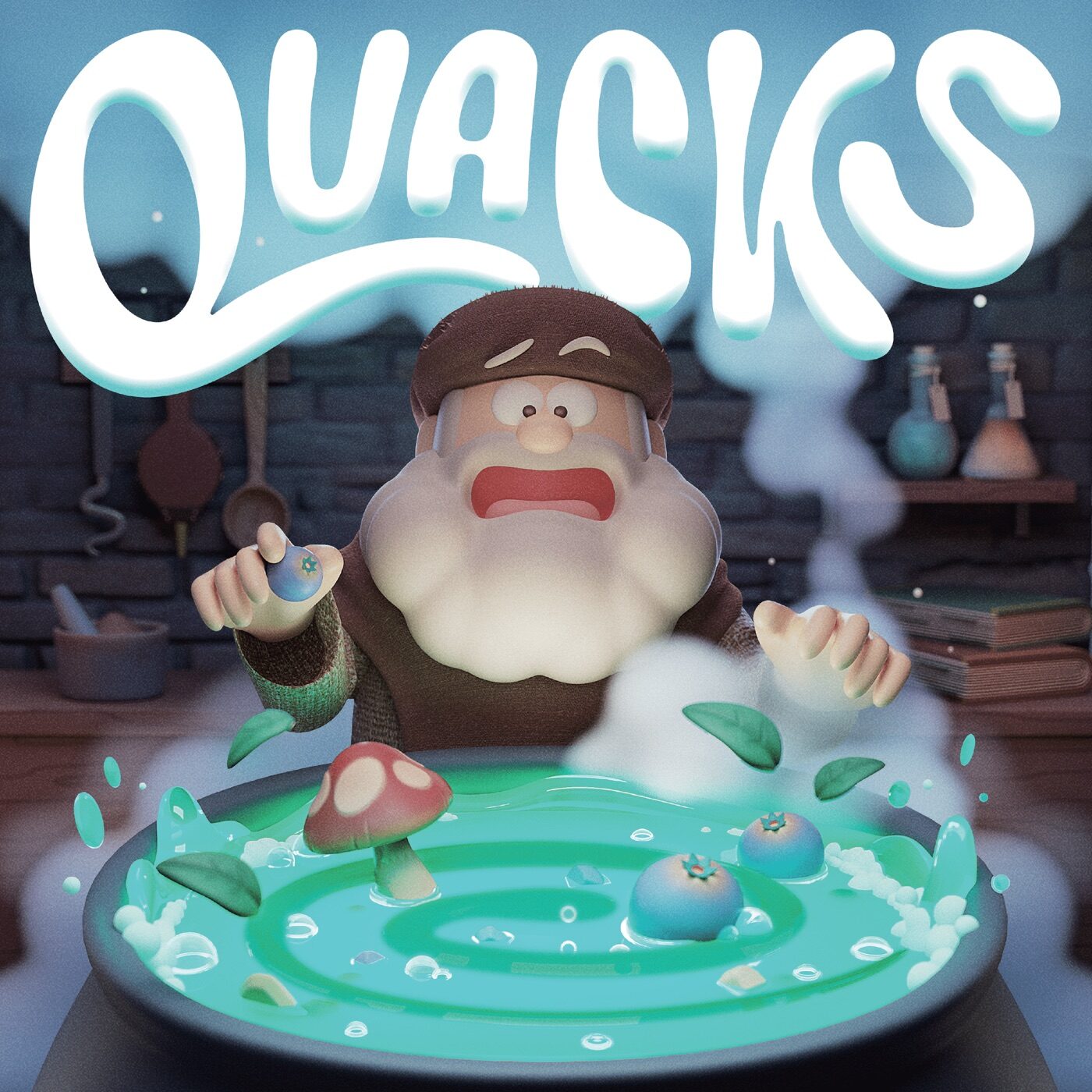
You’re quack doctors brewing potions from a bag of ingredients. Each round you blindly draw tokens from your bag one at a time, placing them on a spiral track. Further along the track means bigger rewards. The catch is that white “cherry bomb” tokens cause your pot to explode if you draw too many - and you never know when the next one is coming. Stop early and you’re safe but left behind. Push further and maybe your potion is spectacular. Or maybe it blows up in your face.
What elevates Quacks above basic push-your-luck is the bag-building layer. Between rounds you spend your earnings on new ingredient tokens, adding them to your bag. Better ingredients push the track further or give special powers. Crucially, adding good tokens also dilutes your cherry bombs - so smart purchasing gradually makes you a more efficient risk-taker. Your push-your-luck decisions in round 9 are shaped by what you bought in rounds 1-8.
This gives experienced players a real edge without making new players feel helpless. The simultaneous bag-drawing also means there’s no waiting - everyone pushes their luck at the same time, and the table stays noisy throughout.
Play if: You want push-your-luck with real depth underneath. The gateway game that doesn’t feel like a gateway game.
3. Diamant
Diamant | 3-8 players | 20-40 min | Weight: 1.11 | BGG Rating: 6.85
© Iello / BGG
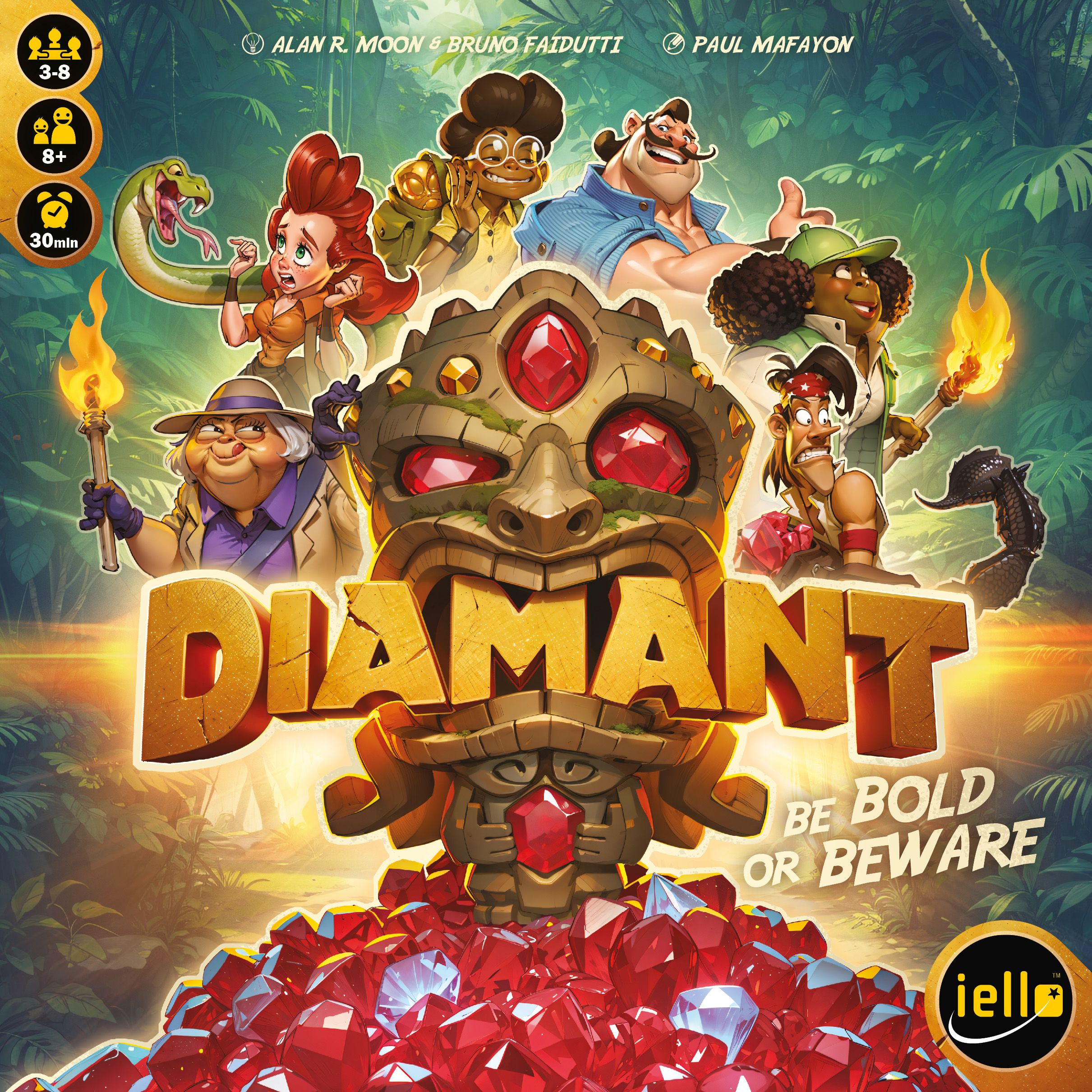
Diamant (also published as Incan Gold) flips the individual decision into a social one. Everyone is in the same mine, and each round a new card flips: it’s either treasure (split equally among those still in) or a hazard. If the same hazard appears twice, everyone still in the mine loses everything they’ve accumulated that round.
The twist: at the start of each card flip, every player secretly decides whether to continue or escape. Players who leave bank their current stash. Players who stay keep going - and any treasure on the remaining path gets split among fewer people, potentially making the stakes much richer.
The brilliant part is reading the table. Will the others stay? If everyone else bolts and you remain, you could scoop the jackpot. If you run and everyone else stays, they split the treasure and you look foolish. Diamant turns push-your-luck into a game of social inference and light game theory.
At 3-8 players with a near-zero learning curve, Diamant is the most versatile game on this list. It works as a family opener, a party game filler, or a pre-game warmup. At 20 minutes it rarely overstays its welcome.
Play if: You want push-your-luck as a group experience, with tension that comes from reading people, not just probabilities.
4. Deep Sea Adventure
Deep Sea Adventure | 2-6 players | 30 min | Weight: 1.18 | BGG Rating: 6.86
© Oink Games / BGG
Deep Sea Adventure is the smallest box on this list and possibly the most psychologically vicious. A compact Japanese design from Oink Games, it fits in a pocket but creates enormous table drama.
Everyone is a diver going down for treasure chips. Each turn you roll two dice and advance that many spaces, picking up treasure if you like. The catch: every piece of treasure you’re carrying adds to a shared oxygen countdown. More treasure in play across all divers = oxygen running out faster. You need to turn around and get back to the submarine before the oxygen hits zero - or you drop everything and resurface empty-handed.
The mechanic creates a brilliant tragedy of the commons. Every diver wants to grab one more chip. Every extra chip suffocates everyone a little faster. Players who grab aggressively punish the whole group. Players who play conservatively enable the greedy ones. There’s a moment in almost every game where the oxygen meter is ticking toward zero and half the divers are still deep underwater and everyone is screaming at each other.
At its best, Deep Sea Adventure is about managing collective greed. At its worst (with very conservative players) it can feel slow. But find a table with the right energy and it’s relentlessly funny.
Play if: You want push-your-luck with a social/cooperative twist and a game that fits in your jacket pocket.
5. Perudo
Perudo | 2-10 players | 15-30 min | Weight: 1.25 | BGG Rating: 6.93
© Ravensburger / BGG
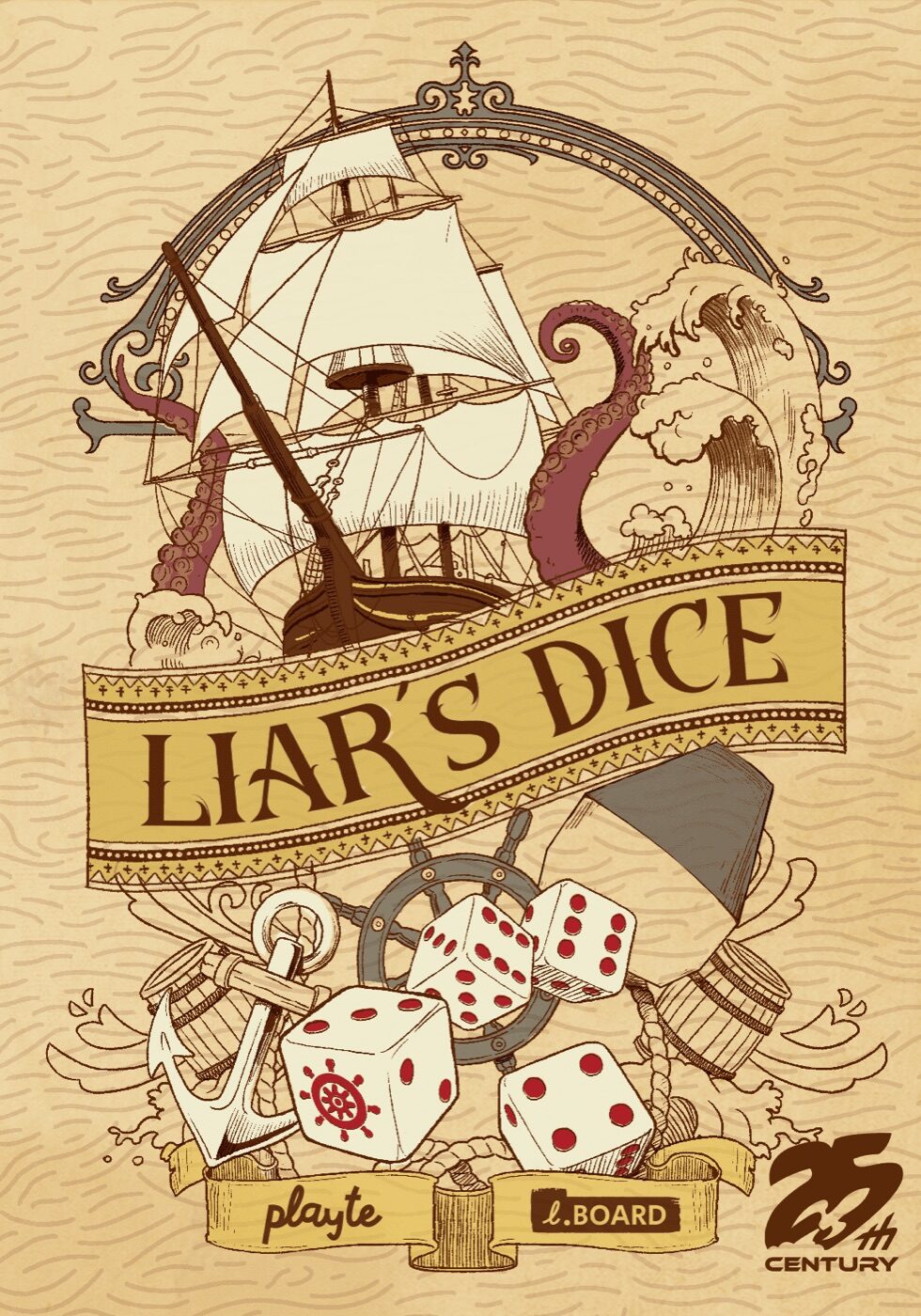
Perudo is the odd one out - not push-your-luck in the traditional sense, but occupying the same emotional space through different means. The classic Andean liar’s dice game tasks players with bidding on how many dice showing a given face exist across all hidden cups. Each player either raises the bid or calls the bluff. Loser removes dice from their cup.
The push-your-luck element is in the bidding. You can keep making safe, small incremental bids - or you can push high and force your opponents into difficult territory. A bold bid at the right moment can completely shift the psychological weight of the game. But overreach and you lose dice you can’t afford.
Where Perudo differs from the other games here is that the risk isn’t random: it’s unknown information. Your five dice are certain; everyone else’s are hidden. You’re not fighting probability - you’re constructing a model of the table and betting on it. This gives analytically minded players a genuine edge while still leaving plenty of room for chaos.
It also scales from 2 to 10 players, making it the party option of the bunch. With large groups it becomes genuinely frantic. With two it becomes almost like chess - slow, tense, psychological.
Play if: You want the push-your-luck feeling through bluffing and hidden information rather than dice rolls. Works with almost any group size.
Push-Your-Luck Across the Complexity Spectrum
All five games here are light (BGG weight 1.11-1.94), which reflects something real: push-your-luck as a pure mechanic works best uncluttered. The tension lives in the moment of decision, and heavy rules overhead dilutes it.
That said, the mechanic appears as a layer in heavier games too. Spirit Island has elements of it in certain spirits’ power card draws. Pandemic creates informal push-your-luck when deciding how long to delay before treating outbreak risks. Clank! is a deck-builder explicitly built around a push-your-luck dungeon-crawl layer. The mechanic is flexible precisely because it’s just a decision structure - push further or bank what you have - and that structure survives grafting onto almost anything.
Who Should Play Push-Your-Luck Games?
Great fit for:
- Players who enjoy tension without analysis paralysis - these games move fast
- Mixed groups with different experience levels (the rules are simple; the decisions are relatable)
- Families looking for games that feel exciting without being complex
- Anyone who wants to finish a game in under an hour
Not ideal for:
- Players who strongly dislike randomness - bust at the wrong moment and there’s genuinely nothing you can do
- Those who prefer complete control over outcomes
- Gamers who find luck-mitigation more satisfying than luck-embrace
The thing push-your-luck does better than almost any other mechanic is create a story. When the session ends, everyone remembers the turn someone kept rolling when they definitely shouldn’t have. The decision to push - not the roll itself - is what gets remembered. That’s a rare quality in game design.
Where to Start
If you’re new to push-your-luck: Can’t Stop - it’s cheap, fast, and utterly pure.
If you want depth with the chaos: The Quacks of Quedlinburg - it’ll take more sessions to get the bag-building clicks but it absolutely does.
If you’re hosting a larger group: Diamant or Perudo - both scale up beautifully and both teach in under five minutes.
And if you want something compact and slightly mean: Deep Sea Adventure fits in a bag and creates outsized drama.
Push-your-luck rewards a certain kind of player - one who can accept the bust without fury, appreciate the tension of the decision more than the outcome, and laugh when things go catastrophically wrong. If that sounds like your table, you’ve found your mechanic.