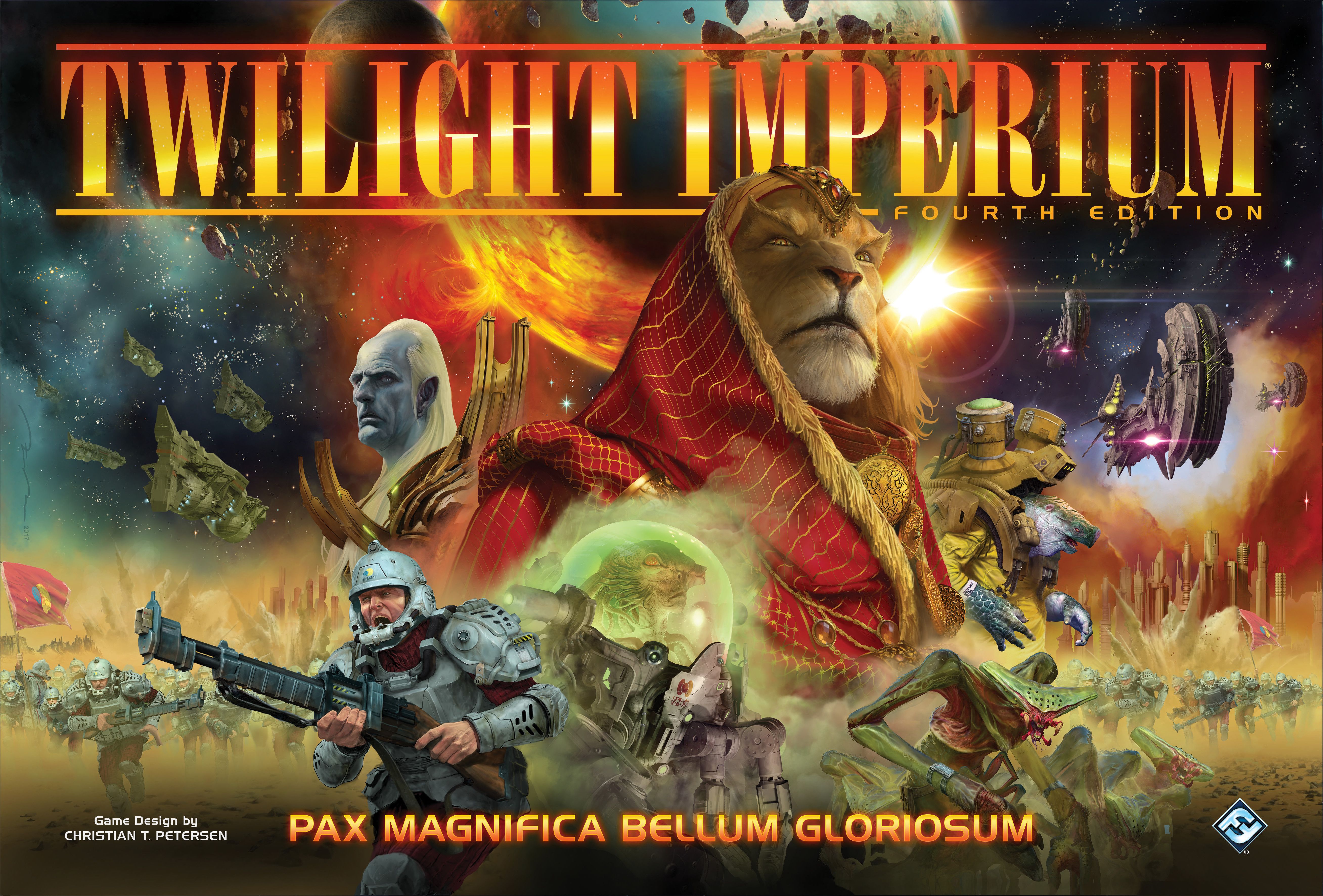
There’s a specific moment most board game shoppers hit when researching Twilight Imperium: Fourth Edition: you see the price (£90-£120 in the UK, $100-$150 in the US depending on retailer), you see the 6-8 hour play time, and you wonder whether this is a board game or a lifestyle decision.
It’s a fair question. TI4 is one of the most expensive games in the hobby, takes more wall-clock time than most films, and needs up to six players who all agree to give up an entire day. So: does it deliver?
What Twilight Imperium 4th Edition Is
Published by Fantasy Flight Games in 2017, TI4 is a game of galactic conquest for 3-6 players. Each player controls one of 17 asymmetric alien factions competing to conquer Mecatol Rex, the galactic capital, and score ten victory points across a match that typically runs 4-8 hours.
That sounds straightforward, but TI4 contains multitudes: a political system where players vote on laws that reshape game rules mid-match, a technology tree unique to each faction, commodity trading and backroom deals between players, and naval combat that rewards preparation and punishes overextension. The board itself is built fresh each game from 51 hexagonal galaxy tiles, so no two games begin on the same map.
BGG’s community has rated TI4 8.56 out of 10 across nearly 28,500 ratings, making it BGG rank #7 globally - sitting comfortably among Gloomhaven, Brass: Birmingham, and Ark Nova. The weight rating is 4.35 out of 5: this is a heavy game by any measure.
What’s in the Box
Open a TI4 box and you’ll find a significant quantity of physical components:
- 17 faction sheets with unique abilities and starting fleets, plus faction-specific technology cards
- 51 hexagonal galaxy tiles covering planets, anomalies, wormholes, and deep space
- 522 plastic miniatures (fighters, destroyers, cruisers, dreadnoughts, carriers, flagships, mechs, infantry, space docks, and PDS units)
- 8 strategy cards that determine round order and grant special powers each round
- A Mecatol Rex tile, action cards, agenda cards, objective cards, relic cards, and tech cards
- Dice, tokens, and a full player aid for each seat
Fantasy Flight builds physical games at a high production level, and TI4 reflects that. The miniatures are not painted, but they’re chunky and distinguishable. The galaxy tiles are thick and satisfying to assemble. The card stock is premium. This is a game that looks like it justifies its shelf footprint.
The Six-Player Sweet Spot
Community data on BGG is unambiguous on player count: 486 voters rate TI4 “Best” at six players, versus 175 for four and 127 for five. At three players - technically valid - only 24 voters call it “Best.”
This matters enormously when evaluating whether TI4 is worth it for you. At six players, the political system fires on all cylinders - there are enough factions that alliances shift, diplomacy feels meaningful, and no single player can dominate without eventually triggering a coalition against them. At four players, TI4 is still excellent, but the political layer feels thinner. At three, you’re playing a stripped-down version of a game designed for six, and the experience is noticeably diminished.
If your group maxes out at four players and only occasionally hits five, TI4 is still worth owning - but you should know the conditions under which it truly excels.
The Time Commitment, Clearly Stated
Four to eight hours is the official range. In practice:
- First game with new players: expect 7-9 hours, often more. Setup alone takes 45-60 minutes. Teaching the rules adds another hour. First-timers make suboptimal decisions that slow combat resolution.
- Experienced group at six players: 5-7 hours is realistic if everyone knows their faction and no one deliberates excessively on every action.
- Four players, all experienced: a tight group can finish in 4-5 hours.
This is not a game you pull out on a Tuesday evening. It requires a dedicated session - a “TI4 day” - with a set start time, snacks, and probably a meal factored in. Groups that successfully play TI4 regularly treat it like an event, not a pickup game.
If your gaming group already plays multi-session campaigns, marathon games, or “gameday” formats, this is trivial. If your group struggles to finish a 90-minute game before people need to leave, TI4 will sit on the shelf.
Complexity: Learnable, Not Casual
Weight 4.35/5 means TI4 is genuinely complex. The rulebook runs to 56 pages plus a separate 40-page “Learn to Play” booklet. However - and this is important - TI4’s complexity is mostly breadth rather than depth. There are many interlocking systems, but each individual rule is fairly straightforward once you understand the flow.
The standard advice from experienced players: don’t try to teach the full rulebook before the first game. Use the “Learn to Play” guide, accept that you’ll look up edge cases during play, and plan a teaching game where winning matters less than getting the rhythm down. Most players who bounce off TI4 do so because they tried to teach every rule upfront and lost the room before a single piece moved.
The learning curve is front-loaded. By game two, experienced players report that TI4 clicks - the systems feel connected rather than arbitrary, and the decisions become genuinely thrilling.
The Prophecy of Kings Question
Fantasy Flight released the Prophecy of Kings expansion in 2020. It adds six new factions, a new map option, mechs, relics, exploration mechanics, and agents - increasing both the faction roster to 23 and the strategic surface area considerably. BGG users who own it rate it 9.19 out of 10.
The expansion costs around £70-£85 (UK) or $80-$100 (US). It is not necessary to enjoy TI4 - the base game is complete - but if you already know the base game and love it, PoK is widely considered essential by the community. The new factions are varied and well-balanced, and the exploration cards add a mid-game wildcard layer that experienced players enjoy.
The practical advice: buy the base game first. Play it 2-3 times. If you’re still excited about it after three sessions, add PoK. Don’t buy both simultaneously unless you know your group already.
Who Should Buy Twilight Imperium 4th Edition
Buy it if:
- You have 4-6 players who will commit to a dedicated gaming day
- Your group includes at least some experienced hobby gamers willing to absorb rules
- You’re drawn to political negotiation, faction asymmetry, and emergent narratives (“we formed an alliance for three rounds and then I stabbed everyone” stories)
- You’ve watched a TI4 playthrough (Watch It Played’s TI4 series is the standard recommendation) and found yourself wanting to be at that table
- You can treat it as an occasion game played 4-8 times a year, not a weekly staple
Skip it if:
- Your group tops out at three players most of the time
- Sessions routinely end early or get cancelled mid-game
- You want a game you can teach to newcomers in 20 minutes and finish in 90
- Solo play matters to you - TI4 has no solo mode (1 voter “Recommended” solo on BGG, 476 “Not Recommended”)
- Budget is tight: there are excellent heavy strategy games at half the price (Brass: Birmingham, Great Western Trail, Archeos Society)
The Verdict
Twilight Imperium 4th Edition is not a game you buy casually. It’s an investment in a specific kind of gaming experience - one that requires the right group, a clear calendar commitment, and willingness to invest a few hours learning what you’re doing.
For the group that fits that profile, TI4 delivers something most hobby games don’t: a complete, self-contained epic that generates different stories every single time. Rank #7 on BGG from a community of tens of thousands is not hype maintenance - it reflects a game that, in the right conditions, is genuinely unlike anything else.
The question isn’t whether TI4 is good. It clearly is. The question is whether your group will actually play it. If the answer is yes - confidently, not optimistically - then the money is well spent. If the realistic answer is “maybe if we ever find the time”, buy something lighter and save TI4 for when the group exists.
BGG rank #7 out of 100,000+ games. 8.56/10 average rating. Weight 4.35/5. Plays best at 6. Recommended with zero reservations for the right table.