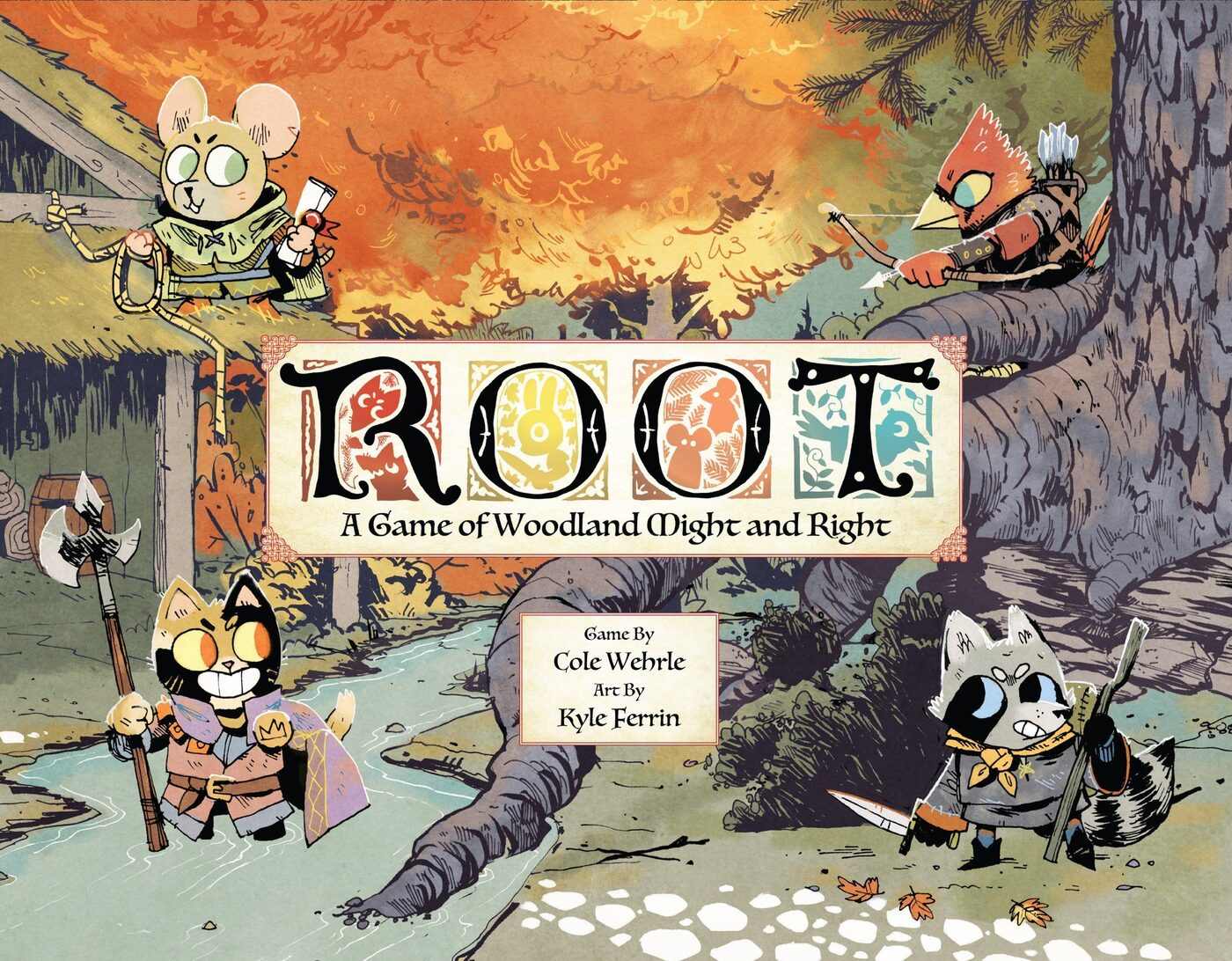
Root is BGG #34. It has 66,000+ ratings, a 8.07 average, and a near-mythological status in the hobby - the game where woodland creatures wage asymmetric warfare and every faction plays like a completely different game. Cole Wehrle’s 2018 design from Leder Games has been praised as a masterpiece and dismissed as a teaching nightmare in equal measure.
Before you drop £60+ on the base game (and inevitably spiral into the expansion ecosystem), here’s what you actually need to know.
What Root Actually Is
Root is an asymmetric area-control game. Players control factions - the Marquise de Cat, the Eyrie Dynasties, the Woodland Alliance, the Vagabond - each with completely different rule sets, actions, and victory conditions. One player might be building sawmills and factories; another is fomenting revolt through hidden sympathy tokens; a third is exploring the woods as a mercenary, caring nothing for territory.
The theme is deceptively cute. The woodland art is gorgeous. The game underneath is one of the most demanding designs on the market, with a BGG weight of 3.84/5.
Here’s the hard part: in most games, every player reads the same rulebook. In Root, each faction has its own mini-rulebook. Teaching Root to new players is not “explaining the game” - it’s delivering four simultaneous tutorial sessions to people who haven’t read any of the same pages.
The Player Count Question (This Is Critical)
This is the most important data point in any Root purchase decision. Let’s look at the BGG community poll from 1,443 voters:
| Player Count | Best | Recommended | Not Recommended |
|---|---|---|---|
| 4 players | 1,206 (84%) | 143 (10%) | 15 (1%) |
| 3 players | 253 (18%) | 900 (62%) | 95 (7%) |
| 2 players | 33 (2%) | 392 (27%) | 725 (50%) |
| Solo | 6 (0.4%) | 103 (7%) | 897 (62%) |
The data is unambiguous. Root is a 4-player game. At four players, 84% of voters call it Best - one of the highest Best-at-exactly-this-count scores you’ll see for any game. At two players, half the community says don’t bother. Solo isn’t really a thing here (the Clockwork expansion adds bot opponents, but that’s a workaround, not a feature).
If you have a regular group of four who will commit to the game together - great. If you’re buying this as a two-player game to play with your partner, you are setting yourself up for a disappointing experience.
The Asymmetry: Feature or Bug?
Root’s asymmetry is its genius and its poison.
The Marquise de Cat is a resource-and-engine builder. Place buildings, generate wood, produce victory points. If you’ve played most Euros, this faction will feel almost familiar.
The Eyrie Dynasties are a momentum engine that punishes themselves - they must add a card to their Decree each round and can never remove one. When they can’t resolve their Decree, they fall into turmoil and lose points. Managing this creeping constraint is endlessly tense.
The Woodland Alliance are insurgents. They spread sympathy tokens across the board; other players removing them trigger outrage and card draws. The Alliance generates points by staging revolts - sudden, explosive takeovers of clearings. They start weak and snowball in the late game if ignored.
The Vagabond ignores territory entirely. They wander, quest, repair items, and score points through relationships and ruins. Their win condition operates in a completely different dimension from everyone else.
These asymmetries create extraordinary moments: the cat player ignoring the Alliance spreading across the board until suddenly it’s turn 15 and the revolt fires. The Vagabond quietly winning while two players were too busy fighting each other.
But - and this matters - the asymmetries are not balanced for two players. Some faction matchups at two players are deeply skewed. At four players, the ecology largely self-corrects through the dynamics of mutual threats and soft coalitions.
The Teaching Problem
Root requires a different teaching strategy than almost any other game.
The wrong way: Read everyone the rulebook front to back, then play.
The right way: Teach the Cats to everyone first. Get one full round in where everyone acts as the Marquise. Then introduce the second faction. Then the third. The game is genuinely playable once everyone understands the Cats - it’s the clearest faction and the one that most resembles “normal” games.
There’s also an excellent digital version (Root on Steam, iOS, Android) that teaches each faction through a tutorial. Playing two or three hours of the digital game before your first tabletop session dramatically reduces first-session friction. If you’re planning to introduce this to new players, nudging them toward the app first is not cheating - it’s the practical thing to do.
Rough first session timeline (4 players, all new): 3-4 hours. Second session: 90-120 minutes. By session three, experienced players hit the advertised 90 minutes.
The Expansion Ecosystem (Know What You’re Getting Into)
The base game retails at ~£55-65 and comes with four factions. It is a complete game. But Leder Games has built a substantial expansion library:
- The Riverfolk Expansion - adds two factions (Riverfolk Company, Lizard Cult) and brings the player count up to 6
- The Underworld Expansion - adds two more factions (Underground Duchy, Corvid Conspiracy) and a second map
- The Marauder Expansion - adds Keepers in Iron, Lord of the Hundreds, and Hirelings (NPC mini-factions)
- The Clockwork Expansion - adds automated bot versions of all four base factions for asymmetric solitaire play
- The Landmark Pack, Exiles & Partisans deck - smaller add-ons
The base game is not a demo. You do not need expansions to have a complete experience. But the factions are designed to create specific ecological dynamics - Riverfolk in particular adds meaningful economic interactions - and if your group gets deep into Root, expansions become harder to resist.
Realistic total spend if you go deep: £150-200+. Know this going in.
Replayability and the Faction Rotation
Root ages unusually well because no two games use the same faction combination. Even with just the four base factions, you’ll have different match-ups each session. Each faction pair-up creates different dominant strategies and coalitions.
The Vagabond, in particular, plays very differently depending on who they’re allied with or antagonising. The Alliance at a table with experienced Cat players who know to clear sympathy tokens is a different animal from the Alliance at a table with players who ignore it until turn 14.
This replayability is genuine. Root has a higher ceiling than most games - you can play it thirty times and still discover new dynamics. It also has a higher floor - the first three sessions feel rough while everyone is still learning their own faction let alone reading the room.
What BGG Players Actually Say
“I’ve taught this game maybe fifteen times. The secret is: don’t teach it all at once. Play the first round with everyone as the Cats. Then introduce the Eyrie. Never explain the Alliance until it’s their turn. Works every time.”
- BGG forum, teaching tips thread
“Two player Root is a different game in the worst way. Without the political dynamics of four players, the asymmetry feels exploitable rather than elegant. If it’s just you and your partner, get Patchwork.”
- BGG user review
“This game broke up my game group and then put it back together. First session: everyone hated it. Second session: two people loved it. Third session: everyone loved it. Do not judge Root on one play.”
- r/boardgames
The Verdict: Is Root Worth It?
Yes, if:
- You have a committed group of 3-4 who will play it multiple sessions together
- At least one person is willing to learn it first and teach it
- You enjoy asymmetric games and don’t mind factions that play completely differently
- You’re willing to invest 2-3 sessions before it clicks fully
No, if:
- You’re buying it for 2-player use - the data is clear, it doesn’t shine at that count
- Your group won’t tolerate a rocky first session
- You need a game that a different group can pick up and play cold each time
- You’re not ready to potentially get drawn into the expansion ecosystem
The bottom line: Root is genuinely exceptional when it hits. The faction asymmetry is unlike anything else in the hobby; watching four completely different strategic organisms collide across the same board is something that doesn’t get old. But it asks for investment - in teaching, in multiple sessions, and potentially in your wallet if you go deep.
If your group is up for that, Root will become a staple. If you’re hoping for a one-and-done accessible hit, look elsewhere.
BGG Rating: 8.07 / 10 · Weight: 3.84 / 5 · BGG Rank: #34 · Best at: 4 players · Designer: Cole Wehrle
Root (2018) published by Leder Games. BGG data accurate as of September 2026. Cover image via BoardGameGeek.