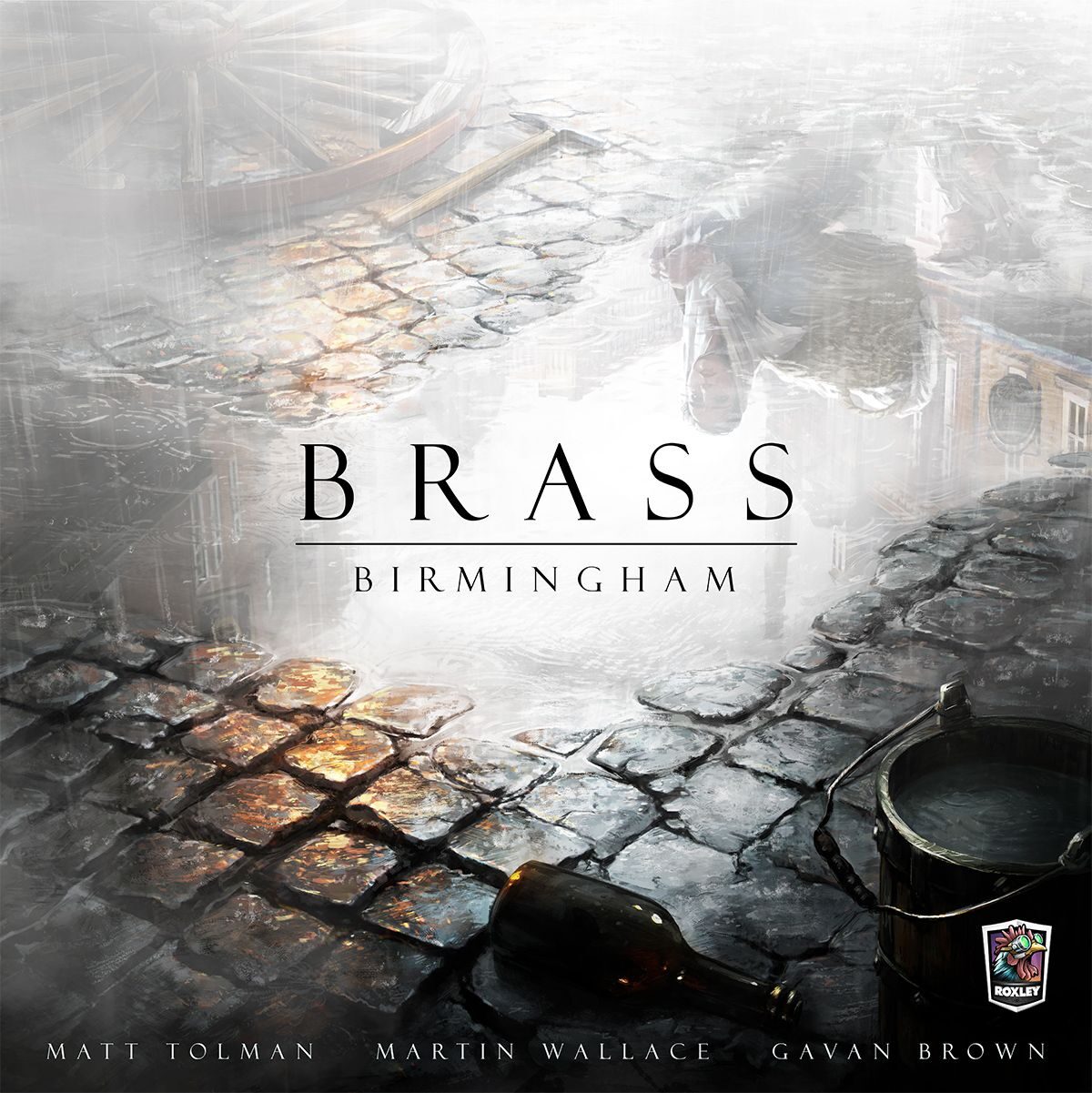
Brass: Birmingham has occupied the top spot on BoardGameGeek for years. Not one of the top ten - the top spot. That kind of sustained dominance is almost without precedent in board gaming, and it creates a specific problem: a mountain of hype that either pulls you in or makes you suspicious.
So let’s cut through it. Is Brass: Birmingham actually worth buying? Or is it a game that suits a very specific kind of player that might not be you?
What You’re Actually Getting
Brass: Birmingham is a heavy economic strategy game set during the British Industrial Revolution. You’re building industries - coal mines, iron works, cotton mills, potteries, breweries - and connecting them with a network of canals (era one) then railways (era two). Resources flow through the network. Buildings flip and score when their goods are consumed. The player with the most victory points at the end wins.
On paper that sounds approachable. In practice, it’s anything but. The game runs at BGG weight 3.86 out of 5 - firmly in the “heavy euro” bracket. For comparison, Wingspan sits at 2.45, Scythe at 3.44, and Twilight Imperium at 4.22. Brass: Birmingham lives closer to TI4 than Wingspan on the complexity dial.
Key stats (verified BGG data):
- BGG Rank: #1 overall
- BGG Rating: 8.56 / 10 (from ~75,000+ ratings)
- Weight: 3.86 / 5
- Players: 2-4 (best at 3-4)
- Play time: 60-120 minutes (closer to 120-150 your first few plays)
- Designer: Martin Wallace
The Learning Curve is Real
Let’s be direct about this: your first game of Brass: Birmingham will be uncomfortable. Not because the rulebook is badly written - it’s actually quite good - but because the game has a dozen interacting systems that only make sense once you see them in motion.
The specific stumbling blocks new players consistently hit:
Links vs. connections. Your buildings are “connected” if you can reach them via anyone’s links, but “in your network” only if they’re reachable through your own links. This distinction drives the entire sell mechanic and trips up nearly every new player at least once.
The two-card rule. Every turn you play two cards and take two actions. Cards are discarded whether the action succeeds or not. Missing this rhythm breaks turns.
Coal travels through networks; iron doesn’t. Iron can come from the market no matter where you are. Coal must be physically accessible via a connected path. This feels arbitrary until suddenly it doesn’t.
Turn order resets based on money spent. The player who spent least goes first next round. Again, unintuitive until you’ve experienced the strategic implications.
The BGG community’s most-cited tip: download the fan-made player aids before your first game and print one per player. The official ones are fine; the BGG ones are genuinely excellent. That single step smooths out roughly 40% of the friction.
Most players also recommend playing the canal era only for the very first session - treating it as a two-hour tutorial that naturally explains the rail era’s expanded rules by contrast.
Player Count: Where the Game Actually Lives
Brass: Birmingham is listed as 2-4. The BGG community is clear that 3 or 4 players is the intended experience.
At four players, the board fills up fast, competition for key locations is fierce, and every action you take benefits (or threatens) someone. The game is at its most tense and most social.
At three players, you still get meaningful competition and blocking without the full squeeze. Many experienced players actually prefer three - more room to breathe, but still enough conflict to keep decisions interesting.
At two players, the game is playable and strategically deep, but qualitatively different. Without a third party to disrupt your plans, the game becomes more of a pure optimization puzzle. Some people love 2p Brass; others find it loses the knife-edge quality that makes the multi-player game special. Worth noting if you’re primarily a two-player household.
There is no official solo mode.
Replayability: Yes, Genuinely
Here’s where the game earns a lot of its reputation. The card-driven network building means no two games look the same. Your hand of cards dictates which cities you can build in (you need a matching card or a wild), so your strategic options shift every single game.
Add in the fact that the optimal path changes dramatically based on what other players are doing - blocking a key city, consuming the iron supply, taking the last beer connection - and you have a game that experienced players call “unsolvable.” There’s no dominant strategy. There’s no opening book to memorise. Every game requires reading the table and adapting.
After five or six plays, once the rules stop being an obstacle, Brass: Birmingham becomes the thing its fans claim it is: a genuinely layered economic puzzle that rewards careful thinking without ever quite letting you solve it.
Value for Money
The standard Kickstarter edition runs around £60-£80 depending on where you find it. The Roxley production is excellent - clear iconography, solid components, a board that’s functional if not flashy. This is not a miniatures spectacle, but nothing feels cheap.
For a game you’ll play dozens of times with the right group, £70 is reasonable. For a game that bounces off your group after two sessions, it’s painful.
The real calculation: if you have two to three friends who regularly play games rated 7+ on BGG and who want a challenge, Brass: Birmingham is one of the best purchases you can make. If you’re buying it speculatively to “graduate” a casual group, the risk is higher.
Who Should Buy It
Buy it if:
- Your group regularly plays medium-heavy or heavy games (Agricola, Viticulture, Arkham Horror LCG, etc.)
- You have 3-4 players who will commit to at least three sessions
- You enjoy economic optimization and network-building
- You’re not put off by a steep first-game learning curve
- You want a game that will reward you for years without being “solved”
Skip it (for now) if:
- Your group tops out at Catan or Pandemic complexity
- You’re primarily a two-player household who wants a light-to-mid game
- You want a game that’s fun from session one without prior exposure
- You have analysis paralysis issues - Brass: Birmingham can genuinely paralyse over-thinkers with the breadth of options
- You’re colourblind: the iconography relies partly on colour differentiation that some colourblind players report as a genuine obstacle
Who This Game Is Not For
There’s a vocal minority on BGG who find Brass: Birmingham overrated, and their complaints deserve acknowledgment rather than dismissal. The most common ones:
- Plays longer than the box claims. The 60-120 minute estimate assumes experienced players. Budget 150-180 minutes for your first two games.
- Low direct interaction. You’re blocking spaces and consuming resources, but you’re never directly attacking another player. Players who love conflict-heavy games sometimes find this quiet competition underwhelming.
- Two-era structure can feel repetitive. The board resets at the halfway point, which some find clever and others find like playing the game twice.
None of these are wrong. They’re just mismatches of preference rather than design failures.
The Verdict
Brass: Birmingham is the #1 game on BGG for defensible reasons. The depth is real. The replayability is real. The satisfaction when systems click - when you sell cotton through a partner’s network, flipping your mill and scoring both the building and the rail link in one action - is genuinely pleasurable.
But it is not a game for everyone, and it is not a game that forgives a casual group.
If you have the right group: buy it without hesitation. It will be in your collection for a decade.
If you’re unsure about your group: try to get a play in at a game cafe, a local club, or with a friend who owns it first. One session will tell you everything you need to know.
If you already own it and haven’t played it: clear a Saturday, download the BGG player aids, commit to the canal era only for the first game, and give it a real chance. Most players who write it off in the first session come back to it - and the second game is almost always better.
It earned that top spot. Whether it earns a spot in your collection is a question only your play group can answer.
BGG data verified August 2026. BGG ID: 224517. Weight 3.86, Rating 8.56, Rank #1.