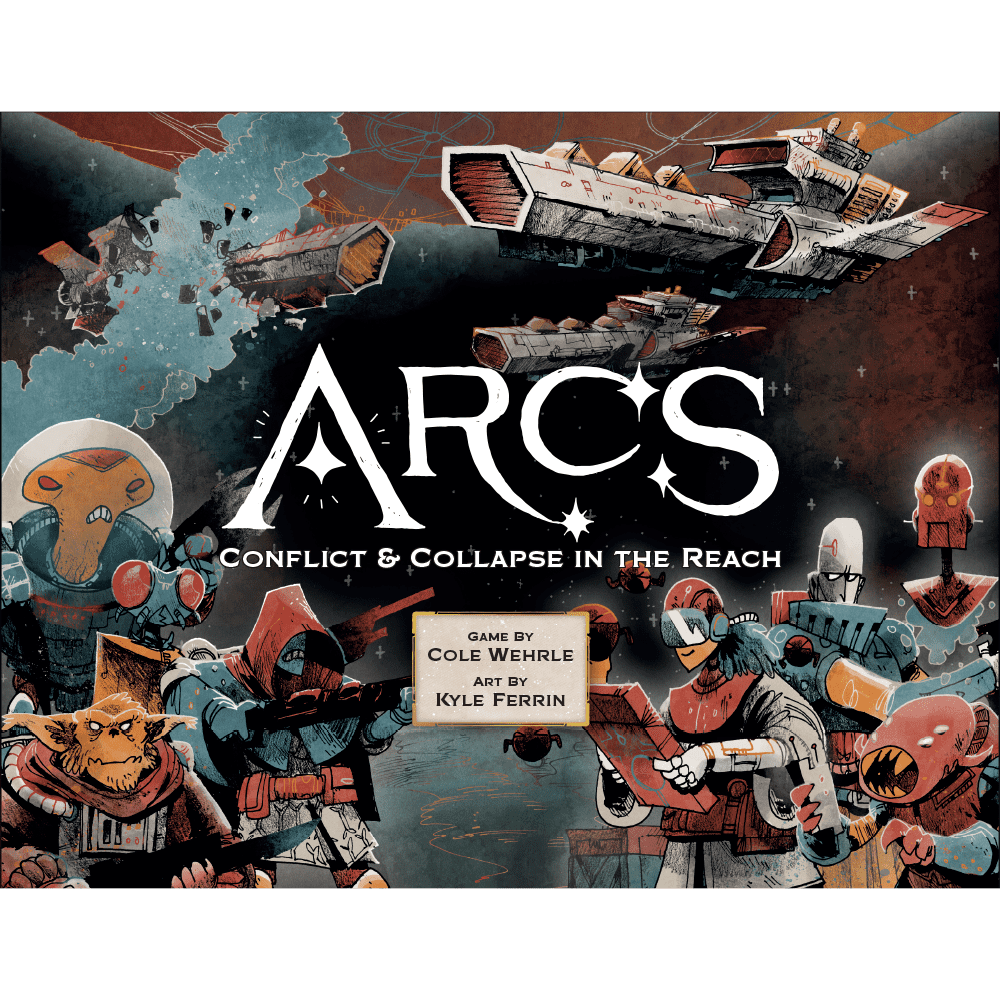
Cole Wehrle has earned a rare kind of designer trust. If his name is on the box, a certain tier of board gamer will buy it without reading the rules. Root, Oath, Pax Pamir 2nd Edition - the man has a track record.
Arcs arrived in 2024 trailing that reputation like a comet tail. It sold out fast. It generated immediate debate. And now, two years in, it has settled into something more complicated than pure acclaim: a game that inspires real devotion from some players and genuine frustration from others.
So - is Arcs worth your money?
What You’re Actually Getting
Key stats (verified BGG data):
- BGG Rank: #101 overall
- BGG Rating: 7.99 / 10 (from ~18,600 ratings)
- Weight: 3.45 / 5
- Players: 2-4 (solo requires expansion)
- Play time: 120 minutes
- Designer: Cole Wehrle / Leder Games
Arcs is a space area control game built on an unusual trick-taking action system. Players represent factions of a crumbling empire scrambling for dominance across a star map - through conquest, resource control, and political manoeuvring.
Each round, one player leads a card from their hand. The card’s suit determines the action (attacking, building, securing territory, or mobilising fleets). Other players must either follow the same suit (doing a lesser version of the action), lead a different suit by spending pips to “seize the initiative,” or pass and draw a card.
That last option - passing - is more important than it sounds. Every card you play is a card you don’t have for later. Passing builds your hand for future turns. The tension between acting now and conserving options for later is the game’s central pulse.
Victory comes from accumulating Power (the victory currency) through a mix of battle, controlling key systems, and achieving hidden agenda objectives. Games end when the Power gap between players reaches a threshold, meaning the leader is always a target - and the game can end abruptly.
The Weight and Learning Curve
A BGG weight of 3.45 puts Arcs in solidly challenging territory. But the weight is distributed unusually. The rules themselves are not especially long. The trick-taking follow system takes about five minutes to explain. Setup is straightforward.
The difficulty is almost entirely in the decision space. With four suits, limited hand size, and a shared action system where what you do affects what your opponents can do at a fraction of the cost, every card play has second-order consequences. New players routinely describe their first game as “feeling like I was reacting to things rather than making decisions.”
The first game typically runs long - budget 150-180 minutes with new players. Once the follow system clicks, that tightens considerably.
There is a meaningful skill curve here. Players who have internalised the priority system (which suit combination creates the best sequencing advantage) will consistently outperform those who haven’t. That’s not a flaw - it’s the feature for the right audience. But it does mean your first three games are as much education as entertainment.
The Player Count Question
This is where Arcs earns its reputation for divisiveness.
At 2 players: Tight, strategic, and tense. The follow system creates a genuine mind-game where you’re constantly trying to read your opponent’s hand state. The aggression is present but controlled. This is the cleanest version of the game’s design.
At 3 players: The consensus best count. There’s enough chaos to create narrative moments without the “feel-bad” problem that plagues higher player counts. Deals get made and broken. The board state evolves dramatically turn to turn. The game’s dark comedy comes alive here.
At 4 players: Genuinely controversial. The take-that elements amplify significantly. Ganging up on the leader is both a rational strategy and a source of frustration for the player in front. Turns where you’re “locked out” by a dominant follow chain - unable to do anything productive - happen more often. Many players who love Arcs at 3 find 4-player sessions exhausting.
BGG’s player count poll reflects this split clearly: the 3-player “Best” vote share is substantially higher than 4-player, which sits at “Recommended” rather than “Best” territory.
If your gaming group is reliably 4 players, factor that in.
What It Gets Right
When Arcs sings, it produces moments few games can match. The trick-taking system creates genuine tension out of extremely simple inputs. You played a Sword card of rank 5 - now every other player has to decide whether to follow (and help you achieve the action they’d rather you not do) or seize initiative (burning resources they might need) or pass. That three-way decision, repeated across a hand of cards, builds a kind of psychological pressure that feels like a card game crossed with a negotiation.
The theme integration is stronger than it first appears. The suits aren’t just abstract colours - Aggression, Construction, Mobilisation, and Skirmish each map to a coherent faction strategy. A player who commits to Mobilisation cards is building a different fleet from a player stacking Aggression. The card market (where you buy better cards) creates genuine strategic identity.
And the endgame mechanism - where the leader is constantly being hunted and the game can end faster than expected - creates dramatic last-act moments that players remember long after the session ends.
Wehrle’s games tend to reward players who lean into the narrative. Arcs is no different. If your group treats the conflict personally (“You took my resource node AGAIN?”), the story writes itself. If your group prefers pure optimisation with a clean end state, the chaos may frustrate rather than delight.
What It Gets Wrong (or At Least, Accepts as a Trade-off)
The “locked out” feeling is real. When another player seizes initiative ahead of you and you have nothing useful to follow with, you pass and draw a card - and watch two other players do interesting things. At 4 players this can create genuinely inert turns for one player. Some people find this tense and exciting (what cards are they building? what does it mean that they passed?). Others find it frustrating. Know your group.
The scoring is non-obvious in a way that can feel opaque until it suddenly doesn’t. Early games often produce a winner that wasn’t visibly “winning” for most of the session. This is by design - Power accumulation is meant to be partially obscured - but it means new players can feel like the game happened to them rather than being played by them.
Arcs also rewards replay more than most games at this price point. Your first game teaches you the system. Your second game, you start making real strategic decisions. If your group tends toward one-and-done play, Arcs won’t give you everything it has.
Is It Worth the Money?
At current retail (typically £55-£70 depending on retailer), Arcs is priced like the heavy game it is.
Buy it if:
- You liked Root or Oath and want another Wehrle design with different DNA
- Your group plays 3 players regularly and enjoys chaotic, story-generating sessions
- You appreciate the trick-taking meta - reading hands, managing follow pressure, timing your seize moments
- You’re willing to invest 2-3 plays before judging it
Hold off if:
- Your group is primarily 4 players who prefer tense but fair competition - the gang-up dynamics may generate friction
- You want a game that feels decisive and legible from turn one
- Your group doesn’t have patience for a “clicks on play three” learning curve
- You’re comparing it to Root expecting a similar feel - these are very different games despite sharing a publisher
Avoid if:
- You prefer games where you can clearly track who’s winning throughout
- Your group gets annoyed by “locked out” turns or high player-to-player take-that
- Solo is your main use case (the base game doesn’t include a solo mode)
The Verdict
Arcs is one of the most interesting games published in 2024. It’s also not for everyone, and that’s a feature rather than a bug.
The trick-taking action system is genuinely novel in the space of area control games. The narrative chaos it generates at 3 players is frequently spectacular. Cole Wehrle was clearly trying to build something that felt different from everything else on the table - and he succeeded.
But “interesting” and “worth it for your collection” aren’t the same thing. If you’re a careful optimizer who wants transparent scoring and predictable agency, Arcs will test your patience. If you’re a story-first player who thrives in chaos and wants games that generate table talk for weeks, Arcs will reward you handsomely.
At BGG rank #101 with a 7.99 rating across nearly 19,000 ratings, the overall verdict from the community is clear: this is a very good game. Whether it’s the right game for your group is the only question that matters.