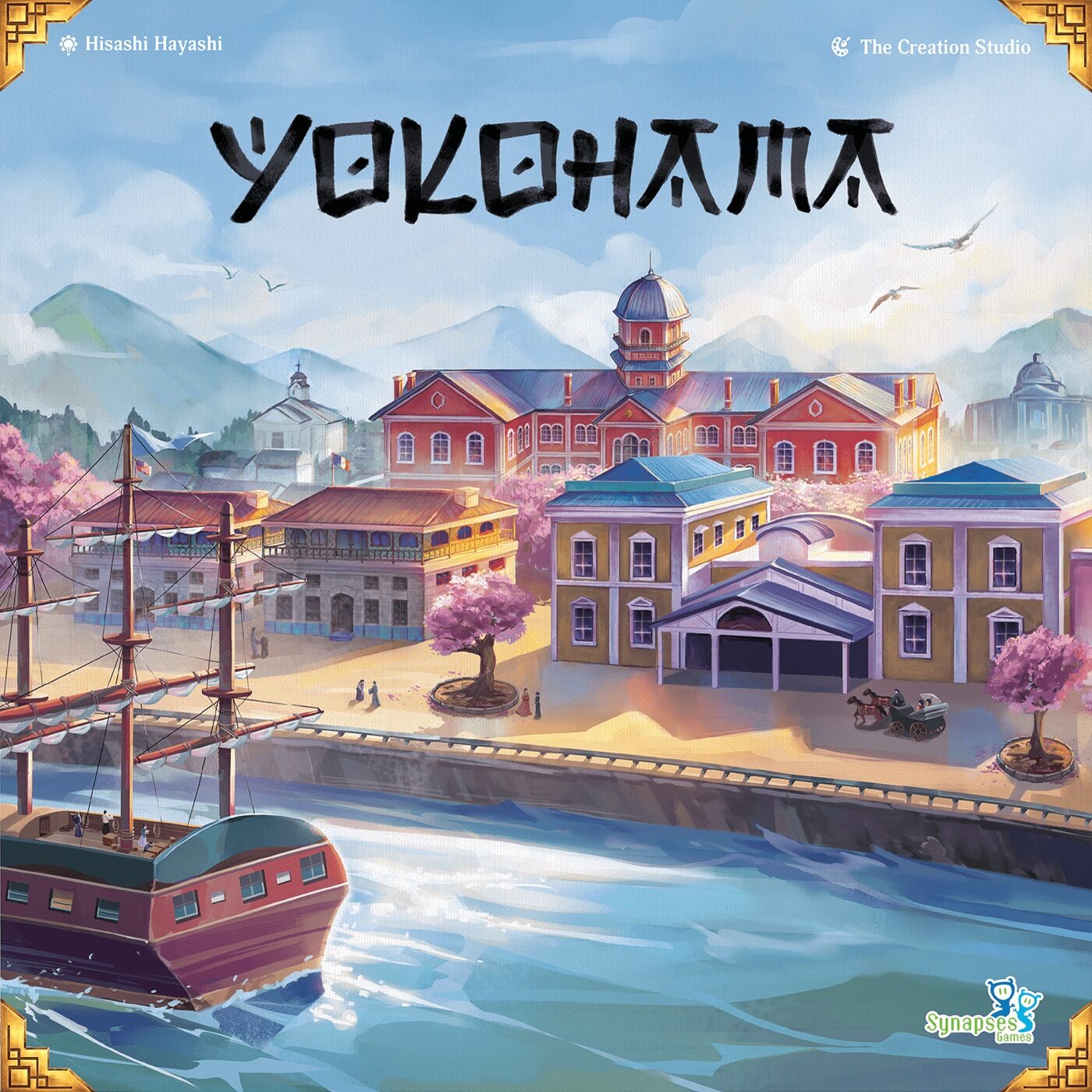
Here is a game that does almost everything right. It has a gorgeous table presence with vibrant Japanese artwork. It has a deeply satisfying central mechanism that is unlike anything else in the hobby. It has tremendous replayability through a modular board. It is designed by one of Japan’s most talented designers. It sits at #156 on BGG, rated 7.79 by nearly 14,000 people, with a strategy game rank of #116.
And yet, if you mention Yokohama at a game night, you will almost certainly get blank stares. In a world where everyone has an opinion about Brass, Terraforming Mars, and Great Western Trail, this game from 2016 has somehow slipped through the cracks of collective consciousness.
That is a shame. Because Yokohama is extraordinary.

The Setup: Meiji-Era Merchants in a Living City
It is 1859, and the port of Yokohama has just been opened to foreign trade. Japan is stepping out of centuries of isolation, and the merchants of Yokohama are scrambling to establish themselves as the most influential trading houses in the city. You are one of those merchants - building shops, fulfilling foreign trade orders, importing technology, and navigating the bustling streets of a city that is changing faster than anyone can keep up with.
The theme is not just pasted on. Every mechanism connects back to the idea of a merchant building influence across a modular cityscape. You physically move your president piece through the streets, leaving assistants behind like a trail of business connections, and the areas where you concentrate your workforce become your strongholds.
Yokohama plays 2 to 4 players in about 90 minutes and sits at a weight of 3.27/5 - firmly in medium-heavy territory, comparable to games like Concordia or Viticulture. It is best with 3 players according to BGG’s polls (153 votes for “Best”), though it plays well at 2 and 4 as well.
The Core Mechanism: Building Your Own Path
Here is what makes Yokohama special, and it is genuinely unlike anything else I can think of in board gaming.
Each round has two phases. First, everyone simultaneously places three assistants onto the modular board’s various districts. Then, in turn order, you move your president piece through adjacent districts, picking up the assistants you placed along the way. When your president arrives at a destination with enough combined power (president plus assistants), you take that district’s action - and the more assistants you have gathered there, the more powerful the action becomes.
This creates a fascinating spatial puzzle. You are not just choosing what to do - you are planning a route. Your president can only move through districts where you have at least one assistant, so every placement in the first phase is simultaneously an investment in a future action and a bridge to get there. Place poorly and your president is stranded. Place brilliantly and you chain together multiple powerful actions in a single turn, your president sweeping across the board like a merchant making rounds.
The beauty is in the tension between commitment and flexibility. You place assistants before you know what your opponents will do. Maybe you have lined up a perfect route to the Church (for prestige) through the Copper district (for trade goods) - but then another player’s president lands in the Copper district first, activating it with their assistants and potentially building a shop there. Suddenly your carefully planned route needs rethinking.
The Five Pillars: What You Are Actually Doing
Yokohama gives you five major areas to pursue, and trying to do all of them is a guaranteed route to mediocrity. The game rewards focus - but not tunnel vision.
Trade Orders are the bread and butter. Foreign ships want Japanese goods - copper, silk, tea, fish, pottery. Collect the right combinations and fulfil orders for points and bonuses. This is the most straightforward path to victory, but it requires consistent access to the production districts.
Technology cards give you permanent abilities and end-game scoring. Each technology you acquire makes your engine slightly more efficient, but they cost resources you could be spending on trade orders. The technology tree is where Yokohama’s long-term strategy lives.
The Church and Customs House are the prestige play. Building influence here requires specific resources but scores big - and the Church offers powerful one-time bonuses that can swing a game.
Shop Building is permanent territory. When you activate a district with enough power, you can build a shop there. Shops give you an assistant permanently stationed in that district, making future routes through it easier. A well-placed network of shops turns the board into your personal highway while everyone else is stuck navigating traffic.
The Canal is Yokohama’s quietest scoring path and often its most efficient. Advancing your boat along the canal scores points at certain milestones and grants bonuses. It is easy to ignore - and that is precisely why the player who doesn’t ignore it often wins.
Why Nobody Talks About It
So if the game is this good, why does it fly under the radar? A few reasons.
The Istanbul comparison. Yokohama draws frequent comparisons to Istanbul, Rüdiger Dorn’s Kennerspiel des Jahres winner from 2014. Both have you moving a piece around a modular grid of action spaces, leaving workers behind. Istanbul got there first and won an award for it. In many people’s minds, Yokohama is “that game that’s like Istanbul but heavier,” which is unfair but hard to shake. The games actually feel quite different in practice - Istanbul is a tight race where you optimise a delivery route, while Yokohama is a sprawling sandbox where you build an engine across multiple scoring dimensions - but first impressions stick.
The production quality split. The original Japanese OKAZU Brand edition and the Tasty Minstrel Games English edition had different art styles and component quality. Early copies had some production issues, and the game went through a somewhat confusing edition history. None of this affects how the game plays, but it muddied the waters for potential buyers.
Designer recognition. Hisashi Hayashi is brilliant. He also designed Trains (a deck-builder-meets-route-building game that deserved more love) and Sail to India (a micro-game with surprising depth). But Japanese designers rarely get the same hype cycle as their European or American counterparts. Hayashi does not have the name recognition of Lacerda, Rosenberg, or Pfister, and in a hobby where designer names drive purchases, that matters.
The rules overhead. Yokohama is not complicated by modern Euro standards, but it has a lot of stuff. Five scoring areas, a modular board with location-specific actions, technology cards, trade orders, the canal, area bonuses for districts where multiple players have shops. Your first game involves absorbing a lot of iconography and spatial concepts before the elegance of the design becomes apparent. People who push through that first play almost universally love the game. But that first play is a real barrier.
Who This Game Is For
Yokohama hits a specific sweet spot that very few games occupy.
If you love Concordia for its elegant simplicity but sometimes wish it had more crunch, Yokohama delivers. If you enjoy Great Western Trail for its route-based decision-making but want something with a tighter spatial puzzle, Yokohama has it. If you think Istanbul is a great game but too light, Yokohama is literally what you are looking for.
It scales well from 2 to 4, though it shines brightest at 3 where the board is contested enough to create tension without becoming chaotic. At 2 players, it becomes a more strategic affair with more planning certainty. At 4, it gets wonderfully combative as everyone’s routes collide.
It plays in about 90 minutes once everyone knows the game - snappy for its weight class. Setup takes a bit of time due to the modular board, but that same modularity means no two games feel the same.
The Verdict
Yokohama is the kind of game that makes you wonder how it ended up overlooked. It has a unique central mechanism that no other game replicates. It has multiple viable strategies that shift depending on the board layout and your opponents’ choices. It has gorgeous production values and a theme that actually connects to the gameplay. And it sits at a weight and play time that makes it accessible to anyone comfortable with medium-heavy Euros.
The BGG numbers back this up. A 7.79 rating from nearly 14,000 voters. A #116 strategy game rank. A weight of 3.27 that places it right in the meaty Euro sweet spot. And yet only about 19,000 people own it - a fraction of comparably ranked games.
If you have ever looked at your shelf and thought “I need something that feels genuinely different,” Yokohama is that game. It has been sitting at #156 on BGG for years, quietly being excellent, waiting for you to notice it.
Stop walking past it.
Yokohama is designed by Hisashi Hayashi, published by OKAZU Brand, with international editions from Tasty Minstrel Games and Synapses Games. It plays 2-4 players in approximately 90 minutes.