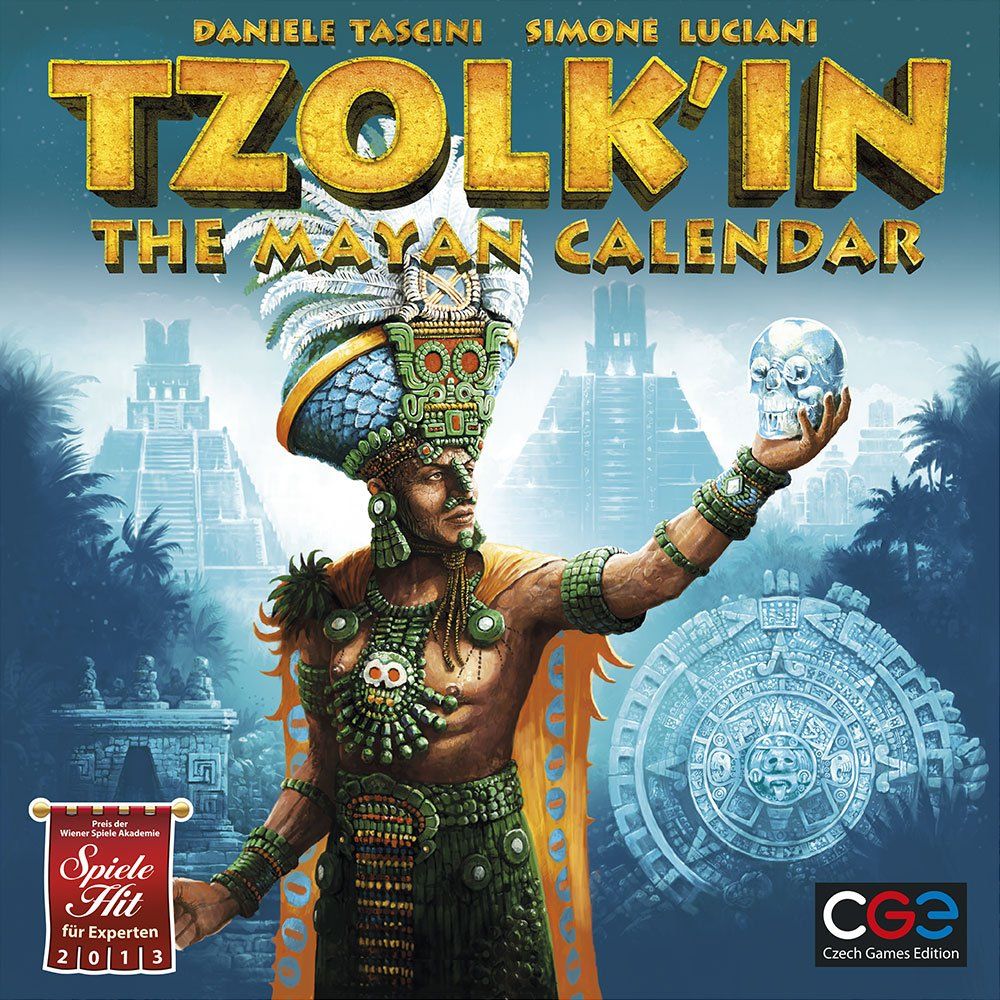
There’s a board game that physically ships with five interlocking plastic gears that turn together as a single mechanism - and the gears aren’t a novelty. They’re the entire game.
Tzolk’in: The Mayan Calendar sits at #74 on BoardGameGeek with a 7.85 rating from over 42,000 users. It has a devoted following, critical acclaim from game designers, and a completely unique mechanism that no other game in the hobby has replicated in the twelve years since its release.
And yet - outside of hardcore euro circles - almost nobody talks about it.
Ask ten non-obsessive board gamers if they’ve played Tzolk’in and you’ll likely get nine blank faces. Ask ten heavy-euro fans and at least six will tell you it’s one of their favourite games. That gap is exactly what a hidden gem looks like.
The Numbers (Verified via BGG)
| Stat | Value |
|---|---|
| BGG Rank | #74 Overall / #67 Strategy |
| BGG Rating | 7.85 / 10 |
| Users Rated | 42,551 |
| Weight | 3.66 / 5 |
| Players | 2-4 |
| Play Time | 90 minutes |
| Year | 2012 |
| Designers | Simone Luciani & Daniele Tascini |
| Publisher | Czech Games Edition |
That weight of 3.66 puts it firmly in heavy-euro territory - comparable to Brass: Birmingham (3.86) but noticeably lighter than Terra Mystica (3.99) or Twilight Imperium (4.22). It’s demanding enough to reward experienced players, accessible enough that a focused group can learn it in an evening.
What Makes It Different
Most worker placement games follow the same loop: place a worker to take an action, retrieve your workers at the end of the round, repeat. Tzolk’in throws that loop out entirely.
The board has five large plastic gears arranged around a central gear called the Tzolk’in wheel. Each round, the Tzolk’in turns - and all five gears turn with it. Workers placed on a gear don’t stay stationary. They advance with each rotation, moving from the weaker action spaces at the bottom of the gear toward the more powerful ones at the top.
This creates the central tension: place early for a low-powered action now, or wait for the gear to carry your worker to a stronger space?
Retrieving workers costs corn - the game’s primary resource. The longer you leave workers on the gears, the more powerful the action when you finally pull them off. But corn is tight, especially early, and if you can’t afford to retrieve you’ll quickly run out of actions entirely.
It sounds abstract. On the table, it’s startlingly intuitive. The gears visually show you where your workers are headed. You can see at a glance which workers are almost at powerful action spaces and which ones you should retrieve now before they miss the sweet spot. The mechanism creates a natural planning rhythm that clicks surprisingly fast.
The Five Gears
Each of the five outer gears governs a different area of the game:
Pakal - the smallest gear (6 teeth, cycles fastest). Corn and resource income. This is where you stabilise your food supply. Low-power actions but you visit them often.
Ixmucane - resource and building gear. Stone, wood, gold, and crystal skull production. Also the primary source of building tiles, which unlock passive bonuses.
Ixchel - tech tree gear. Each advancement on the three technology tracks (Chichen Itza, agriculture, extraction) bends the rules in your favour. The higher you climb, the cheaper things get.
Balam - monument and construction gear. Monuments score massively at the end of the game - but they’re expensive, and placement on Balam is competitive.
Kukulkan - the main gear, connected directly to the Tzolk’in wheel. The most powerful actions in the game: jump the temple tracks, score resources, gain the biggest bonuses. Also the most expensive to retrieve from.
Layered over everything are three temple tracks - Chaac (corn/water), Quetzalcoatl (skulls/crystals), and Kukulkan (central track). Scoring happens twice: at a mid-game checkpoint (around round 7) and at game end. Temple position creates a secondary competitive layer on top of the gear economy.
Why It Flies Under the Radar
Several things conspire to keep Tzolk’in off casual players’ radars, and none of them are about quality.
The gears look like a gimmick. Every description of Tzolk’in leads with “it has spinning gears.” That phrasing makes it sound like a novelty - the kind of thing that’s visually impressive but mechanically shallow. The opposite is true. The gears are the reason the game is good. But you wouldn’t know that from a first glance at the box.
The theme is niche. “Mayan civilisation economic worker placement” is not a pitch that travels well at game nights. It’s not that the theme doesn’t work - it does, the calendar motif integrates beautifully into the rotation mechanic - but it’s harder to sell than “build a train network” or “cultivate a vineyard.”
It came out in 2012. The board game market in 2026 is vastly more crowded than in 2012. Games that didn’t build sustained YouTube/TikTok presence in recent years tend to get buried under new releases. Tzolk’in reviews from its launch era are sparse by modern standards, and it rarely appears in newcomer recommendation threads.
It punishes passive play. New players who don’t retrieve workers efficiently will run out of corn and grind to a halt. This can create rough first games that put people off, even though the solution (keep your corn income healthy early) is relatively simple once understood.
What Players Actually Say
The BGG community is remarkably consistent on what makes this game land.
One reviewer put it plainly: “The gear mechanism isn’t just clever - it forces you to plan two or three rounds ahead, which is exactly the kind of thinking a game like this should reward.”
The corn-retrieval tension comes up constantly: “It feels terrible when you’re corn-poor and can’t pull workers off. It feels amazing when you’ve planned your economy properly and you pull off a triple-retrieve chain.”
A common sentiment from people who bounced off it initially: “I thought the gears were just decoration until my second game. Once I stopped trying to map it onto regular worker placement games and treated it as its own thing, it clicked completely.”
There’s also a consistent thread about replayability. The tech tree, monument selection, and four distinct player strategies (corn-rush, skull economy, tech-heavy, monument-focus) mean that experienced groups report games feeling genuinely different run to run, even after 20+ plays.
Who It’s For
Heavy-euro players who’ve exhausted the standard worker placement canon - Agricola, Viticulture, Architects of the West Kingdom - and want something that operates on a completely different axis.
Planners and spatial thinkers. The gear mechanism is visual and intuitive. If you like watching a system unfold and finding the optimal moment to act within it, this is your game.
Groups that play the same games multiple times. Tzolk’in rewards investment. The first play is about surviving and learning the rhythm. Play two is where the strategy opens up.
Fans of Daniele Tascini’s other work. Tascini co-designed this alongside Simone Luciani, and you can feel the DNA shared with Tzolk’in and his later titles. The interlocking economy, the multiple scoring dimensions, the texture of decisions that compound across the game - it’s the same designer voice.
Who It Isn’t For
Players who want narrative or theme. Tzolk’in is an abstract puzzle dressed in Mayan clothes. The theme is coherent and the calendar imagery is genuinely beautiful, but nothing happens to you. If you need story, events, or surprise cards to stay engaged, this won’t scratch that itch.
Two-player seekers. Tzolk’in works at two players, but the competitive pressure on action spaces and the reading-opponent’s-timing element is greatly diminished. It’s a notably better experience at three or four.
Impatient or analysis-prone groups. Watching the gears turn doesn’t speed up decision time. With an AP-prone group, a four-player game can push past two hours. The mechanism rewards deliberate play but can frustrate players who want to move faster.
Players who need to love a game on the first play. The corn-retrieval rhythm takes a game to internalise. Your first play will likely involve at least one catastrophic run-dry moment. If that kind of learning-by-failing kills your enjoyment, the ROI isn’t there.
The Verdict
Tzolk’in: The Mayan Calendar is one of those games where “ranked #74 on BGG” actually undersells how good it is. Not because the ranking is wrong - it’s hard to argue with 42,000 ratings - but because the number doesn’t capture how unlike anything else the experience is.
Every worker placement game asks you to time your actions. Tzolk’in makes the passing of time visible - you can watch your workers riding the gears toward the spaces you need, calculating exactly when to pull them back and what the corn will cost you. It’s a different kind of pressure to the snap-the-last-spot urgency of Agricola or the tableau-building patience of Viticulture.
If you’ve played most of the canonical heavy euros and want something that operates on entirely different mechanical logic, Tzolk’in is the answer hiding in plain sight. It’s been sitting quietly in the BGG top 100 for over a decade. It’s time more people found it.
BGG link: Tzolk’in: The Mayan Calendar