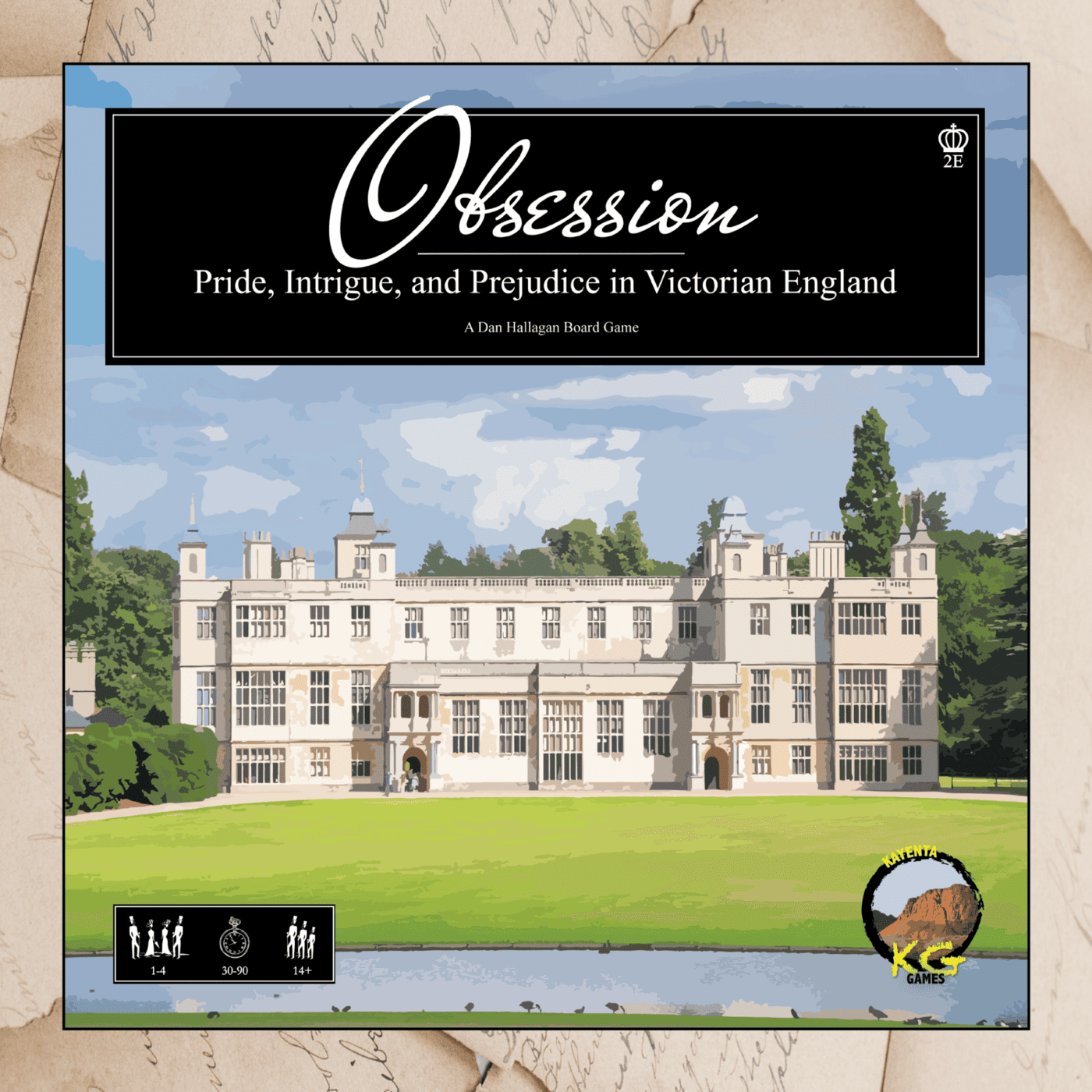
There’s a specific kind of board game that sits in a strange blind spot: critically adored, mechanically brilliant, and somehow completely unknown to anyone who isn’t already deep into the hobby.
Obsession is that game.
It’s ranked #67 on BoardGameGeek with an average rating of 8.07 from nearly 20,000 votes - yet you won’t find it in a single high-street game shop. Most people who discover it stumble across it through a random Reddit recommendation or a YouTube deep-dive, fall completely in love, and then spend three weeks trying to explain to friends why a Victorian estate management game is one of the best things they’ve ever played.
This is that explanation.
The Hook: Downton Abbey as a Board Game
The premise is elegant and immediately evocative. You are the head of a once-respected but now financially struggling English family estate in mid-19th century Derbyshire. Your goal: rebuild your reputation, renovate your manor, and establish your family as a premier force in Victorian social society - ideally before your rivals do the same.
Concretely: you’re building a deck of Victorian gentry (guests who come to your estate), constructing building tiles into your manor (which unlock new actions and spaces), hosting elaborate social events, and accumulating the prestige and favour that comes with navigating the unspoken rules of the British upper class.
The result plays like Downton Abbey designed by a board game nerd who also loves Viticulture. Every turn you’re making decisions about who to invite to your dinner parties, which renovations to commission, and how to allocate your limited household staff. The flavour text on cards is witty. The Victorian photography artwork on the guest cards is genuinely atmospheric. And somehow, through all of this theme, the underlying engine-building loop is tight, tense, and rewarding.
“I cannot seem to play without speaking in a snooty Victorian England voice.” - BGG user, 9/10
That’s not a coincidence. This is what exceptional theme-mechanic integration looks like.
How It Actually Plays
Obsession is a 16-20 turn game played across four rounds (the seasons). Each turn follows a clean, satisfying structure:
- Rotate your staff - workers who’ve been busy come back to service
- Select an activity - from your estate buildings or the shared market
- Invite guests - draw from your deck of gentry and assign them to the activity
- Resolve the event - gain resources, reputation, favours, or recruit new guests
The core tension is in the deck-building layer. Your hand of gentry represents your social circle - the quality and composition of that circle determines what you can accomplish. High-society guests unlock better events. Well-connected families open doors to advantageous courtship arrangements. Tradespeople give you access to building discounts. Over the course of the game you’re curating a social network, and the deck you end up with is a mechanical portrait of your strategy.
The building tiles are the other half. Each building you add to your estate unlocks a new type of action or enhances an existing one. You’re not just building to have more options - you’re building towards a specific playstyle. An estate focused on reputation gains plays very differently to one optimised for guest recruitment.
Player count: 1-4 | Play time: 30-90 min | BGG Weight: 3.11
That weight sits firmly in the medium-heavy zone. This is not a gateway game. But it’s nowhere near the complexity ceiling either - experienced Euro players will feel at home within two turns.
What Makes It Actually Good
Plenty of games have interesting themes and solid mechanics. What separates Obsession is how thoroughly the two are fused.
The Workers Are Your Servants
In most worker placement games, your meeples are abstract. In Obsession, they’re your household staff - butler, housekeeper, footman, ladies’ maid, cook. Each one has a distinct role, and they’re assigned to activities that feel plausible given who they are. The butler assists at formal dinners. The footman handles outdoor sporting events. The cook (obviously) manages kitchen operations.
When workers are “exhausted” and need to rest, it’s framed as staff being occupied with existing duties. It sounds like pure flavour. In practice, it creates genuine planning constraints that feel thematic rather than arbitrary.
The Guest Cards Do Real Work
Your deck isn’t a collection of anonymous cards with stat blocks. Each guest belongs to a specific family, has a defined social rank, and brings particular skills or connections to events. Inviting a medical professional to a dinner party lets you fulfil certain objectives. Securing a courtship between families requires having the right gentry available at the right moment.
The card artwork - period Victorian photography with painterly overlay - is striking on the table. Players consistently report that the tactile experience of laying out guest cards for an event genuinely feels like running an estate.
The Arc Is Satisfying
Obsession has a clear game arc that most engine-builders lack. Early turns, you’re scraping together resources with a weak deck and a half-renovated estate. Mid-game, your engine starts to fire - better guests, better buildings, better events. Late game, you’re executing your strategy at full efficiency while watching the prestige clock tick down.
“The game arc is very satisfying because often it feels like everything comes together in the final stretch.” - BGG user, 9/10
That progression from struggling newcomer to polished Victorian host isn’t just thematic narrative - it’s a mechanical journey that every player experiences at their own pace and in their own direction.
The Reputation System: Where It Gets Clever
Obsession uses reputation as both currency and victory condition, and the way it works is more interesting than it first appears.
Reputation is scored publicly on a track that all players share. But the types of reputation matter - social prestige, cultural refinement, sporting prowess, and so on. Different objectives reward different combinations. Which means two players can both be climbing the reputation track in wildly divergent ways and both be entirely correct in their approach.
This creates indirect competition that feels very true to the setting. You’re not directly attacking your rivals (this isn’t that kind of game). You’re competing for the same guests from the communal market, racing to build before a limited tile sells out, and watching each other’s estates develop with a certain aristocratic anxiety.
“Player interaction is good - this is not a solitaire multiplayer game, there is genuine competition for market tiles and guests.” - BGG user, 9/10
Solo Mode: Genuinely Excellent
Obsession’s solo mode deserves special mention because it’s not an afterthought. You play against an automa (the Fairfax family) with well-designed AI behaviour, variable difficulty levels, and enough mechanical personality to make the competition feel real.
The automa management is straightforward - BGG consensus rates it as notably easy to run without slowing down the game. Yet the difficulty curve is real. Experienced solo gamers report the hardest Fairfax settings being legitimately punishing.
“Great solo mode. Nice gameplay that runs smoothly. Easy automa management. Many different automa to beat.” - BGG user, 8.75/10
For solo euro players who’ve exhausted Viticulture, Ark Nova, and Wingspan’s solo modes, Obsession offers something meaningfully different: a focused, thematic, medium-weight game that plays in 45-60 minutes solo and rewards careful planning without demanding spreadsheet-level optimisation.
One Real Caveat: The Expansions Help
The base game of Obsession is excellent. The expansions - particularly Upstairs, Downstairs - make it significantly better.
The base game has a reputation for slightly punishing randomness in the guest market and objective scoring. Upstairs, Downstairs addresses this directly with additional buildings, more guest variety, and refinements to how objectives are distributed. Multiple BGG reviewers describe it as a near-mandatory purchase.
“The base game is very luck-heavy and [Upstairs, Downstairs] fixes this.” - BGG user, 9/10
The Useful Box expansion is also worth investigating if you plan to play regularly - it adds low-VP monument tiles and several quality-of-life variants that tighten up edge cases in the base game.
If you’re buying Obsession, budget for Upstairs, Downstairs from the start. The good news: you can also try the base game free on Board Game Arena before committing.
The Numbers Don’t Lie
| Stat | Value |
|---|---|
| BGG Rank | #67 |
| Average Rating | 8.07 / 10 |
| BGG Weight | 3.11 / 5 |
| Players | 1-4 |
| Play Time | 30-90 min |
| Year Published | 2018 (2nd ed. 2021) |
For context: Wingspan sits at BGG #38 with 8.00. Everdell is #45 with 7.98. Obsession at #67 with 8.07 is in the same tier - and yet Wingspan has over 160,000 BGG ratings while Obsession has fewer than 20,000.
That gap is the hidden gem effect in action.
Who Should Play This
Obsession is for you if:
- You love Viticulture’s combination of tableau-building and thematic storytelling
- You enjoy Wingspan but want more mechanical depth and player tension
- You’re drawn to historically-grounded themes (British history, Regency/Victorian era)
- You want a satisfying solo experience that plays in under an hour
- You appreciate games where the theme enriches rather than sits on top of the mechanics
It’s probably not for you if:
- You prefer direct conflict and take-that mechanics
- You want something you can teach in five minutes to non-gamers
- You’re put off by randomness in market tiles (the expansions help; the base game doesn’t fully solve it)
- Victorian social hierarchy sounds more exhausting than entertaining
The Bottom Line
Obsession is what happens when a designer builds exactly the game they want to build, with no concessions to commercialism or mass-market accessibility, and the result is a minor masterpiece that flies completely under the radar because there’s no publisher with a marketing budget behind it.
BGG rank #67 is not a fluke. The 8.07 average from nearly 20,000 players is not inflated enthusiasm. This is a genuinely excellent game that deserves to be on more shelves.
The best place to start is Board Game Arena - the base game is available free, and it’ll tell you within a session whether the theme hooks you. If it does, you’ll be ordering the physical copy and the Upstairs, Downstairs expansion within the week.
Play it before the secret gets out.
Obsession (2018/2021) - 1-4 players, 30-90 minutes, BGG weight 3.11. Designer: Dan Hallagan. Publisher: Kayenta Games. BGG rank #67, average rating 8.07.