Uwe Rosenberg has a name-recognition problem - and it’s the exact opposite of what you’d expect. Everyone knows Agricola. Everyone’s heard of Caverna and A Feast for Odin. His big, sprawling, feed-your-family-or-suffer epics dominate “best euro” lists and BGG rankings. But hiding in their enormous shadows is a game that does almost everything better in half the time and a fraction of the table space.
That game is Nusfjord, and it might be the single most underappreciated worker placement game of the last decade.
The Numbers Don’t Lie (But They Do Mislead)
Let’s start with the elephant in the room. Nusfjord has 7,349 ratings on BoardGameGeek. For context:
| Game | BGG Rating | Weight | Ratings |
|---|---|---|---|
| Agricola | 7.86 | 3.64/5 | 69,000+ |
| Caverna | 7.92 | 3.78/5 | 33,000+ |
| A Feast for Odin | 8.16 | 3.87/5 | 33,000+ |
| Nusfjord | 7.64 | 2.85/5 | 7,349 |
That’s roughly one-fifth the exposure of its siblings. And that rating - 7.64 - is dragged down by sheer obscurity, not quality. Among people who actually play it, the reception is overwhelmingly positive. The Opinionated Gamers review summed it up perfectly: this is the Rosenberg game that people who play it keep coming back to, while the big-box titles collect dust between sessions.
What Even Is Nusfjord?
You’re running a fishing company in a tiny Norwegian village in the 1970s. That’s the pitch, and yes, it sounds about as thrilling as a spreadsheet about herring. Stay with me.
Over seven rounds, you place three workers per round on a shared action board. You’re catching fish, issuing shares in your company, hiring village elders, chopping forests, and constructing buildings. Everything connects to everything else in a web of tight, interlocking resource loops that reward planning three rounds ahead.
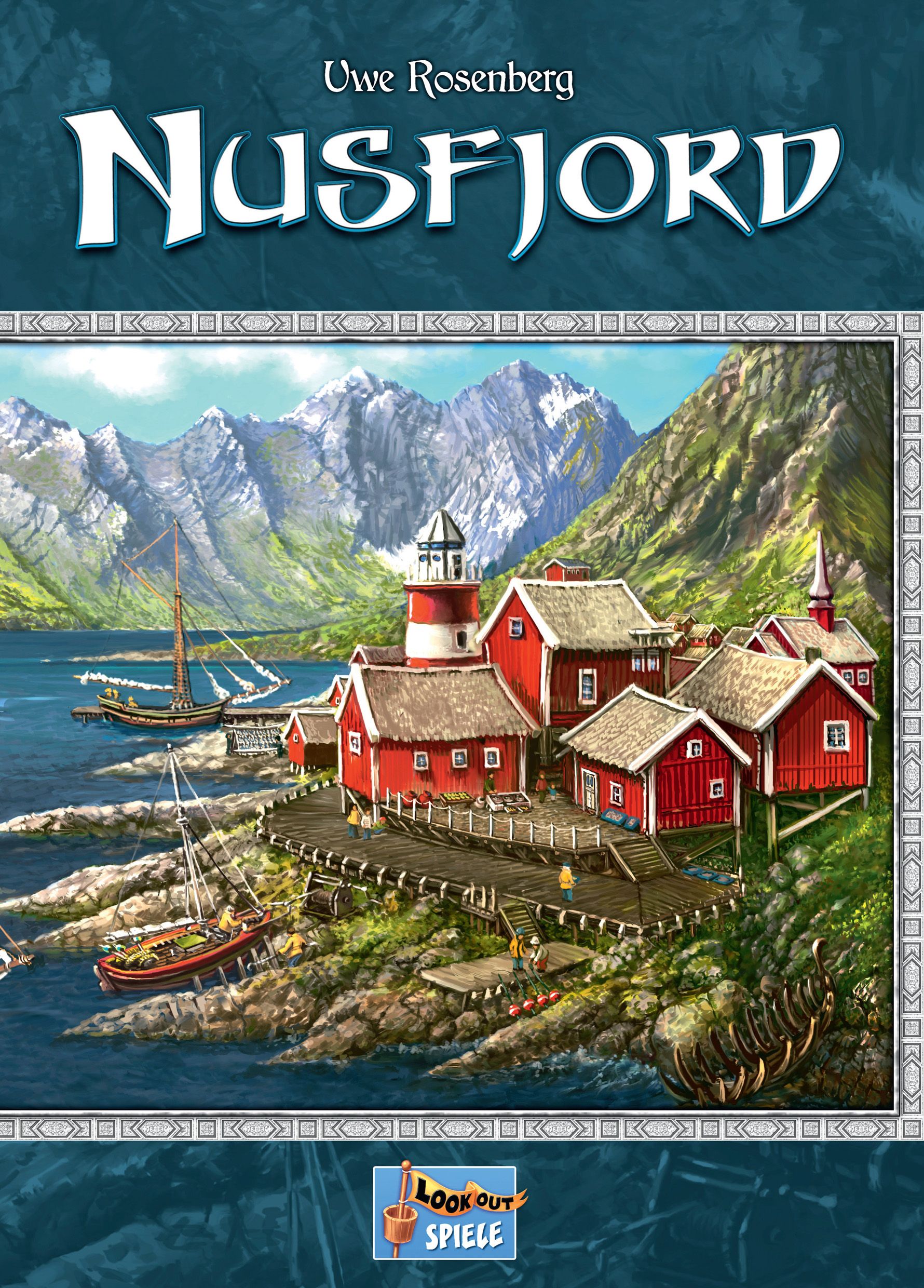
 Box art: Lookout Games
The genius is in the shares mechanism. You start with five shares in your own company. You can sell them for quick gold - two gold per share, no questions asked. But every share you’ve sold means fish from your catch go to whoever bought it instead of to you. It’s a loan with compound interest paid in mackerel, and it creates the most agonising short-term-vs-long-term decisions in any Rosenberg game.
Meanwhile, the elder system forces communal tension. Elders give you powerful special actions, but activating them requires fish from a shared banquet table. When it empties, someone has to sacrifice their own fish to refill it - gaining gold but losing crucial resources. It’s a game of chicken played with wooden fish tokens, and it’s brilliant.
Why It Gets Overlooked
Three reasons, all unfair:
1. It launched alongside monsters. Nusfjord came out in 2017, the same year people were still digesting A Feast for Odin (2016). Rosenberg fatigue was real. Reviewers who’d spent 40 hours on Odin’s puzzle-piece bonanza didn’t have bandwidth for another Rosenberg, especially one that looked… simpler.
2. The theme is aggressively mundane. Vikings raiding is sexy. Farming with subsistence anxiety is dramatic. Norwegian fishing villages in the 1970s is… nice? The box art is lovely (those misty fjords), but it doesn’t scream “buy me” the way a snarling Viking on Caverna’s cover does.
3. It’s “only” a 2.85 weight. In an era where heavy euros get the hype, Nusfjord sits in the mid-weight sweet spot that doesn’t generate Reddit threads titled “finally conquered this beast.” Nobody writes a love letter about a game they learned in ten minutes. But that accessibility is a feature, not a bug.
The Case for Nusfjord Over the Big Three
Here’s where I pick a fight with Rosenberg’s own catalogue.
Against Agricola (Weight: 3.64)
Agricola is magnificent, but it’s also a stress simulator. The feeding requirement turns every round into crisis management, and teaching it to new players means watching them slowly realise they’re already starving by round three. Nusfjord keeps the tight action-blocking that makes Agricola sing while ditching the punitive survival loop. You’re building an engine, not running a triage unit.
Also: Nusfjord plays in 45-60 minutes with experienced players. Agricola routinely runs 2+ hours. That matters when you’re an adult with responsibilities.
Against Caverna (Weight: 3.78)
Caverna is Agricola’s kinder, fatter sibling - more choices, less punishment, more components spilling off the table. The problem is that all those choices make it less interesting, not more. When you can do everything, nothing matters much. Nusfjord’s constrained action board (fewer spaces, more blocking) creates genuine tension on every single worker placement. The tightness is the point.
Against A Feast for Odin (Weight: 3.87)
Odin is Rosenberg’s magnum opus and I won’t pretend Nusfjord is “better” - they’re different animals. But Odin takes 2-3 hours, needs a table the size of a small country, and has a learning curve that requires a dedicated teaching session. Nusfjord delivers 80% of the satisfaction in 30% of the time. If you love Odin but can’t always commit to it, Nusfjord is the answer.
What Makes It Sing
The three decks. Each game uses one of three building decks - Herring, Mackerel, or Cod - and each fundamentally changes your strategy. The Herring deck rewards efficient fishing empires. The Mackerel deck leans into elder manipulation. The Cod deck introduces wildcard strategies. It’s like having three games in one box, and it means your fiftieth play feels different from your fifth.
The player count flexibility. This is a genuine 1-5 player game that works at every count. Solo is a tight puzzle. Two players is a knife fight over action spaces. Three to four is the sweet spot - enough blocking to create drama, fast enough to finish in an hour. Even five works, though the downtime ticks up slightly.
The pacing. Seven rounds, three actions each. Twenty-one decisions and you’re done. No filler rounds, no “setup phase” that takes four turns before anything interesting happens. From your very first action, you’re making meaningful choices with real consequences.
The teach. Ten minutes. Maybe fifteen if your group asks a lot of questions. Compare that to Agricola’s 30-minute rules explanation followed by a practice round, or Odin’s “let me show you these sixty different action spaces.” Nusfjord respects your time at every stage.
Who Should Buy This
- Rosenberg fans who don’t always have 2+ hours for Agricola or Odin
- Mid-weight euro lovers who want something meatier than Viticulture but less exhausting than Brass
- Solo gamers looking for a tight, replayable puzzle (the solo mode is excellent)
- Gateway graduates ready to step up from Lords of Waterdeep or Stone Age
- Anyone who’s ever said “I’d play more heavy games if they were shorter”
Who Shouldn’t
- If you need conflict, interaction, or negotiation, Nusfjord’s shared-action-space blocking is the only friction you’ll find. This is a parallel-engine-building euro, not a war game.
- If you want spectacle. The components are functional but unexciting. No miniatures, no oversized boards, no “wow” factor when you open the box.
- If “only” three decks of variety isn’t enough. Some players burn through the novelty faster than others.
The Verdict
Nusfjord is the best argument for restraint in game design. In a genre that keeps adding more - more components, more hours, more complexity, more everything - Nusfjord proves that less can be more. It’s Uwe Rosenberg at his most disciplined, and it deserves far more than 7,349 ratings buried at rank #381.
If you own any of the big Rosenberg titles and they’re gathering dust because you never have two free hours, Nusfjord is your rescue. If you’ve never played a Rosenberg game at all, it’s the perfect entry point. Either way, it belongs on your shelf.
BGG Weight: 2.85/5 · Players: 1-5 · Time: 20-100 min · BGG Rating: 7.64/10 · Rank: #381
Have a hidden gem we should cover? Let us know on Twitter.