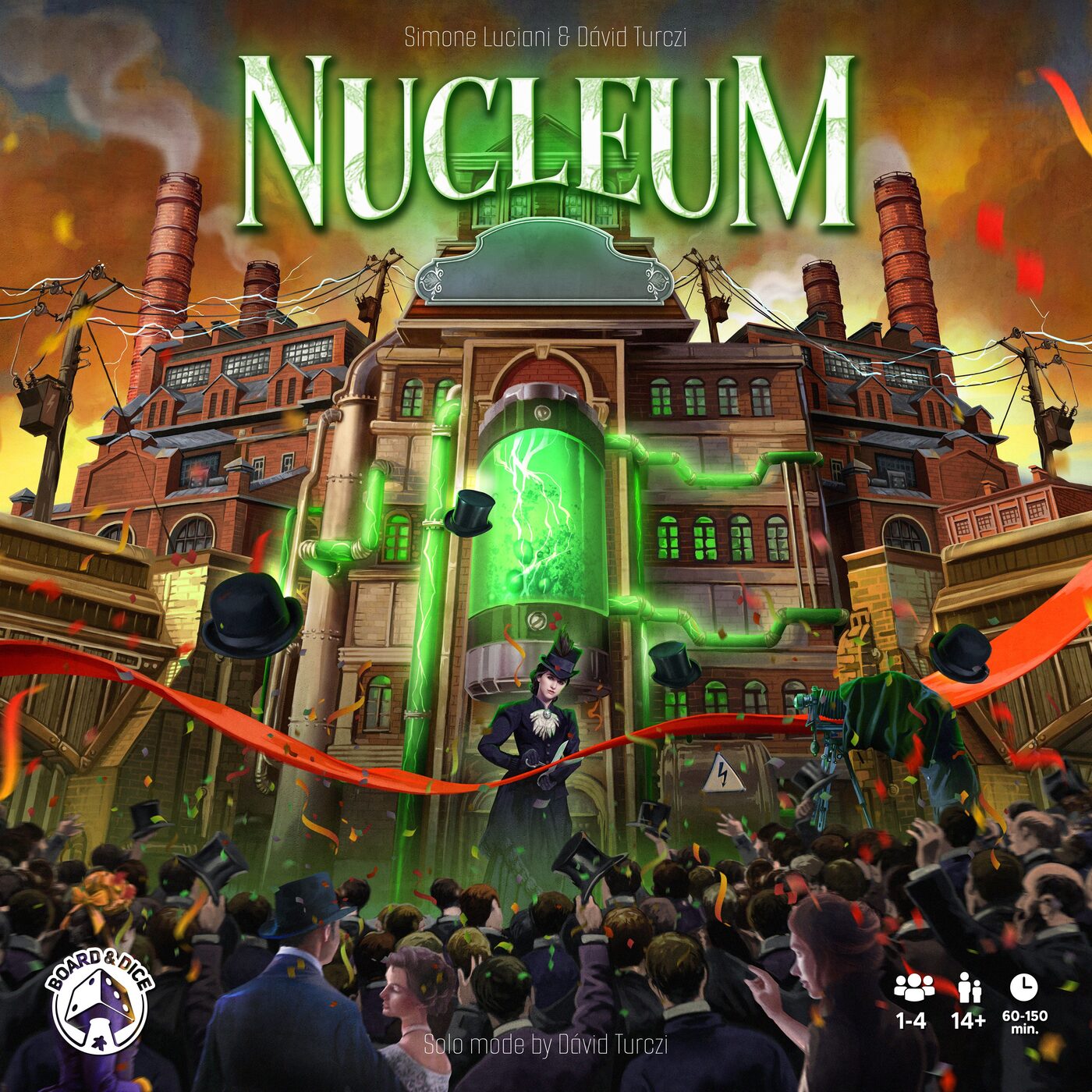
There is a quiet corner of BoardGameGeek that most people never visit. It sits just outside the household names - Wingspan, Catan, Gloomhaven - and just below the critical darlings everyone discusses at every game night. This is where Nucleum lives.
Nucleum carries a BGG rating of 8.11, placing it among the best-reviewed board games in history. It holds the #131 all-time rank on the world’s largest board game database. And yet it has been rated by fewer than 9,000 people - a fraction of what you’d expect for a game at that altitude. For context, Brass: Birmingham sits at rank #1 with nearly 60,000 ratings. Nucleum is operating at a comparable quality level with about one-seventh of the attention.
That is the definition of a hidden gem.

The Premise: Nuclear Power in 1800s Saxony
Here is the hook that separates Nucleum from every other heavy euro on your shelf: the premise.
It is an alternate history. In this version of the 19th century, a scientist named Elsa von Frühlingsfeld demonstrates a device called the Nucleum to the King of Saxony - a machine that uses uranium-powered atomization to generate steam and electricity. The invention transforms Saxony from a minor regional power into the industrial hub of Europe. A generation later, factories are hungry for more power, and you are one of the industrialists racing to build the infrastructure to deliver it.
Nuclear power. Railways. Power lines. Factories. 19th century Saxony. Designed by Simone Luciani (Marco Polo, Tzolk’in, Grand Austria Hotel) and Dávid Turczi (known for some of the best solo modes in the hobby).
This is not the story of industrial England or the canals of Birmingham that you have already played five times. It is weirder, more distinctive, and more memorable for it.
The Core Mechanism: Action Tiles That Do Two Things
Nucleum’s central design decision is elegant and unusual. Your actions are performed using a set of action tiles, and every single tile in the game serves two distinct purposes depending on how you play it.
When you take a turn, you choose one of your available action tiles and either:
- Play it as an action - using the tile’s ability (build a factory, extend your network, import uranium, etc.) and then permanently placing that tile on the board to build your route network.
- Activate it on your player board - adding it to a queue of actions you can fire in sequence on a future turn, then retrieving it when you Rest.
That dual-use design creates a constant, meaningful tension. Every time you want to take a powerful action, you are also deciding whether to commit that tile to your board network forever - extending your reach across Saxony and unlocking scoring potential - or to bank it for a burst turn where you chain multiple actions in sequence.
The Rest action - where you retrieve all your banked tiles - is one of the most interesting design details. It resets your queue and refreshes your options, but it costs you your full turn. Managing when to Rest, how deep to run your queue before refreshing, and which tiles to sacrifice permanently to the board is where Nucleum’s strategic depth lives.
It is a system that rewards players who think several turns ahead. And it punishes reactive play in a satisfying, fair way.
Building Your Network
The board is a map of Saxony, covered in cities connected by potential rail and power-line routes. Your goal is to build a contiguous network that reaches factories, uranium mines, and scoring cities - and to fuel your Nucleums (the reactors at the heart of your engine) with the uranium you import along the way.
Network building in Nucleum does not feel like a chore. Every extension you make opens up new city connections, new scoring opportunities from completed contracts, and new efficiency in your resource chain. The network is not just a point tracker - it is a physical representation of your industrial reach, and watching it grow across the map across four to five rounds is genuinely satisfying.
Contrast this with other network builders: in Brass: Birmingham the network is your production chain, but it resets between eras in a way that can feel disconnected. In Nucleum, your network is permanent and cumulative. Every tile you place is there for the rest of the game, compounding your efficiency and your reach. The payoff builds slowly but hits hard in the final rounds.
Variable Player Powers Done Right
Each player starts with an asymmetric company tile that grants a unique ongoing ability - a different Nucleum capacity, a resource advantage, a bonus action trigger, or a different cost structure for specific actions.
The asymmetry is meaningful without being overwhelming. You do not need to read five pages of unique rules for each character. You read one ability, understand how it shifts your approach, and then play the same game as everyone else - just slightly differently.
This kind of light-touch asymmetry tends to produce the best outcomes in heavy euros. It gives each player a different strategic lens without fragmenting the ruleset into five different games happening at the same table.
The End Game: Racing Toward Conditions
Nucleum ends when the group collectively triggers a set number of victory conditions. These are public milestones - a certain number of factories built, enough cities connected, specific tech achievements reached - and when enough of them fall, the final round triggers.
This creates a natural accelerating tension. Early in the game, everyone is building quietly, extending networks and acquiring technology. But as conditions start ticking off, the game shifts into a race. Someone pushes hard on a condition you needed, the end trigger moves a round closer, and suddenly your carefully planned sequence of actions needs to compress into fewer turns than you expected.
It is the kind of end-game pressure that rewards players who have been watching the shared conditions all game rather than just staring at their own board. Nucleum rewards awareness.
Who Is This Game For?
Nucleum sits firmly in heavy euro territory at a BGG weight of 4.2 out of 5, which puts it in the same bracket as Food Chain Magnate and Lacerda’s heavier designs. This is not a game you hand to someone who enjoyed Ticket to Ride last Christmas.
But for the right player - and specifically, for fans of network building, engine construction, and multi-layer action management - Nucleum is outstanding.
If you loved Brass: Birmingham but want something more tightly constructed around a single expanding engine rather than a two-era structure, Nucleum delivers. If you enjoyed Marco Polo and want to revisit Luciani’s design sensibility in a completely different mechanical setting, this is where to look. If you have been hunting for a solo-friendly heavy euro with real solo depth (Turczi’s solo mode is excellent, as you’d expect from the master of solo modes in the hobby), Nucleum belongs in your basket.
It is best avoided by:
- Players who want significant direct conflict (Nucleum is parallel-solitaire with shared board competition, not a combat game)
- Groups who bounce off long setup times or complex iconography
- Anyone who finds heavy euros frustrating to teach - the first game is absorbing and rewarding, but getting there requires patience
The Numbers Behind the Claim
Let the data speak plainly.
| Stat | Value |
|---|---|
| BGG Rating | 8.11 |
| BGG Rank | #131 all time |
| Ratings Count | ~8,750 |
| Weight | 4.2 / 5 |
| Players | 1-4 |
| Play Time | 60-150 min |
| Year | 2023 |
| Designers | Simone Luciani & Dávid Turczi |
For reference: Wingspan, rated similarly highly, has over 100,000 BGG ratings. The games sitting near Nucleum in the all-time ranks - Food Chain Magnate, Twilight Imperium, Pandemic Legacy - all have far larger communities. Nucleum is punching above its weight class in quality while flying completely under the cultural radar.
That gap will not last forever. As more players discover it - through the Nucleum: Australia expansion which shipped in 2024, through word of mouth, through articles like this one - the rating count will grow and the rank will stabilise. Right now, in mid-2026, you are still ahead of the curve.
The Verdict
Nucleum is not a game that announces itself loudly. It does not have a famous licence, a whimsical animal theme, or a designer whose name alone generates pre-orders. It is a quiet, precise, deeply satisfying heavy euro that rewards careful planning and long-term thinking.
The 8.11 BGG average from nearly 9,000 voters is not an accident. This game earns every fraction of that rating through a central mechanism that is genuinely novel, a network-building system that compounds meaningfully over time, and a variable power structure that gives each game a slightly different feel without overwhelming the ruleset.
If you have a game group that can handle the weight and enjoys spending an evening building an industrial empire in a world where nuclear power was invented a century early - Nucleum deserves a place on your table.
Nucleum is designed by Simone Luciani and Dávid Turczi, published by Board&Dice. It plays 1-4 players in 60-150 minutes. BGG weight: 4.2/5.