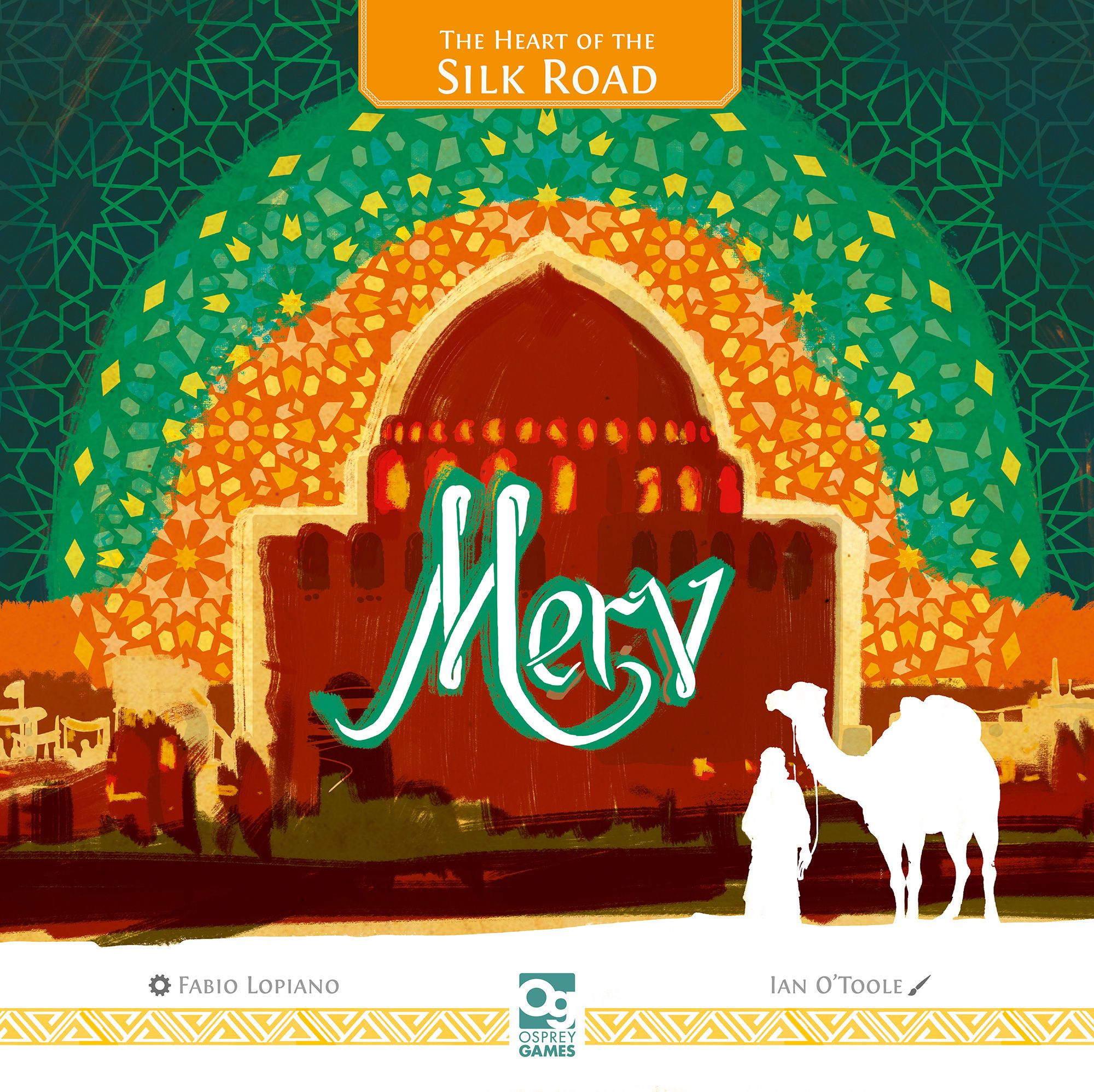
There’s a particular kind of euro game that doesn’t want you to feel clever. It doesn’t hand you a satisfying engine that hums along, spitting out resources while you lean back and admire your tableau. Instead, it grabs you by the collar every single turn and says: “Choose. And know that whatever you pick, you’re giving something up.”
Merv: The Heart of the Silk Road is that game. Designed by Fabio Lopiano and illustrated by the ever-brilliant Ian O’Toole, this 2020 release from Osprey Games has quietly become one of the most respected mid-weight euros among people who’ve actually played it - while remaining almost completely invisible to the broader hobby.
The Numbers Tell a Story
Here’s the gap between Merv’s quality and its reach:
| Game | BGG Rating | Weight | Ratings | Rank |
|---|---|---|---|---|
| Dune: Imperium | 8.41 | 3.08/5 | 58,188 | #6 |
| Scythe | 8.10 | 3.45/5 | 93,162 | #26 |
| Merv | 7.48 | 3.44/5 | 4,637 | #773 |
Look at that weight rating - 3.44 out of 5, nearly identical to Scythe. Merv operates at the same complexity tier as some of the hobby’s most celebrated designs. Yet it has roughly one-twentieth the exposure. That’s not a quality problem. That’s a visibility problem.
So What Actually Happens in Merv?
The year is roughly 1200 CE. Merv - historical capital of the Seljuk Empire and the largest city in the world at the time - sits at the crossroads of the Silk Road. Players are merchants and courtiers jockeying for wealth and influence as trade caravans roll through. It sounds standard enough. It isn’t.
The centrepiece is a 5×5 grid of buildings arranged around the city. On your turn, you move a shared pawn along the outside edge of the grid (a rondel-like mechanism) and activate a row or column of buildings. Here’s the twist: you only activate buildings you’ve built in that line. Other players’ buildings? They get activated too, giving them resources. The player who built the most in that line gets to choose which action type to take first.
This creates a brilliantly agonising spatial puzzle. Building in popular rows means your buildings fire more often - but so do everyone else’s. Building in neglected corners gives you exclusivity - but fewer activations. Every placement is a negotiation between frequency and control.
The Mongol Problem
And then there are the Mongols.
At the end of each of the game’s three years, a Mongol raid strikes. Unprotected buildings in the attacked rows burn. Gone. Not damaged - destroyed. You can invest in building walls to protect them, but wall-building costs you precious actions that could have gone toward trading, courting favour at the mosque, or establishing caravans.
This is where Merv distinguishes itself from nearly every other euro on the market. Most mid-weight euros let you safely build your engine and optimise in peace. Merv introduces genuine loss. Not “you scored fewer points than you might have.” Actual destruction of things you built. The threat of the Mongols warps every decision from turn one, creating a tension that most euros simply don’t have.
Do you over-invest in walls and fall behind economically? Do you gamble, leaving buildings exposed and hoping the raid hits a different row? Do you deliberately build disposable structures in vulnerable positions, extracting value before they burn? Every approach is valid. None feel safe.
Why It Flew Under the Radar
Three factors conspired against Merv:
Timing. It released in 2020, the year the hobby industry went haywire. Distribution was disrupted, conventions were cancelled, and games that relied on word-of-mouth struggled to find their audience.
Publisher profile. Osprey Games makes excellent products but doesn’t have the marketing muscle of a CMON or Stonemaier. Their games tend to be discovered rather than hyped - which works for some titles (Undaunted broke through) but leaves others languishing.
Designer recognition. Fabio Lopiano is phenomenal but not yet a household name. His other designs - Ragusa (BGG rating 6.91, weight 2.81) and the more recent Zapotec - share Merv’s DNA of tight, interlocking mechanisms without flashy hooks. He’s a designer’s designer, respected by those who know his work but lacking the instant name recognition of a Lacerda or Pfister.
Who Is This Actually For?
Merv thrives with players who:
- Want tension in their euros. If you think most worker placement games feel like multiplayer solitaire, Merv’s shared-activation system forces you to care deeply about what everyone else is doing.
- Enjoy spatial puzzles. The 5×5 grid isn’t just flavour - it’s the entire decision space. Where you build matters as much as what you build.
- Can handle loss. The Mongol raids will test you. If losing a building you spent two turns constructing makes you flip the table, this isn’t your game. If it makes you want to play again smarter, it absolutely is.
- Appreciate 90-minute experiences. At a listed play time of 90 minutes, Merv delivers a remarkably dense decision space without overstaying its welcome.
Best player count? The BGG community is clear: 4 players (69 votes for “Best”) is the sweet spot, with 3 also excellent. At 2, it’s functional but loses some of the shared-activation tension. Solo mode exists but isn’t where the game shines.
The Ian O’Toole Factor
It would be criminal to discuss Merv without mentioning the art. Ian O’Toole - the artist behind Brass: Birmingham, On Mars, and The Gallerist - delivers one of his most beautiful boards here. The Silk Road palette of warm golds, deep blues, and terracotta reds gives the game a visual identity that’s immediately distinctive. The graphic design is characteristically clean, with iconography that’s readable at a glance once you’ve played a round or two.
This is a game that looks as good as it plays, which makes its obscurity all the more puzzling.
The Verdict
Merv: The Heart of the Silk Road sits at #773 on BGG’s overall rankings, quietly outperforming its meagre 4,637 ratings. For a game with this level of design craft - from a designer on the rise, with art from one of the industry’s best, published by a company known for quality - that position should be at least 300 ranks higher.
If you’ve ever wished your favourite euro had real stakes, genuine player interaction beyond blocking a worker placement spot, and a historical theme that actually informs the mechanisms - Merv is waiting for you. It’s been waiting since 2020. And frankly, it’s been patient enough.
Merv: The Heart of the Silk Road is available from Osprey Games and most major board game retailers.
Have you played Merv? Did the Mongols burn your best buildings? Tell us about it on Twitter/X.