There’s a corner of the board game shelf that exists in the shadow of giants. You’ve got Terraforming Mars (BGG top ten, over 100,000 ratings), you’ve got Twilight Imperium (the weekend-eating behemoth for dedicated space nerds), and you’ve got Scythe, which somehow convinced everyone it’s a sci-fi game. And just behind all of them, quietly accumulating a devoted following, sits Beyond the Sun - a game rated higher than most of what you’re currently playing.
Beyond the Sun holds a BGG rating of 7.86, placing it at #114 overall and #77 in strategy games. It does this with fewer than 18,000 ratings - a fraction of the attention commanded by the household names in the same weight class.
This isn’t a game that slipped past without notice because it’s mediocre. It slipped through because the sci-fi worker placement space already had occupants, and most people never looked around.
Here’s why you should.
What It Is
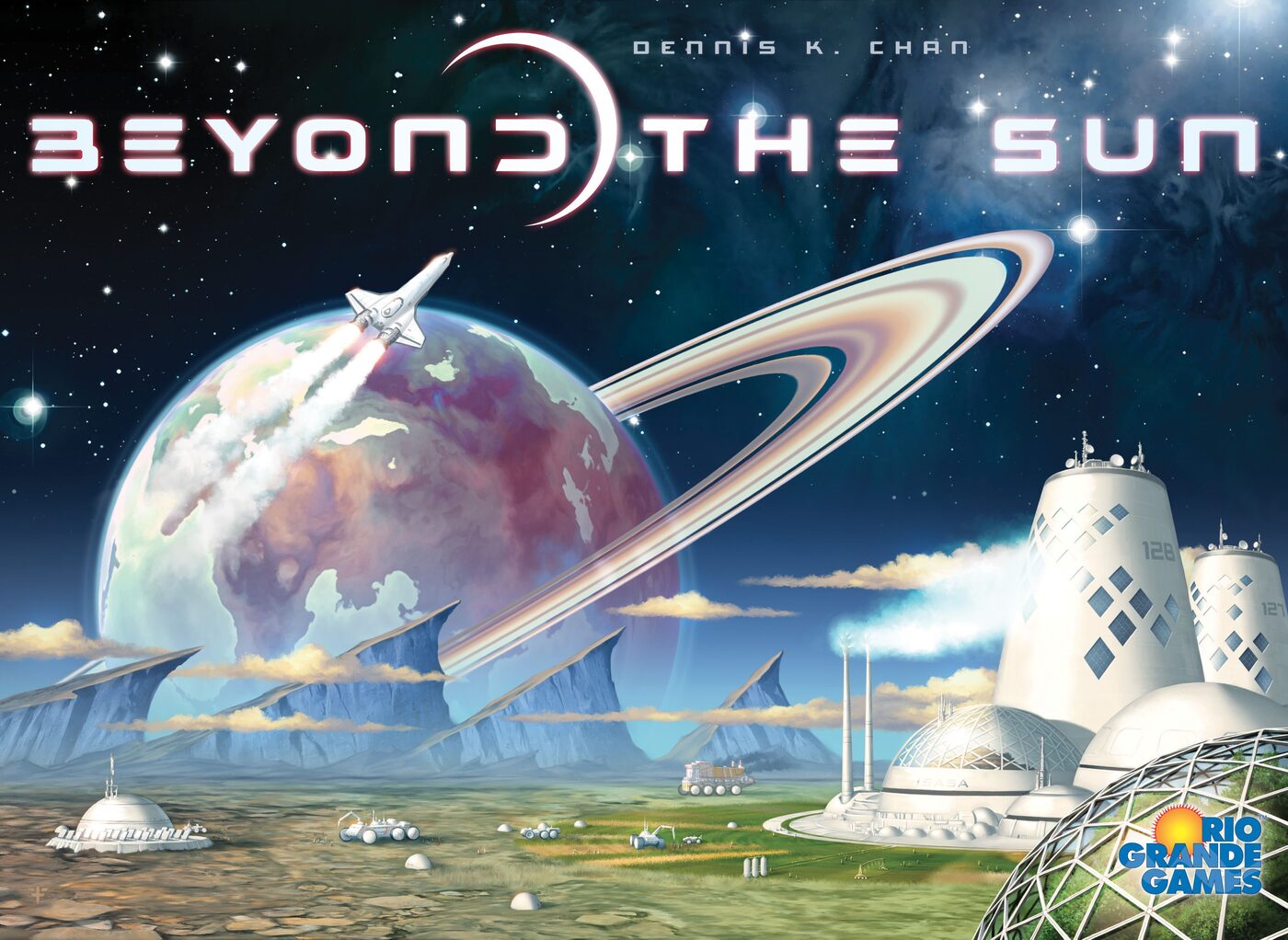
Beyond the Sun is a civilization-building game set in the far future, designed by Dennis K. Chan (his debut major design) and published by Rio Grande Games in 2020. You’re leading a faction of humanity’s interstellar expansion - researching new technologies, claiming star systems, and building the infrastructure to sustain a civilization across the galaxy.
Key stats (verified BGG data):
| Stat | Value |
|---|---|
| BGG Rating | 7.86 / 10 |
| BGG Rank | #114 overall / #77 strategy games |
| Ratings Count | ~17,876 |
| Weight | 3.15 / 5 |
| Players | 2-4 |
| Play Time | 60-120 minutes |
| Year | 2020 |
| Designer | Dennis K. Chan |
| Publisher | Rio Grande Games |
The weight places it in comfortable mid-to-heavy territory: lighter than Brass: Birmingham (3.86) and Spirit Island (3.77), broadly comparable to Terraforming Mars (3.26). This is a game you can realistically finish in a focused evening with experienced players.
The Core Mechanic: A Tech Tree That Belongs to Everyone
Here is what makes Beyond the Sun mechanically distinct from anything else in its weight class.
The central board isn’t a map of space. It’s a technology tree - a branching network of technologies organized across four eras, from basic propulsion and resource extraction through advanced terraforming, wormhole navigation, and interstellar colonization.
Every player takes turns placing workers on this shared tree. When you research a technology, you unlock it - for everyone. The technology becomes available for all factions to develop from that point forward. You don’t own it exclusively. You pioneered it.
That single design decision changes the entire character of the game.
It creates a constant, dynamic question: should you research something new, or exploit what someone else already unlocked? The researcher gets first-mover advantage - often a bonus action or an immediate resource payoff - but the technology immediately becomes accessible to competitors. You’re essentially funding R&D for the whole table.
This produces a genuinely collaborative-competitive tension that you won’t find in Terraforming Mars, where corporations play almost entirely in parallel with occasional collisions. In Beyond the Sun, you’re watching the tech tree evolve turn by turn, reading which paths your opponents are developing, and deciding whether to race them to the next tier or branch into territory they’re ignoring. The shared tree makes each game feel like a collective story unfolding - one where you happen to be competing.
The Space Layer
While the shared tech tree drives research, the game’s second half plays out on a star map - a collection of star systems that players can explore, develop, and colonize.
Claiming a star system costs an action and the right technology unlock, but it pays off through ongoing production bonuses, scoring objectives, and control over rare resources. The map is modular: the available systems change game to game, and the technologies that unlock access to them scale across the four eras of play.
The push and pull between “spend actions advancing the tech tree” and “spend actions claiming space” is where the game’s strategic depth lives. A faction that spends all its time in the research tree falls behind on territory and scoring position. A faction that races to colonize without the right technological foundation runs dry on production. Leaning too hard on either track is punished.
This two-layer structure - research on the shared tree, expansion on the map - keeps Beyond the Sun interesting across repeated plays. Different tech paths produce meaningfully different games.
The Action Economy
Beyond the Sun uses a clean worker-placement structure. On your turn you place one worker on the tech tree or the star map, take your action, and that’s your turn. No complex chaining, no hand management - just a clear, readable action space that scales naturally with player count.
What makes the decisions feel weighty is precisely the shared-board tension. A slot you take on the tech tree is one your opponent cannot take this round. A star system you claim is gone from the pool. Every action is simultaneously building your engine and constraining someone else’s options.
The game ends when a set of shared progress goals are met - civilizations developed, technologies researched, star systems colonized. These public milestones create a natural pace across the four eras, and the group collectively drives toward the finish line even as individual players compete. You always know roughly when the game is ending. The question is whether you’re positioned to score when it does.
How It Compares to Terraforming Mars
The comparison is unavoidable. Both games are sci-fi strategy games in the 3.0-3.5 weight range with technology development as a core element. But they’re playing fundamentally different games.
Terraforming Mars is a card-engine builder. Technology comes from a giant deck - you draft, buy, and chain card synergies. The satisfaction is in combo discovery and watching your private tableau grow. It’s largely parallel-solitaire play; you’re building your engine, they’re building theirs, and you occasionally brush up against each other.
Beyond the Sun is a worker placement game built around a shared board. Technology emerges from collective decisions. You’re not discovering combos in a hand of cards - you’re watching a research tree evolve in real time and positioning yourself relative to every other faction’s choices.
If you want card synergy and emergent engine-building from a randomized card pool, Terraforming Mars delivers more of that. If you want shared strategic tension, a cleaner action economy, and a game where other players’ decisions directly shape your strategy every turn, Beyond the Sun is the stronger choice. They’re genuinely different games wearing similar clothes.
Who It’s For
Beyond the Sun is the right call if:
- You enjoy worker placement with genuinely meaningful placement decisions
- You want sci-fi strategy without Twilight Imperium’s eight-hour commitment
- You like games where other players’ decisions change your strategy, not just your score
- Your group has played Terraforming Mars to death and wants something different in the same weight class
- You’re looking for a design that teaches cleanly - the rulebook is well-organized and the central concept clicks fast
It’s probably not for you if:
- You want strong direct conflict or combat - this is a race with blocking, not a war
- Your group prefers the satisfaction of private card engines over shared board competition
- The idea of researching a technology that your opponents immediately gain access to feels punishing rather than interesting (some players bounce off this concept; others love it)
The Verdict
Beyond the Sun doesn’t announce itself loudly. It has no famous licence, no crossover IP, no viral moment that generated a pre-order surge. What it has is a genuinely clever central mechanic - the shared, evolving technology tree - that produces a different kind of strategic conversation than anything else in its weight class.
The 7.86 BGG rating from nearly 18,000 voters tells you this isn’t a fluke or a small-sample-size effect. It’s a well-executed, well-balanced game that rewards board awareness and long-term positioning.
Dennis Chan’s debut design is one of the more underappreciated entries in the modern worker placement canon. If you haven’t played it, that’s worth correcting.
Beyond the Sun is designed by Dennis K. Chan, published by Rio Grande Games. It plays 2-4 players in 60-120 minutes. BGG weight: 3.15/5.