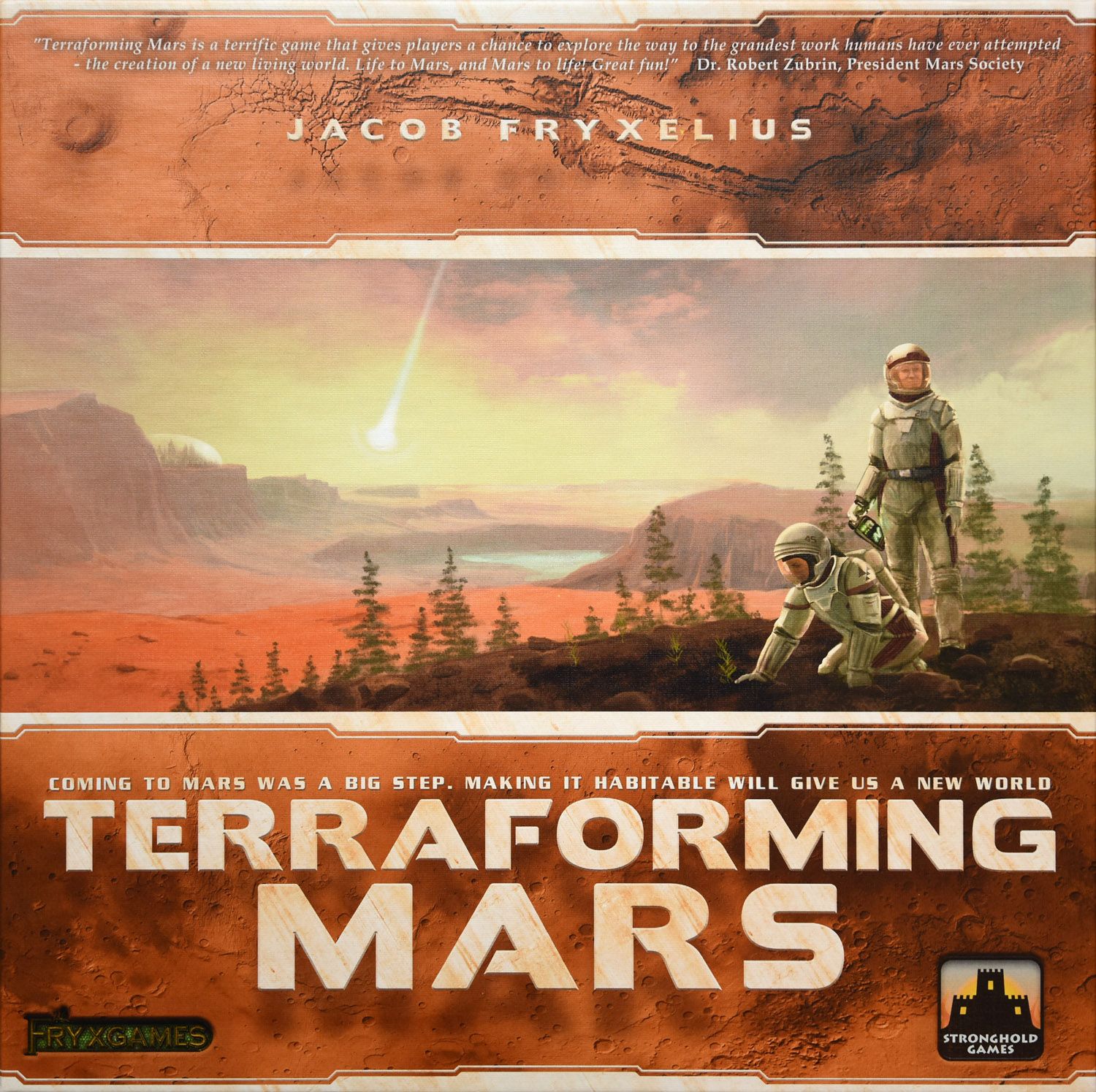
There’s a question that circles every heavy games table at some point: Terraforming Mars or Ark Nova?
Both are card-engine heavyweights. Both sit near the very top of BGG - Ark Nova at #2 with an 8.54 average, Terraforming Mars at #9 with an 8.34 average. Both give you a personal player board, a market of cards to draft from, and a satisfying sense of building something over 2-3 hours. Both have excellent solo modes. Both will eat your evening.
So which do you actually buy?
The answer depends on what you want from a heavy game - and the differences between them are more significant than the surface similarities suggest.
At a Glance
| Terraforming Mars | Ark Nova | |
|---|---|---|
| BGG Rank | #9 | #2 |
| Rating | 8.34 | 8.54 |
| Weight | 3.27 / 5 | 3.80 / 5 |
| Players | 1-5 | 1-4 |
| Play Time | ~120 min | 90-150 min |
| BGG ID | 167791 | 342942 |
| Publisher | FryxGames | Feuerland Spiele |
| Year | 2016 | 2021 |
The Theme: Red Planet vs Conservation Biology
This one actually matters more than it sounds.
Terraforming Mars puts you in charge of a corporation tasked with making Mars habitable. You’re raising the temperature, flooding lowlands to create oceans, and seeding the atmosphere with oxygen - all through a cascade of played cards representing projects, tech, and scientific breakthroughs. The theme is expansive and optimistic, even if the mechanisms are mostly abstract. Cards reference asteroid mining, genetically engineered plants, nuclear reactors - it feels like building a civilisation.
Ark Nova has you building and running a modern zoological park. You’re acquiring animals, constructing enclosures, launching conservation projects, and managing sponsor relationships. The theme is unusually coherent for a euro game - the conservation project track, the animal abilities tied to their real-world classifications, the way your zoo layout affects what you can build next. Players who bounce off euros because they feel “pasted on” often find Ark Nova a revelation.
Neither theme is better - they’re genuinely different. If science fiction and space exploration get you excited, Terraforming Mars will pull you in harder. If you care about animals or want a euro with an unusually coherent real-world theme, Ark Nova delivers something special.
How They Play: Where the Designs Diverge
Both games have you playing cards from a hand, generating resources, and working toward a shared end condition. But the moment-to-moment experience is quite different.
Terraforming Mars: Concurrent progress toward a global board
Every round, you take turns alternately playing cards or passing. Cards cost money (Megacredits) and produce effects - placing greenery tiles, generating steel, boosting your heat production, scoring VP. The game ends when all three global parameters (temperature, oxygen, oceans) are maxed out, which means the end-game timing is a function of the table’s collective effort.
This creates a fascinating shared pacing dynamic: you’re racing to complete your engine while also nudging global progress when it benefits you, and sometimes withholding progress to delay the game ending before you’re ready. The project cards are the heart of the game - there are over 200 of them, and the randomness of what appears drives variety and forces adaptation.
Ark Nova: Two asymmetric tracks with a clever meeting condition
Ark Nova’s end condition is genuinely novel. You have two tracks - Conservation Points (you want this high) and Appeal (you want this high too, but it starts at 22 and counts down as the Appeal track decreases). The game ends when the two markers meet or cross. This creates a constant tension: you can focus on building appeal quickly but risk ending the game before your conservation engine fires, or go deep on conservation projects and lose on appeal.
The five action cards - Animals, Sponsors, Conservation, Build, and Cards - each have a power level that increases as you use them less frequently. Every time you take the most-powerful action, it gets shuffled to the weak end. This means your action sequence is a rhythm game about managing card strength - a mechanic that takes a full game to click but creates enormous decision space once it does.
Ark Nova is the more complex system. Its weight on BGG (3.80 vs 3.27) reflects this accurately - not because it’s harder to understand, but because the interaction between your zoo layout, your card hand, your action card states, and both scoring tracks creates more simultaneous variables to track.
Complexity and Learning Curve
Both games punish new players with a first session that looks worse than it is.
Terraforming Mars is deceptively readable on the surface - the icons are reasonably intuitive, the production mechanics feel familiar, and the turn structure is simple. But first-timers regularly underspend, mistime the game end, and lose by 20+ points. It takes two or three plays to develop the instinct for when to play cards versus when to save.
Ark Nova has a steeper first-session cliff. The action-card rotation system confuses everyone the first time. The scoring mechanism - with its two diverging tracks - is not obvious until you’ve played it. Most groups need to pause mid-game during session one to re-read rules. Session two is dramatically better.
If you’re introducing non-gamers or infrequent players: Terraforming Mars is the slightly more manageable entry point. If everyone at the table is a regular gamer happy to front-load complexity: Ark Nova.
Player Counts
Terraforming Mars plays 1-5, and some argue the 2-3 player game is actually the sweet spot. At 5 players, games can run 3+ hours and the downtime between turns is real. The solo mode uses a dedicated bot ruleset.
Ark Nova caps at 4 and genuinely scales well across that range. The 2-player game is fast and tactical. The 3-4 player game adds interaction around the limited zoo cards and conservation project competition. The solo mode is particularly polished - Ark Nova is consistently cited as one of the best solo games on BGG.
If you regularly play with 5 people: Terraforming Mars is your only option here. Otherwise, both work across their supported player counts.
Solo Modes
This is worth dwelling on because both games are genuinely excellent solo.
Terraforming Mars solo sets you against a timer: you must complete all three global parameters within 14 generations. It’s a puzzle-y race against the clock with clear win/loss criteria and good challenge across difficulty levels. Less narrative, more optimisation.
Ark Nova solo uses an automa system with a bot that occupies conservation projects and zoo tiles, competes for card drafts, and adjusts difficulty cleanly. The interaction feels more genuine - the bot is actually competing rather than just providing an external constraint. BGG solo poll data has Ark Nova rated “Best” for solo by a large margin.
Solo-first players: Ark Nova has the edge, and it’s not close.
Expansions and Longevity
Terraforming Mars has a mature expansion ecosystem after nearly a decade: Hellas & Elysium, Venus Next, Colonies, Prelude, Turmoil, and the re-imagined Ares Expedition card game. If you fall in love with the base game, there’s a clear upgrade path.
Ark Nova launched with Marine Worlds (2023), which adds a significant aquatic layer and is widely regarded as a strong expansion that integrates cleanly rather than bloating the system.
Longevity-wise, both games have deep replayability from card variance alone. Neither game overstays its welcome with expansions.
The Verdict: Which Should You Buy?
They’re not competing for the same slot in your collection - they do different things well enough that heavy game fans often want both. But if you’re choosing one:
Buy Terraforming Mars if:
- You want the more accessible entry into heavy euros
- You regularly play with 5 players
- You love the science-fiction / space colonisation theme
- You want a game with a decade of expansions to explore
Buy Ark Nova if:
- You want the deeper, more tightly designed modern system
- Solo play is a priority
- You prefer coherent, real-world theme over abstract science fiction
- You’re ready to front-load some complexity for a more rewarding long-term game
If the question is which game is better designed in 2026 terms, most serious heavy gamers would point to Ark Nova - its action system and dual-track scoring represent more interesting design than Terraforming Mars’s somewhat older engine. BGG’s rankings reflect this: Ark Nova at #2, Terraforming Mars at #9. That gap is meaningful.
But Terraforming Mars is still an all-timer for a reason. It launched a wave of tableau engine-builders, it handles 5 players, it’s more approachable, and it remains deeply satisfying. Calling it the lesser game ignores context.
The short version: new to heavy euros → Terraforming Mars first. Already have one → Ark Nova next. Solo-focused → Ark Nova, full stop.
All data sourced from BoardGameGeek. Ratings and ranks as of June 2026.