
Two nature-themed engine builders. Both gorgeous. Both in the BGG Top 50. Both sitting on wishlists worldwide, often right next to each other.
Everdell and Wingspan get compared constantly - and it makes sense. On the surface they look almost interchangeable: cards, animals, icons, engines, pretty art. But spend a couple of hours with each and you’ll realise they’re solving very different design problems. The mistake is treating this as a “buy one or the other” decision without knowing what each actually does.
This is the breakdown that should have existed from the start.
The Quick Numbers
| Everdell | Wingspan | |
|---|---|---|
| BGG Rank | #46 | #38 |
| BGG Rating | 7.97 | 7.99 |
| Weight | 2.83 / 5 | 2.48 / 5 |
| Players | 1-4 | 1-5 |
| Play Time | 40-80 min | 40-70 min |
| Year | 2018 | 2019 |
| Publisher | Starling Games | Stonemaier Games |
Both are rated almost identically by the BGG community. Wingspan edges into the top 40, Everdell sits just below. The meaningful difference is the weight gap: Everdell is notably heavier (2.83 vs 2.48), and that single number carries a lot of information about the actual play experience.
What Each Game Is Actually Doing
Everdell: Worker Placement Meets City-Building
Everdell is a worker placement game at its core - but your workers are woodland critters, and you’re building a small city of up to 15 cards beneath the Great Tree. Each season you gain more workers, the events on the board shift, and the resource economy evolves.
The tension in Everdell comes from the card construction chain. Many building cards reduce the cost of workers; many critter cards are free if you’ve built the corresponding building. So you’re constantly triangulating: build the Farm now to get Berries? Or place a worker to grab resources and build later? The engine is built through a sequence of interdependent decisions, not just by playing the most expensive cards you can afford.
There’s also a shared destination board where you’ll be competing for spaces - running out of workers (and knowing when to call the season) is a genuine constraint.
The seasonal structure adds rhythm. You don’t just play until someone runs out of actions; the game breathes through its four seasons, each one opening new strategic lanes. That structure gives Everdell a narrative feel that pure point-salad euros sometimes lack.
Wingspan: Habitat Engine, Cascading Activations
Wingspan is less about planning a construction chain and more about building a cascade. You play birds to one of three habitats - forest, grassland, wetland - and each habitat gives you a different base action. The magic is that when you take a habitat action, every bird already in that row activates its power, in order.
A good Wingspan engine looks like a rube goldberg machine. You place one card in your wetland and suddenly four birds fire off: one draws a card, one lays eggs on other birds, one tucks a card underneath for bonus points, one gives you food. By the end of the game, a single action can do five or six things in sequence.
The depth in Wingspan comes from reading which birds compose well, which end-of-round goals are realistic, and which habitat to prioritise. It’s a lighter and more organic kind of puzzle than Everdell - less about planning a specific build path, more about opportunistically chaining what the card market offers you.
Where They Diverge: The Key Differences
Complexity and Teaching
Wingspan wins this clearly. It’s the easier game to teach - the three habitats map directly onto actions, and the cascading bird powers are readable on the cards. Non-gamers pick it up. It’s one of the rare games that a “not really a board gamer” friend will genuinely enjoy.
Everdell has more moving parts: the multi-resource economy, the event board, the construction chains, the seasonal transitions, what counts as a Building vs. Critter vs. Destination. None of it is hard, but there are more concepts to get off the ground. The first game almost always involves a lot of “oh, I didn’t realise I could do that.”
Verdict: Wingspan for new players. Everdell once people have a few games under their belt.
The Player Count Sweet Spot
Wingspan handles five players, which is unusual for a mid-weight euro. At high player counts, the bird card market cycles quickly, which adds a market-pressure dynamic that doesn’t exist at two. Wingspan at five is chaotic in a fun way.
Everdell is best at two to three players. At four, the shared destination board gets congested fast, resources can feel scarce, and the game extends notably. Two-player Everdell is a particular sweet spot - tight, tactical, genuinely competitive.
If you’re regularly playing with four or five people, Wingspan has the edge. If your group is typically two or three, Everdell shines brighter.
Solo Mode
Both games include solo modes, and both are worth playing. But they work differently.
Wingspan’s Automa system is one of the most polished solo implementations in modern board gaming. The Automa deck simulates an opponent that competes for end-of-round goals and narrows the card market - it’s not quite a full AI opponent, but it creates real pressure. Setup is fast, teardown is fast, and the difficulty scales cleanly across three levels.
Everdell’s solo mode uses a Rugwort villain antagonist - a rat who competes for special cards and spaces, runs his own agenda, and punishes you for ignoring him. It’s thematic in a way the Automa isn’t, and the game’s tree centrepiece makes solo setup visually satisfying. That said, it’s a less refined experience than Wingspan’s, and the community consensus on r/soloboardgaming tends to favour Wingspan’s solo slightly for consistency.
BGG solo poll data:
- Everdell: Best (565), Recommended (855), Not Recommended (283)
- Wingspan: Best (2,047), Recommended (2,431), Not Recommended (415)
Wingspan’s much larger vote sample reflects its bigger audience, but the proportion recommending solo play is also slightly higher. For dedicated solo play, Wingspan is the stronger pick.
Replayability
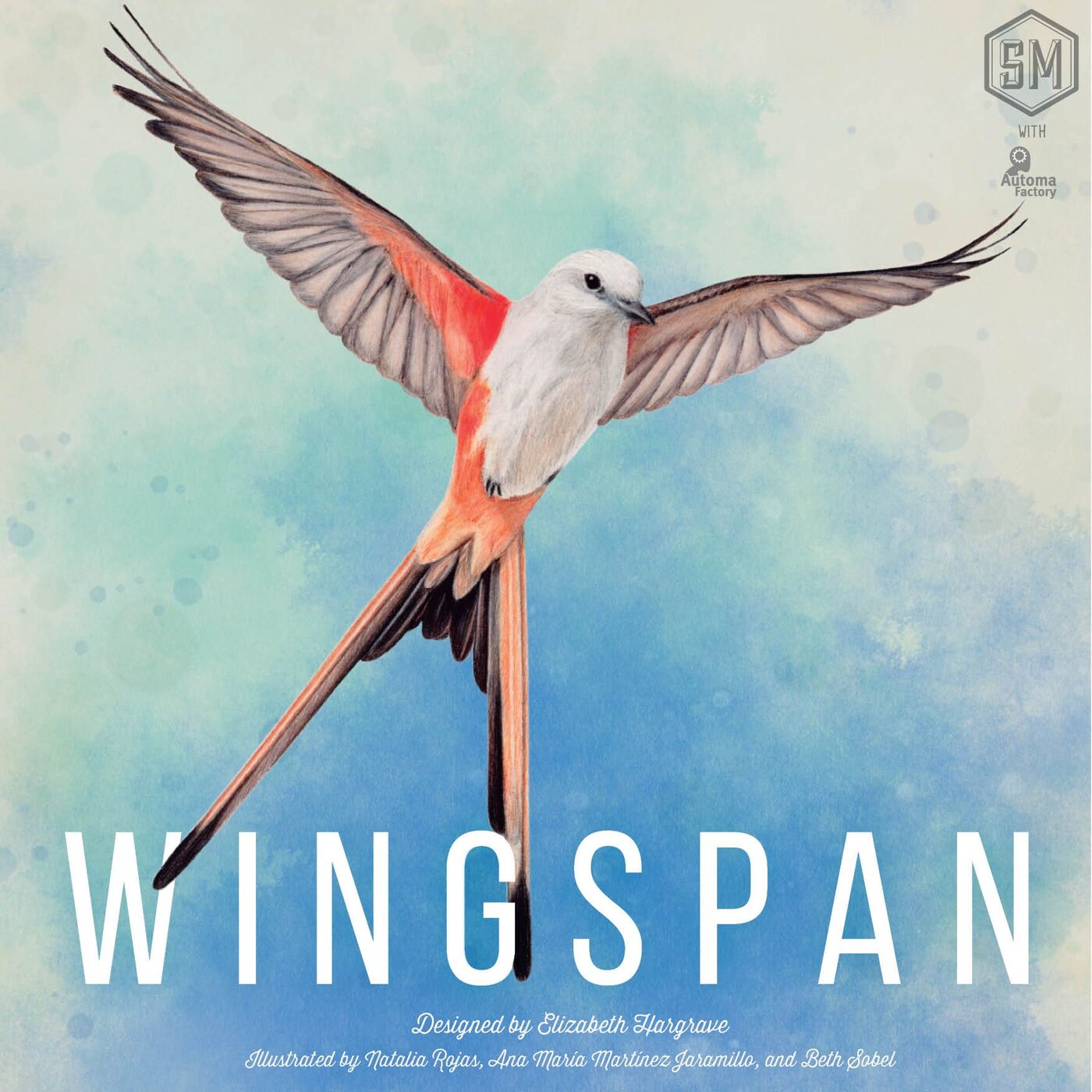 Wingspan by Stonemaier Games. Image via BoardGameGeek.
This is where Wingspan’s expansions become relevant. European Expansion, Oceania, Asia - each adds new mechanics, new end-of-round goals, new egg types. The base game alone has over 170 bird cards and feels varied; with expansions it’s essentially inexhaustible.
Everdell also has expansions (Pearlbrook, Spirecrest, Newleaf, Mistwood), but the core game’s 128-card deck naturally creates varied playthroughs through the event board and seasonal card draws. Many players report that the base game alone holds up well over dozens of sessions.
Both games have strong replayability. If you’re an expansion buyer, Wingspan’s ecosystem is larger and more mature.
Thematic Feel
Both games are nature-themed, but they land in different emotional registers.
Everdell feels like a storybook. You’re building a community, each card is a character (a Miner Mole, a Shopkeeper, a Judge), and the tree centrepiece on the table makes every session feel special. There’s genuine narrative texture to the card interactions.
Wingspan feels like a field guide brought to life. Each bird card is a real species with real facts - wingspan in centimetres, habitat, diet. The accuracy is part of the appeal. You’re not building a story; you’re curating an ecosystem. That’s a different kind of immersion, more scientific, slightly cooler in tone.
Both are beautiful. Wingspan’s production is polished; Everdell’s tree stands several inches tall and makes the game a centerpiece.
What Real Players Say
From BGG forums on Everdell:
“My first game I completely missed the construction chain mechanic and just played cards whenever I had resources. Won by accident but didn’t understand why. Second game it clicked and I’ve played 40 times since.”
“The Great Tree is one of the most impressive production choices in modern board gaming. It’s not necessary, but it makes every session feel like an event.”
On Wingspan, from r/boardgames:
“I’ve taught Wingspan to four separate groups of people who ‘don’t play board games’ - every single one asked to play again immediately.”
“The bird powers feel random at first, but around game three you start reading the synergies and that’s when it becomes a completely different game.”
The Verdict: Who Should Buy Which
Buy Wingspan if:
- You want the best gateway into the hobby for friends and family
- You play with four or five people regularly
- Solo gaming is a priority
- You want an expanding game with years of new content
- You prefer a tighter play time and snappier turns
Buy Everdell if:
- Your group typically plays at two or three players
- You want something with more strategic depth and planning
- The thematic “building a town” narrative appeals to you
- You don’t mind a slightly longer teach for a richer payoff
- You want a game that looks stunning on the table
Buy both if:
- You have a few regular players who’ll appreciate different weights on different nights
- You’re a hobbyist who wants the best of both design approaches
- You already own one and want to fill the gap
Should You Own Both?
This is actually the right question for dedicated hobbyists, and the answer for many people is yes, eventually. Wingspan and Everdell don’t really compete at the table - Wingspan gets played when the group wants something accessible and fast; Everdell comes out when everyone wants to plan and build. They serve different nights.
That said, if you genuinely have to choose one to start: Wingspan reaches more people, more often. Its solo mode is better, it scales to five, and it’s easier to get to the table. It belongs in any collection.
Everdell is the one you’ll love more - if the depth suits you - but it needs the right group to land. Buy Wingspan first. Then, when Everdell is on sale or you’ve confirmed your group wants something heavier, grab it.
Both games have been verified against BGG data. Ratings, weights, and ranks as of September 2026.