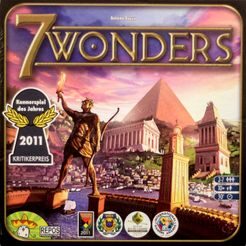
They share a name, a theme, and the same publisher - but play them back to back and you’d be forgiven for wondering if 7 Wonders and 7 Wonders Duel are really the same game at all.
The short version: they’re not. One is a simultaneous card-drafting game for three to seven players that plays in 30 minutes. The other is a tense two-player head-to-head that uses completely different drafting architecture and adds three alternative win conditions on top of points. Both are excellent. Neither is simply the “better” one.
The question isn’t which is the superior game - it’s which one is right for you and the people you play with.
Here’s the breakdown.
The Numbers
| Stat | 7 Wonders | 7 Wonders Duel |
|---|---|---|
| BGG Rank | #119 Overall | #24 Overall |
| Rating | 7.7 / 10 | 8.1 / 10 |
| Weight | 2.31 / 5 | 2.23 / 5 |
| Players | 2-7 (best 4-5) | 2 only |
| Play Time | 30 min | 30 min |
| Year | 2010 | 2015 |
| Designer | Antoine Bauza | Antoine Bauza & Bruno Cathala |
| Publisher | Repos Production | Repos Production |
Duel’s higher BGG rating (8.1 vs 7.7) is partly a reflection of the format: two-player games tend to attract more invested players who’ve specifically sought out the experience. It doesn’t mean Duel is objectively better - it means it has a more dedicated audience.
How 7 Wonders Works
 Image credit: Repos Production / Asmodee via BoardGameGeek
7 Wonders is a simultaneous card-drafting game. Every player gets a hand of cards at the start of each round. Simultaneously, everyone picks one card to play, then passes the hand to the next player. You repeat this until each hand has been stripped to its last card (which is discarded). Do this across three ages - three rounds of hands - and then score.
The genius of the simultaneous play is the pace. With seven players, 7 Wonders takes about 30 minutes. With three players, it takes about 30 minutes. The player count barely affects duration, which makes it an extraordinary group game.
The categories of cards you’re collecting determine your score:
- Raw materials and manufactured goods - resources for building things, but worth no points directly
- Science cards - symbols that score quadratically (matching sets and sets of 7 different symbols)
- Military cards - a track compared left and right with your neighbours each age, not globally
- Commercial cards - trade discounts, gold, and various bonuses
- Guild cards - powerful end-game scoring based on what others have built
- Civilian cards - pure points
- Your Wonder - each player has a unique Wonder board with stages that grant powerful abilities
Most of the game is invisible to you. You can see what your immediate neighbours are building (and react to it), but players further around the table are essentially unknown quantities until scoring. This creates a different type of tension - you’re threading your own strategy through the cards available rather than directly fighting opponents for them.
How 7 Wonders Duel Works
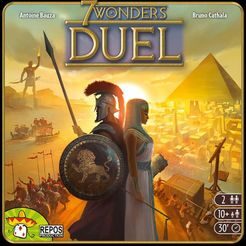 Image credit: Repos Production / Asmodee via BoardGameGeek
Duel takes the civilisation-building theme and rebuilds the drafting mechanic from scratch for two players.
Instead of passing hands around a table, cards are laid out in a pyramid structure face-up (some face-down until uncovered). You can only take cards that are “accessible” - not covered by any other card. Taking one card may reveal new options for your opponent. This creates real tactical decisions: do you take the card you want, or take a card specifically to expose (or deny) something your opponent needs?
The simultaneous-play elegance of the original is gone. Duel is genuinely interactive - you’re watching what your opponent builds and planning around it. This is both its strength and its limitation.
The three ways to win change the entire texture of the game:
- Scientific supremacy - collect all six unique science symbols and win immediately
- Military victory - push the military track to your opponent’s capital and win immediately
- Civilian victory - most points at the end of age three
Sudden-death wins create urgency in every age. If your opponent is collecting science symbols, you have to respond - or concede a track that can end the game early. This gives Duel a tension 7 Wonders simply doesn’t have.
Head-to-Head: The Key Differences
Player Count Is Everything
This is the central fork in the road: 7 Wonders is a group game; Duel is strictly two-player.
7 Wonders at two players is technically possible but awkward - you draft a hand, play one card, discard one card, and pass the rest, which creates a weird forced-discard economy. BGG rates 7 Wonders at its best with four or five players, and that’s accurate. If your game nights usually involve 3-7 people, 7 Wonders is the pick.
If you primarily play games with a single partner (or a regular gaming spouse/friend), Duel was designed precisely for you.
Direct Conflict
7 Wonders has low direct interaction. You see your neighbours’ boards and can steal their resource efficiencies, but most decisions are about your own engine rather than dismantling someone else’s.
Duel is the opposite. Every card draft affects both players. Denying resources, racing military tracks, blocking science symbols - Duel rewards paying constant attention to what your opponent is doing. If “playing your own game and optimising” is your preference, Duel may feel punishing. If you want to fight over every decision, Duel delivers.
Tension Curve
7 Wonders has a relatively smooth experience. You draft three ages, score, see who won. The tension is diffuse - you’re rarely sure how you’re doing until the final count.
Duel’s tension peaks repeatedly. Every time an opponent gets close to a scientific supremacy or pushes military deep into your territory, the game shifts from optimising to reacting. The sudden-death conditions make every age feel critical.
Teaching and Accessibility
Both games have similar weight ratings (2.31 and 2.23 respectively). 7 Wonders has more to explain upfront - six card types with different rules, the Wonder stages, how resources chain, how military works only with neighbours - but once the first round is played, it clicks quickly.
Duel’s tableau layout adds one new concept (the pyramid draft), but the pyramid is actually easier to grasp than explaining the multi-player hand-passing to new players. For strict two-player situations, Duel is slightly easier to teach.
Replayability
7 Wonders has decent replayability from the Wonder variety and the shifting card compositions between games. With seven unique Wonders in the base box and more in expansions, the start states vary meaningfully.
Duel’s replayability is higher game-to-game because the dynamic interaction creates more variable experiences. Two plays of 7 Wonders with the same player count feel similar; two plays of Duel can feel completely different depending on which win condition path emerges early.
Who Should Buy 7 Wonders
- Your game nights have 3-7 players regularly
- You want a 30-minute game that accommodates larger groups without scaling issues
- Your group includes lighter players who appreciate simultaneous play (less downtime)
- You like civilisation building with low conflict and visible long-term planning
- You want an accessible gateway game that teaches card drafting without confusion
Who Should Buy 7 Wonders Duel
- You primarily play with one other person - a partner, flatmate, or regular gaming friend
- You enjoy direct tactical combat where both players are constantly watching each other’s moves
- You want higher drama - three different win conditions, sudden-death possibilities
- You prefer games with stronger interaction and meaningful denial
- You appreciate higher replayability in a short-box package
Can You Own Both?
Absolutely - and many people do. They share a theme but scratch different itches. 7 Wonders comes out at big game nights; Duel comes out on a Tuesday evening with your partner.
The overlap in weight and time makes them feel like they compete, but they don’t really. One is a social group game; the other is an intense two-player duel. Owning both isn’t redundant - it’s covering two distinct situations with the same thematic aesthetic.
The Verdict
Buy 7 Wonders if: You need a fast, accessible game that plays 3-7 without slowing down.
Buy 7 Wonders Duel if: You play primarily at two players and want tactical, high-drama decisions.
Buy both if: You do both regularly and want a consistent visual and thematic identity across your two-player and group game slots.
Duel’s higher BGG rank (24 vs 119) reflects its more focused, tense design - but 7 Wonders earned its massive playerbase (113,000+ ratings) for a reason. At 30 minutes with seven people, almost nothing else comes close.
Neither is wrong. Pick the one that fits your table.