
There is a moment in every Vital Lacerda game where you stare at the board, completely lost, and then something clicks. The interlocking systems suddenly make sense. The action you couldn’t parse ten minutes ago now feels like the only possible move. And you realise that the complexity was never arbitrary — every mechanism exists because the theme demanded it.
That moment is why people keep buying his games despite the four-digit rulebook page counts and setup times that border on ritual. Lacerda doesn’t design games for everyone. He designs games for people who want to feel like they’ve earned something by the time they pack the box away.
This spotlight examines what makes his approach distinctive, why his games provoke such fierce loyalty, and which ones are actually worth the substantial investment of time and shelf space.
The Lacerda formula
Every Lacerda game shares a DNA that is unmistakable once you’ve played two or three of them.
Thematic integration drives mechanism. Where most heavy euro designers start with a mechanism and bolt a theme onto it, Lacerda works the other way around. Lisboa doesn’t have an area-majority mechanic because area majority is fun. It has one because rebuilding a city after an earthquake means different factions compete for influence over the reconstruction. On Mars doesn’t have a dual-layer board because dual-layer boards are clever. It has one because colonising Mars means shuttling between an orbital station and the planet surface, and those are genuinely different operational contexts.
Interlocking systems over isolated engines. In a typical engine-building game, you build your machine and run it. In a Lacerda game, your engine is the entire board. Every system feeds into at least two others. Gaining resources in one area unlocks actions in another, which generates influence in a third. Nothing exists in isolation. This creates that feeling of drowning in your first game and swimming by your third.
Player interaction through shared infrastructure. Lacerda games rarely feature direct conflict. Instead, players interact by competing for limited shared resources, claiming positions in public spaces, and timing their actions around what others are doing. The interaction is constant but civilised — more like a crowded marketplace than a battlefield.
Ian O’Toole. Any honest discussion of Lacerda’s modern catalogue has to acknowledge his partnership with artist and graphic designer Ian O’Toole. Starting with The Gallerist, O’Toole’s distinctive visual language has become inseparable from the Lacerda experience. The clean iconography, the warm colour palettes, the layouts that somehow make absurdly complex boards navigable — these are not cosmetic choices. They are functional design decisions that make the games playable.
The catalogue, ranked by weight
One of Lacerda’s defining traits is that even his “lightest” game is heavier than most designers’ heaviest. Here’s his major catalogue ordered by BGG complexity weight, from most accessible to most demanding.
Escape Plan (2019) — Weight: 3.68
 Box art via BoardGameGeek. Escape Plan by Vital Lacerda, published by Eagle-Gryphon Games.
Escape Plan is the outlier. A heist game where you’ve already pulled the job and now need to get out of the city before the police close in. It plays 1–5 in about 120 minutes, carries a BGG rating of 7.48 from 5,859 ratings, and sits at rank #629.
This is Lacerda’s most thematic game and, by a clear margin, his most accessible. The decision space is tighter, the arc is more dramatic, and the theme is impossible to ignore because the police are literally closing in on you turn by turn. It’s also his most divisive — some fans find it too constrained, too dependent on timing rather than engine construction.
But as an entry point to Lacerda? It’s underrated. The mechanisms still interlock (you’re managing cash, contacts, disguises, and exit routes simultaneously), but the pressure of the closing net keeps you focused. You don’t get lost in Escape Plan. You get chased.
The Gallerist (2015) — Weight: 4.21
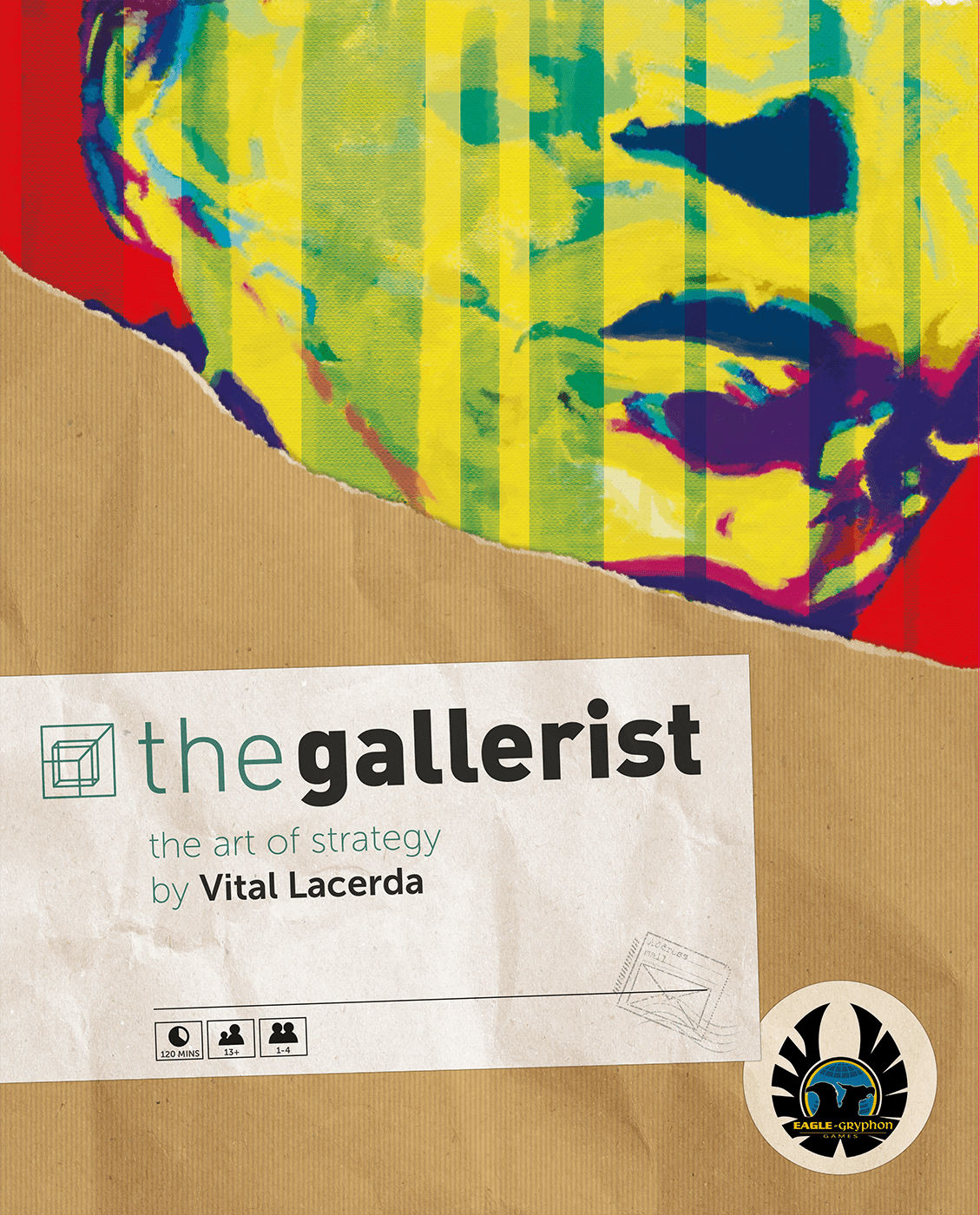 Box art via BoardGameGeek. The Gallerist by Vital Lacerda, published by Eagle-Gryphon Games.
The Gallerist was the breakthrough. Playing 1–4 in about 150 minutes, rated 8.00 from 16,447 ratings, ranked #81 on BGG. You run an art gallery — discovering artists, buying and displaying works, promoting them to increase their value, and selling at the right moment.
The genius here is the “kicked out” mechanism. When you move to a location another player occupies, they get a bonus action. This creates a constant tension: you want to go where the good stuff is, but doing so gives your opponent a free move. It’s one of the most elegant player interaction mechanisms in heavy euros, and it turns what could be a multiplayer solitaire exercise into a game of timing and positioning.
The Gallerist is also where the O’Toole partnership first clicked. The board is beautiful but dense, and O’Toole’s layout makes it parseable in a way that Lacerda’s earlier games (designed with other artists) weren’t always. It remains many players’ favourite Lacerda, and there’s a strong argument that it’s his most balanced design — complex enough to reward deep play, thematic enough to feel alive, interactive enough to matter.
Kanban EV (2020) — Weight: 4.29
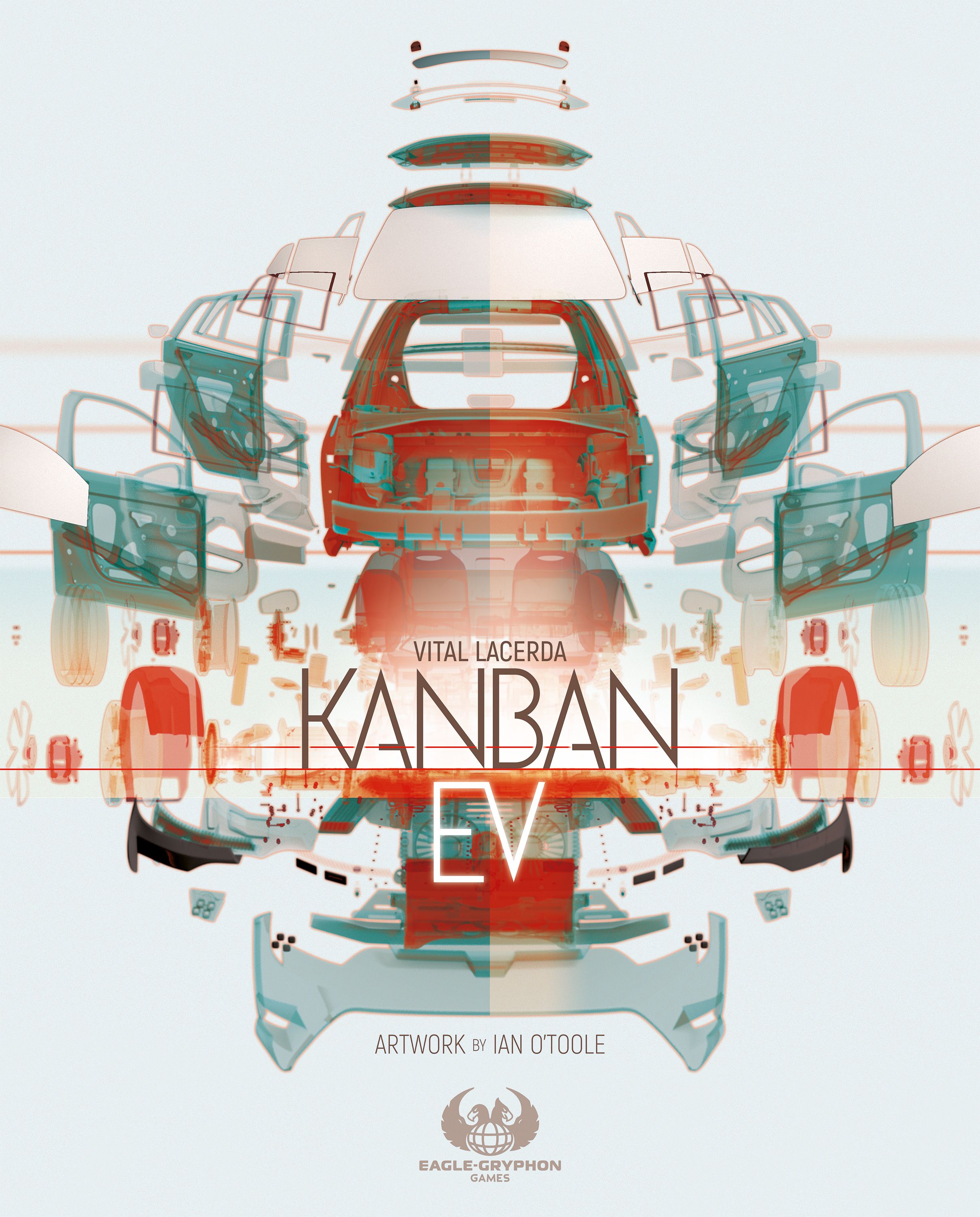 Box art via BoardGameGeek. Kanban EV by Vital Lacerda, published by Eagle-Gryphon Games.
Kanban EV is the revised edition of his 2014 game about managing an electric vehicle factory. It plays 1–4, runs about 180 minutes, has a BGG rating of 8.38 from 10,141 ratings, and sits at an impressive rank #45.
This is arguably his tightest design. The factory floor is divided into departments — design, logistics, assembly, R&D, and administration — and you move between them to develop cars, manage the production line, and impress the factory manager during weekly meetings. That manager, Sandra, is an AI-driven character who evaluates your performance and can reward or punish you depending on how well you’ve been doing your job.
Sandra is what makes Kanban EV special. She introduces an evaluative layer that no other Lacerda game has. You’re not just optimising — you’re performing. You need to look productive during meetings, which means timing your actions around the meeting schedule. It creates a rhythm that feels authentically corporate in the best possible way.
The 8.38 rating makes it his highest-rated game on BGG, and it deserves it. Every department connects to every other department. The upgraded components and O’Toole’s redesigned board turned a good game into a great one.
Weather Machine (2022) — Weight: 4.56
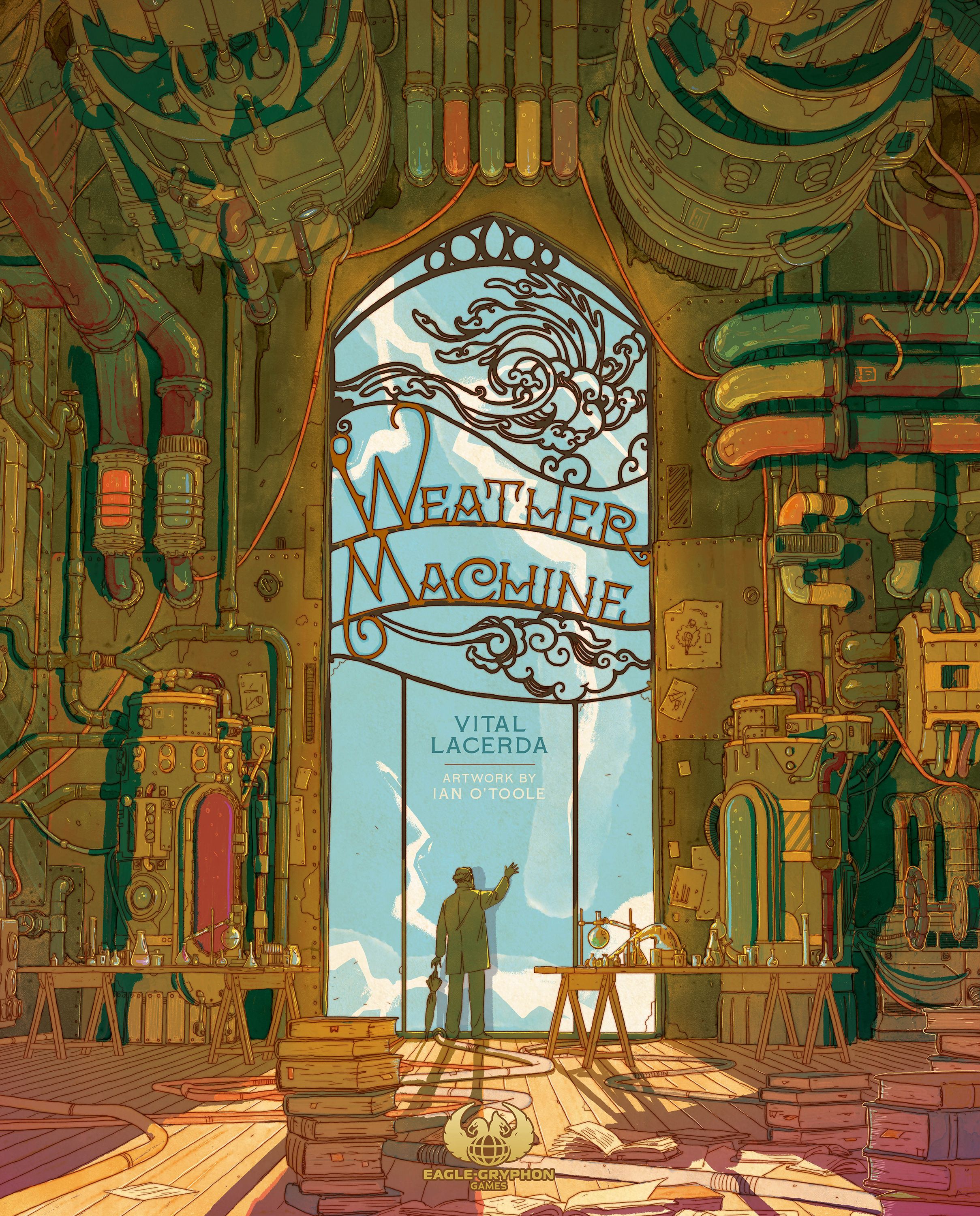 Box art via BoardGameGeek. Weather Machine by Vital Lacerda, published by Eagle-Gryphon Games.
Weather Machine plays 2–4, runs about 150 minutes, rated 7.68 from 4,121 ratings, ranked #709. You’re scientists working to control the weather while navigating government funding and a rogue AI.
This is where the Lacerda formula starts to strain for some players. The thematic integration is still there — the three research tracks map onto different approaches to weather control, the government subsidy system creates real tension about funding priorities, and the AI character adds unpredictability. But the overhead is significant. There are more systems here than in any of his other games, and not all of them feel equally essential.
Weather Machine is the Lacerda game most likely to divide a table. Fans call it his most ambitious design. Critics call it his most overwrought. Both are right. It’s a game that rewards five plays but may not survive three, because some groups will bounce hard off the cognitive load of that second game.
Lisboa (2017) — Weight: 4.57
 Box art via BoardGameGeek. Lisboa by Vital Lacerda, published by Eagle-Gryphon Games.
Lisboa is the masterpiece. Playing 1–4 in about 120 minutes (a generous estimate for first plays), rated 8.17 from 12,834 ratings, ranked #68. You’re rebuilding Lisbon after the devastating 1755 earthquake, tsunami, and fires — one of the worst natural disasters in European history.
The card play system is the heart of it. Every card can be played in multiple ways depending on where you play it and what context you’re in. You can use a card to gain favour with nobles, to build shops in the city, to trade goods at the harbour, or to advance the reconstruction of public buildings. The same card. Different meaning depending on timing and board state.
This is the game where Lacerda proved he could turn historical tragedy into a deeply respectful, deeply engaging design. Lisboa doesn’t trivialise the disaster. It makes you feel the weight of reconstruction — the politics, the economics, the human cost of rebuilding. The scoring is intricate, the decision tree is vast, and every game tells a slightly different story about how Lisbon came back to life.
For many, this is the definitive Lacerda game. Not the heaviest, not the most accessible, but the one where theme, mechanism, and art come together most completely.
On Mars (2020) — Weight: 4.63
 Box art via BoardGameGeek. On Mars by Vital Lacerda, published by Eagle-Gryphon Games.
On Mars is the Everest. Playing 1–4 in about 150 minutes, rated 8.16 from 14,842 ratings, ranked #58. At a weight of 4.63, it’s the heaviest Lacerda by BGG consensus, and it earns every fraction of that number.
The dual-board concept — orbital station above, Martian surface below — is the kind of idea that sounds gimmicky until you play it. Moving between orbit and surface costs you your entire turn’s shuttle phase, so you have to plan ahead. Do you stay on the surface to keep building, or go to orbit to recruit scientists and acquire blueprints? The logistics of space colonisation become tangible.
On Mars is also his most systems-dense game. Building construction, resource management, colony development, technology research, scientist recruitment, shelter maintenance, and a colonist satisfaction track that determines end-game scoring. All of these interact. Learning On Mars is genuinely difficult, and even experienced heavy gamers report needing two or three plays before the fog lifts.
But when it lifts? On Mars is extraordinary. There’s a moment, usually mid-game on your third play, where you see the entire colony as a single interconnected machine and your place within it. That moment is peak Lacerda.
Who should play Lacerda games
The honest answer: not most people. And that’s fine.
Lacerda games require commitment. A first play of any title in his catalogue will run longer than the box says, involve at least one rules lookup, and leave at least one player slightly bewildered. The teach alone can take 30-45 minutes for his heavier titles, and that’s with an experienced teacher.
But for the right group — people who enjoy mastering complex systems, who find satisfaction in a game that reveals new layers over multiple plays, who don’t mind a two-hour commitment — Lacerda’s catalogue is unmatched. No other active designer produces games of this weight with this level of thematic integration and visual polish.
Start with: The Gallerist or Escape Plan if you want a gentler introduction. Kanban EV if your group already plays heavy euros and you want his best-rated design.
Work up to: Lisboa when you’re ready for his most complete design. On Mars when you want to see how far the formula can stretch.
Maybe skip: Weather Machine, unless you’ve played at least three other Lacerda games and want to see his most polarising work.
The Lacerda question
Every designer spotlight inevitably comes to the same question: is this designer for me?
With Lacerda, the question is sharper than usual. His games are expensive, large, time-consuming, and demanding. They take up shelf space, table space, and brain space. They are not casual purchases.
But they offer something almost nobody else in the hobby provides: games where the complexity serves the theme so completely that by your third play, you stop thinking about rules and start thinking about the world on the table. Where the mechanisms disappear and you’re just… running a gallery. Rebuilding a city. Colonising a planet.
That’s the trick. The complexity is the price of admission. The theme is the reward. And for the people who pay that price, there’s nobody quite like Vital Lacerda working in board games today.