There’s a certain type of board game designer who gets discussed in reverential tones on forums and podcasts - the auteur, the artist, the visionary. And then there’s Reiner Knizia, who has designed over 700 games, holds a doctorate in mathematics, and approaches game design with the precision of an engineer solving elegant problems.
Knizia doesn’t get the same breathless devotion as some of his contemporaries. There are no “Knizia weekends” the way there are Lacerda marathons. Nobody calls his games “experiences.” And yet, when you look at what the man has actually produced - the sheer range, the mechanical brilliance, the staying power - the case for Knizia as the greatest board game designer who ever lived is startlingly strong.
Let’s make that case.
The Numbers Don’t Lie
Knizia’s catalogue is staggering. Over 700 published designs across four decades. At least six games currently in the BGG Top 350. A PhD in mathematics from the University of Ulm. Before going full-time into game design in 1997, he worked in the banking sector - and you can feel that analytical precision in every mechanism he builds.
But quantity alone means nothing. What makes Knizia remarkable is that his best games are not just good - they’re definitive. He didn’t just design good auction games; he designed the auction games against which all others are measured.
The Knizia Auction Trilogy
If Knizia had designed nothing else, the auction trilogy would be enough to secure his legacy.
Ra (1999)
 Image credit: 25th Century Games / BoardGameGeek
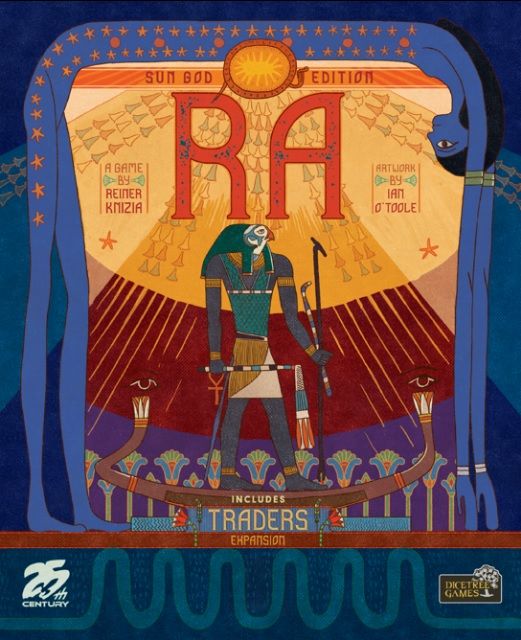
Ra is the purest auction game ever designed. Players draw tiles from a bag, building up a communal lot, until someone calls “Ra!” and triggers an auction. You bid with numbered sun tokens - but here’s the twist: the token you win with becomes available to future winners, and you get the previous winner’s token. It’s a closed economy of escalating tension.
BGG Rating: 7.71 · Weight: 2.31 · Rank: #114 · Players: 2-5 · Time: 45-60 min
What makes Ra transcendent is how much game emerges from how little rules. The entire decision space is: do I draw a tile, or do I call Ra? That’s it. And yet every single call is agonising. Do you push your luck for one more tile? Do you call Ra to force your opponent to bid on a mediocre lot? Do you burn your high sun early or save it?
Ra is a masterclass in negative space - the game is defined by what you choose not to do as much as what you do.
Modern Art (1992)
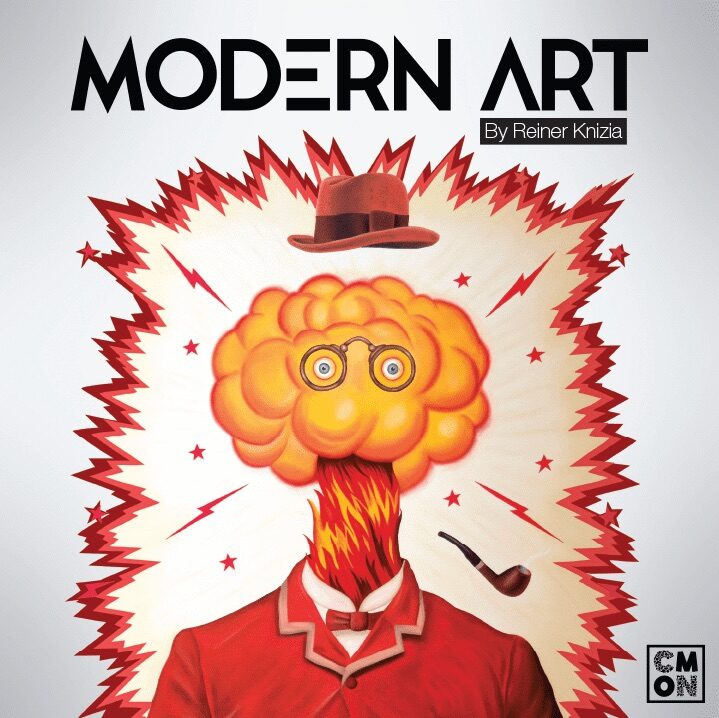 Image credit: CMON / BoardGameGeek
Modern Art might be the single best game about markets ever made. Players are art dealers buying and selling paintings by five artists. The twist: the paintings have no inherent value. Their worth is determined entirely by how many are sold each round - a system that mirrors actual art markets with uncomfortable accuracy.
BGG Rating: 7.52 · Weight: 2.28 · Rank: #222 · Players: 3-5 · Time: 45 min
Four different auction types keep every sale feeling different. Open ascending, once-around, sealed bid, fixed price - each creates a distinct social dynamic. And because you’re simultaneously buyer and seller, every transaction is layered with ulterior motive. You’re never just buying a painting. You’re manipulating a market.
Knizia designed this in 1992. It still teaches better than any economics textbook.
Amun-Re (2003)
Amun-Re completes the trilogy with an auction game wrapped inside a civilisation-building Euro. Players bid on provinces along the Nile, build pyramids, farm, and make offerings to the god Amun-Re - whose generosity is determined by collective player sacrifice. It’s part auction, part area control, part game theory experiment.
BGG Rating: 7.28 · Weight: 3.03 · Rank: #600 · Players: 3-5 · Time: 90 min
The midpoint reset - where the Old Kingdom ends and the New Kingdom begins, stripping you of provinces but keeping your pyramids - is one of the most elegant structural devices in board gaming. It forces you to build for two different time horizons simultaneously.
The Tile-Laying Masterwork
Tigris & Euphrates (1997)
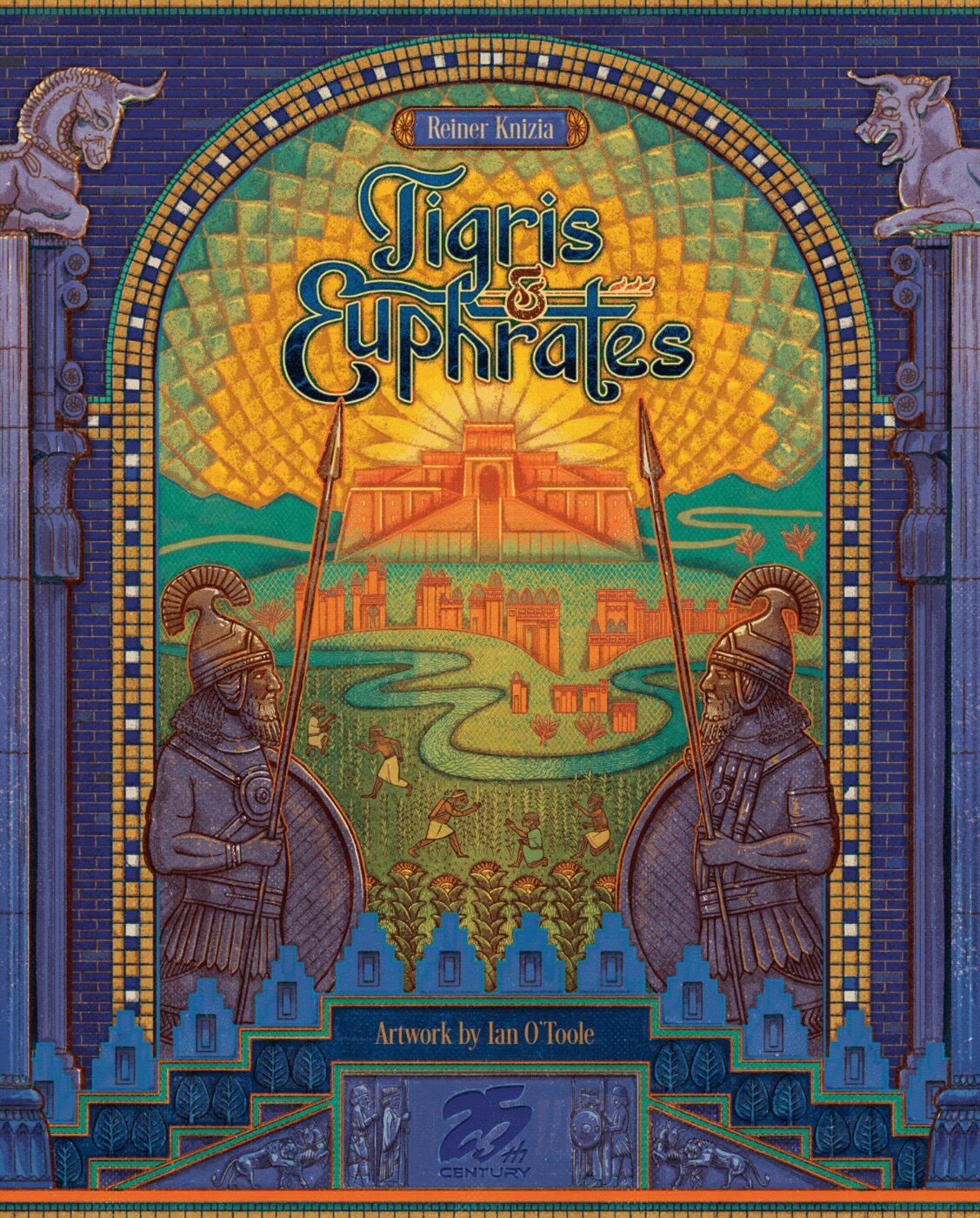 Image credit: Fantasy Flight Games / BoardGameGeek
Tigris & Euphrates is Knizia’s heaviest widely-known game, and many designers cite it as the single best board game ever designed. You’re building civilisations in ancient Mesopotamia, placing tiles to grow kingdoms - but your score is determined by your weakest colour, forcing genuine diversification rather than min-maxing a single strategy.
BGG Rating: 7.70 · Weight: 3.48 · Rank: #131 · Players: 2-4 · Time: 90 min
The conflict system is where Knizia’s mathematical mind truly shines. Internal conflicts (leader vs. leader within a kingdom) and external conflicts (kingdom vs. kingdom when they merge) create cascading, unpredictable interactions. A single tile placement can trigger a war that reshapes the entire board.
At a weight of 3.48, this is Knizia’s most demanding design - and also his most rewarded, with multiple reprints and editions over nearly three decades.
The Two-Player King
Knizia might have more acclaimed two-player games than any designer in history. Two in particular stand out:
Lost Cities (1999)
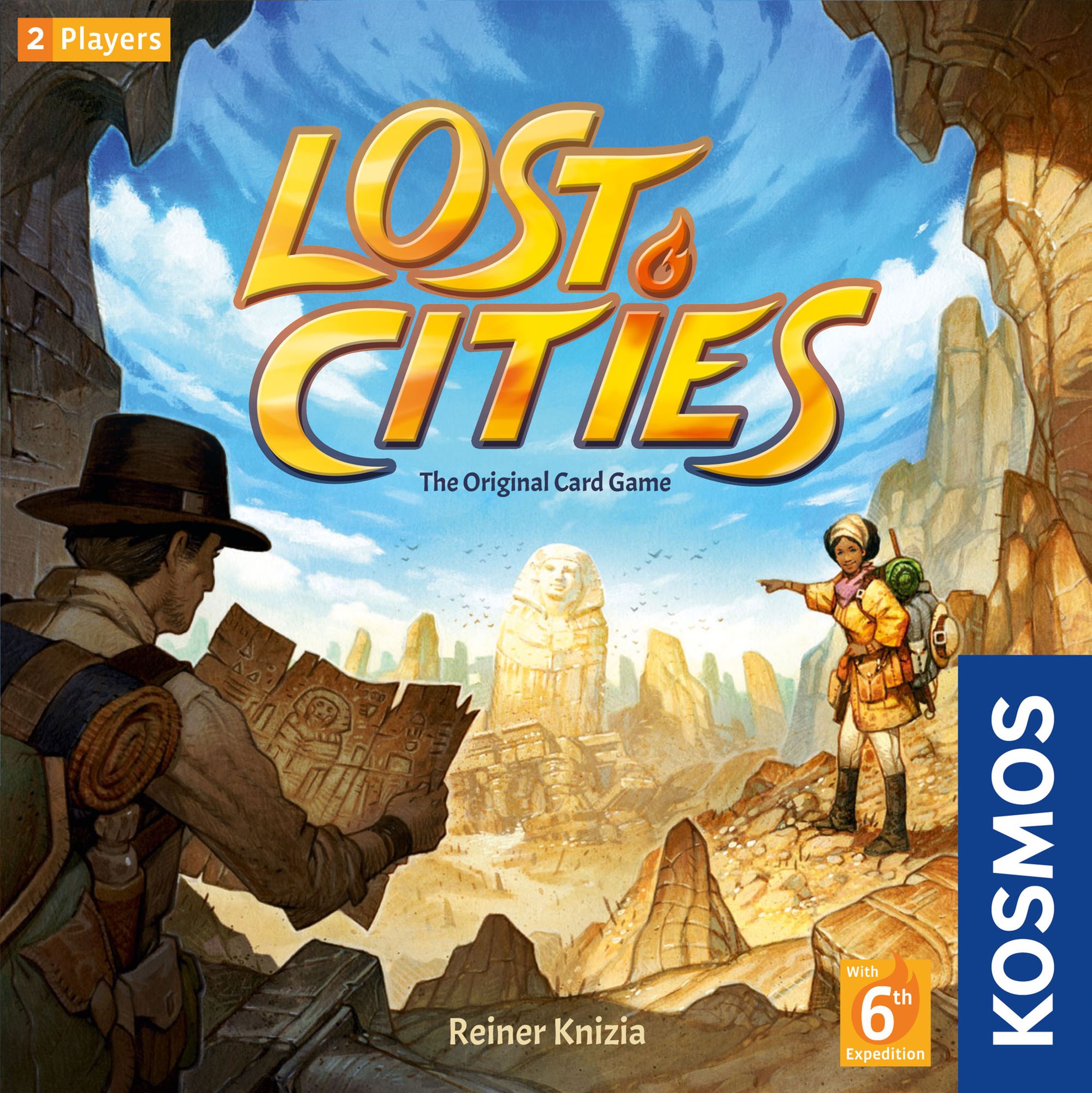 Image credit: KOSMOS / BoardGameGeek
Lost Cities is the gateway drug. Five expeditions, numbered cards 2-10 plus investment multipliers, and one brutal rule: once you start an expedition, you take a -20 point penalty that you need to overcome. Every card played is a commitment. Every card discarded is information your opponent can use.
BGG Rating: 7.26 · Weight: 1.47 · Rank: #343 · Players: 2 · Time: 30 min
At a weight of just 1.47, this is one of the lightest games on this list - and one of the most played. It’s the game couples play 500 times. It’s the game that non-gamers learn in three minutes and obsess over for years. And beneath its simplicity lies genuine Knizia tension: the agony of holding a card you can’t play yet, watching your opponent eye the discard pile.
Battle Line (2000)
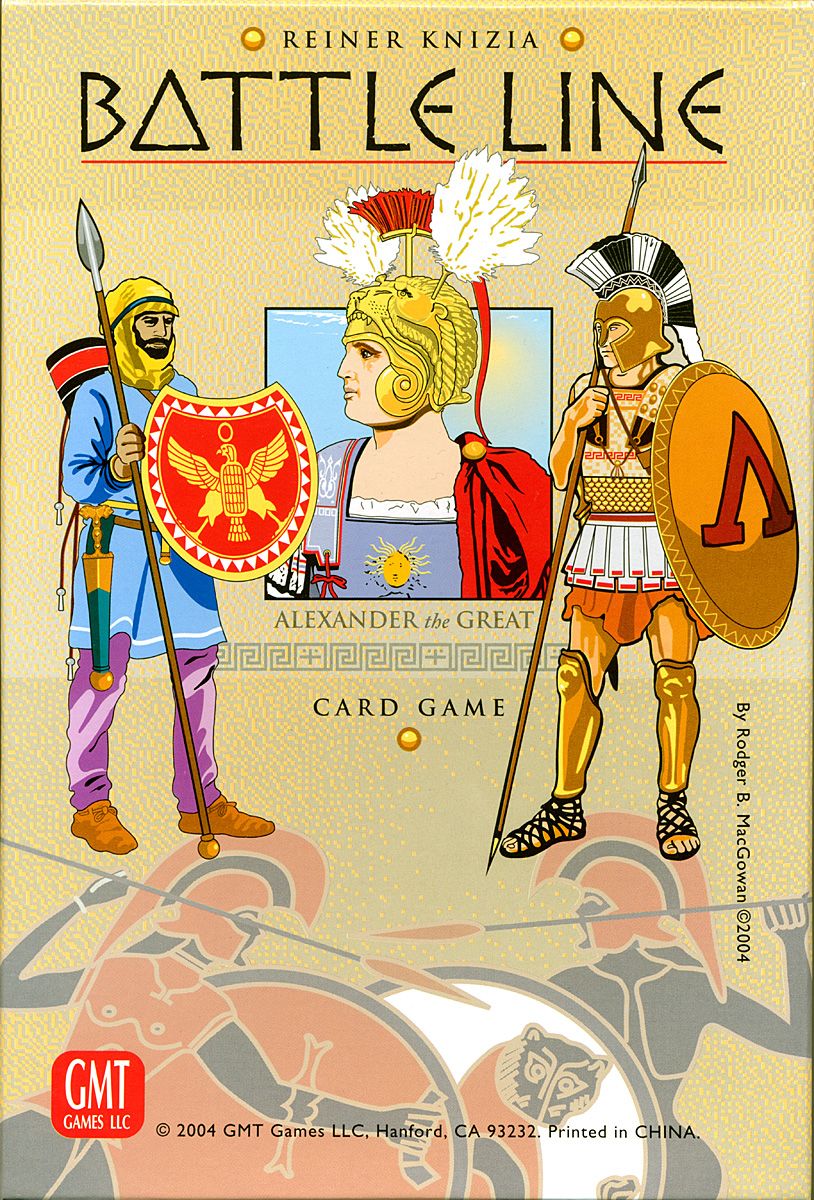 Image credit: GMT Games / BoardGameGeek
Battle Line (also published as Schotten Totten) takes the two-player card game and adds spatial reasoning. Nine flags between you, three cards per flag, and you’re essentially playing nine simultaneous poker hands. But you can claim a flag once the combination is mathematically unbeatable - which means the game rewards you for proving your position, not just hoping.
BGG Rating: 7.41 · Weight: 1.89 · Rank: #329 · Players: 2 · Time: 30 min
The optional tactics cards add asymmetric chaos, but the base game is Knizia at his most elegant: simple components, simple rules, endless depth.
The Modern Era
Critics sometimes claim Knizia peaked in the late ’90s. They’re wrong.
The Quest for El Dorado (2017)
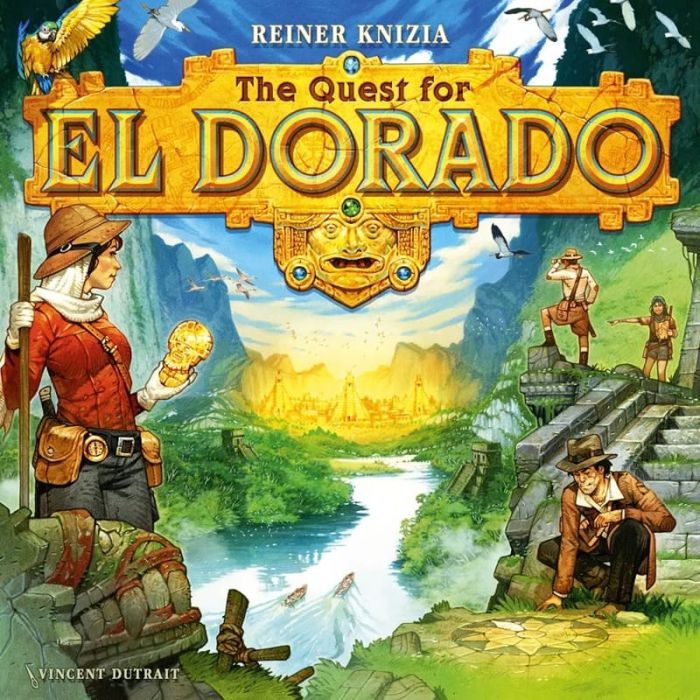 Image credit: Ravensburger / BoardGameGeek
The Quest for El Dorado is a deck-building race game that does something most deck-builders fail at: it gives the cards physical consequence. You’re not just building an engine for points - you’re using that engine to move through a jungle, and every card you buy has to justify its slot in terms of actual board movement.
BGG Rating: 7.72 · Weight: 1.94 · Rank: #122 · Players: 2-4 · Time: 30-60 min
At rank #122 with a 7.72 rating, El Dorado might be Knizia’s most broadly acclaimed modern design. It’s the rare game that works brilliantly as both a gateway and a gamer’s game - the modular board means you can dial complexity up or down, and the racing element adds a tension that pure engine-builders lack.
Nominated for the 2017 Spiel des Jahres, it’s proof that Knizia’s design instincts remain razor-sharp three decades into his career.
The Knizia Philosophy
What connects all these games? A design philosophy that’s become almost countercultural in the age of sprawling, narrative-heavy board games:
1. Theme follows mechanism. Knizia designs the system first, then finds a theme that fits. This draws criticism - “Knizia games are themeless” is a common refrain - but it’s also why his games work. The mechanisms aren’t forced to serve a narrative; they’re free to be as tight as possible.
2. Scoring is the game. Knizia’s scoring systems are famously creative. Your weakest colour in Tigris & Euphrates. The -20 penalty in Lost Cities. The market-driven valuation in Modern Art. He understands that how you score shapes how you play more profoundly than any amount of flavour text.
3. Elegance over complexity. Most Knizia games have rules you can explain in five minutes. The depth comes from interaction, not from rules overhead. This is the mathematician’s instinct: find the simplest system that produces the richest behaviour.
4. Prolific doesn’t mean careless. Yes, not all 700+ games are masterpieces. But the hit rate is astonishing. How many designers have six games in the BGG Top 350? How many have games that are still in print after 25+ years?
Where to Start
New to Knizia? Here’s a path:
- Total beginner: Lost Cities - two players, 30 minutes, heartbreak guaranteed
- Family weight: The Quest for El Dorado - racing meets deck-building, works for everyone
- Ready for tension: Ra - the auction game to end all auction games
- Full Knizia experience: Tigris & Euphrates - his magnum opus, still unmatched
The Verdict
Reiner Knizia doesn’t tell stories. He doesn’t build worlds. He builds systems - and those systems, stripped of everything unnecessary, reveal something fundamental about how humans make decisions under uncertainty.
In a hobby increasingly drawn to spectacle, there’s something quietly radical about a designer who trusts that the game itself is enough. No miniatures required. No legacy envelopes. Just tiles, cards, and the terrifying simplicity of a well-placed auction call.
Seven hundred games. Four decades. And the old mathematician is still designing.
What’s your favourite Knizia game? Have we missed a hidden gem in his vast catalogue? Share your picks in the comments or find us on Twitter/X @TheDiceDrop.