Deck-building is one of the defining mechanics of modern board gaming - and one of the most misunderstood. Ask ten people what a deck-builder is and you’ll get ten slightly different answers. Ask them where to start and you’ll probably get “Dominion,” which is not always wrong, but is often not the best answer.
The truth is that deck-builders span an enormous range of complexity. Star Realms has a BGG weight of 1.91. Mage Knight sits at 4.38. That’s not a small gap - it’s the difference between a 20-minute two-player card game and a 4-hour solo odyssey with a rulebook that reads like a war treaty.
This ladder maps five of the best deck-builders in ascending order of complexity, with verified BGG weight data at each rung. Find where you are. Plan where you’re going.
🪜 The Ladder at a Glance
| Rung | Game | BGG Weight | Players | Time |
|---|---|---|---|---|
| 1 | Star Realms | 1.91 | 2 | ~20 min |
| 2 | Clank! | 2.23 | 2-4 | 30-60 min |
| 3 | Dominion | 2.34 | 2-4 | ~30 min |
| 4 | Aeon’s End | 2.80 | 1-4 | ~60 min |
| 5 | Mage Knight | 4.38 | 1-4 | 60-240 min |
BGG weights as of August 2026.
Rung 1: Star Realms - Weight 1.91
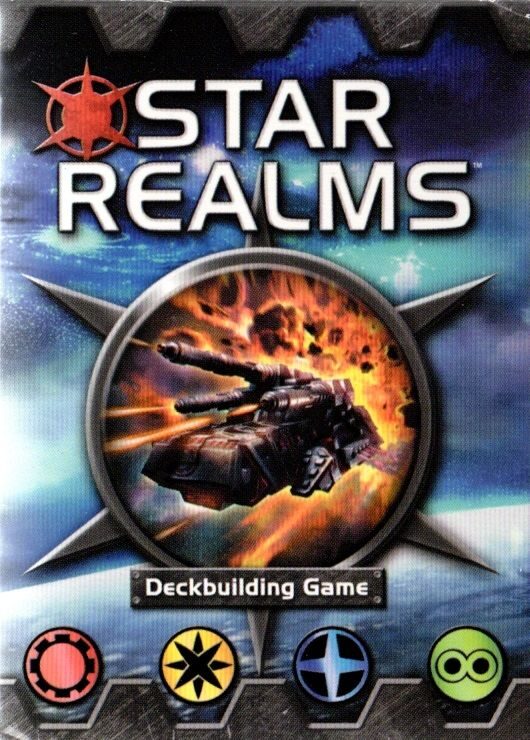 Star Realms. © White Wizard Games. Image via BGG.
BGG Rating: 7.55 | Rank: #178 | Players: 2 | Time: ~20 min
Star Realms is the gateway drug. Two players, a shared card market, and one goal: reduce your opponent’s authority to zero before they do the same to you.
The entire ruleset fits on the back of a card. Ships have two numbers - cost and power. Bases have a shield icon, which means you have to deal with them first. That’s most of what you need to know to play your first game.
What makes Star Realms an excellent entry point isn’t just simplicity - it’s that the core deck-building loop is pure and unobstructed. You buy cards, you improve your deck, your deck gets faster and more lethal. Nothing muddies that loop. No board. No resource tracks. No victory point calculations at the end. You win by doing the thing, not by tracking the thing.
The faction system (four factions with ally bonuses when you play two cards of the same faction) adds genuine strategic depth without adding rules overhead. It’s the kind of design that reveals itself through play rather than through the rulebook.
Go here if: You’ve never played a deck-builder, you want something you can explain in two minutes, or you’re looking for a tight two-player game that fits in a jacket pocket.
Ceiling: Two players only is a real limitation. Once you’ve absorbed the loop, you’ll start wanting more. That’s fine - that’s what the next rungs are for.
Rung 2: Clank! - Weight 2.23
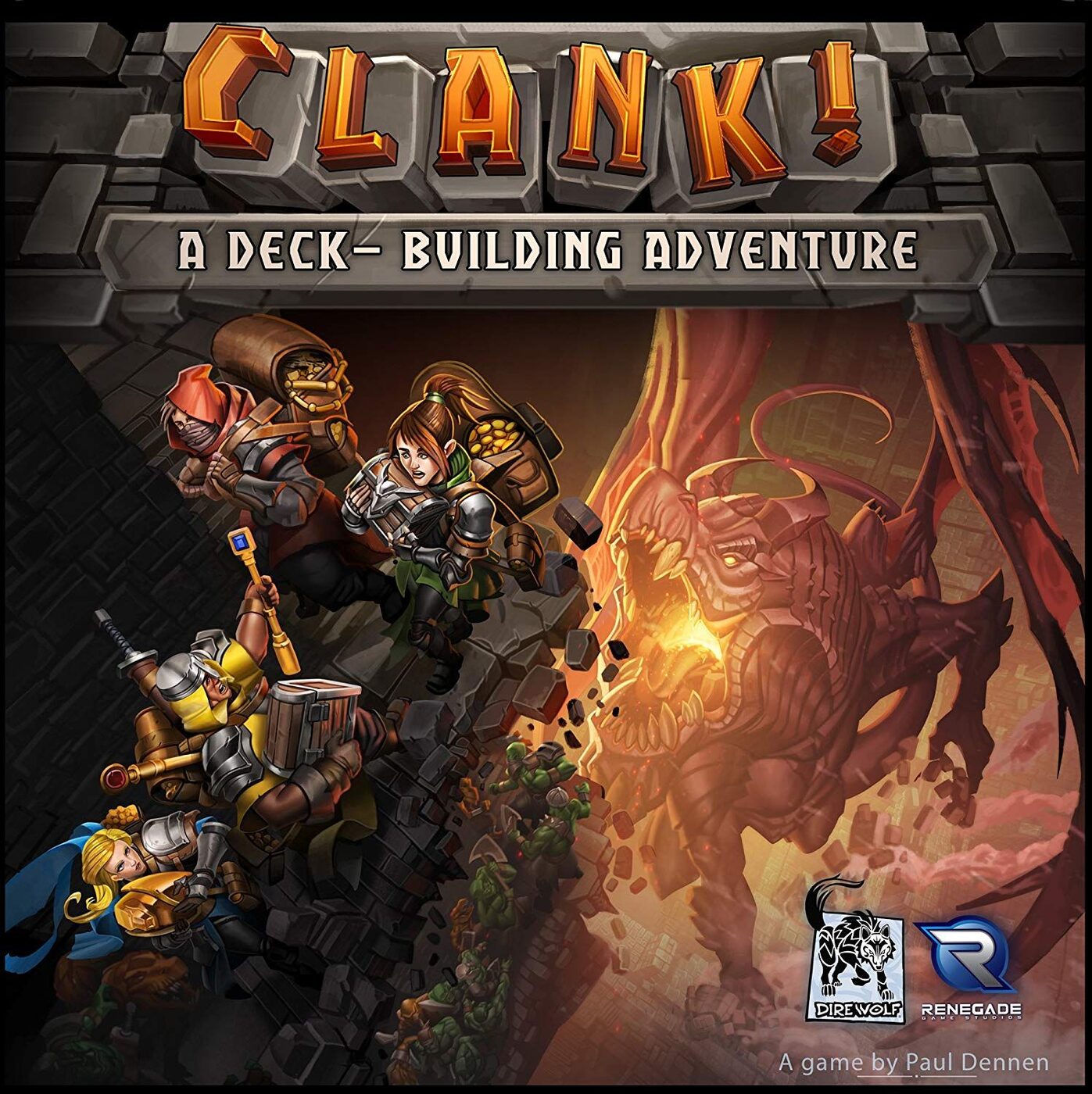 Clank! A Deck-Building Adventure. © Dire Wolf. Image via BGG.
BGG Rating: 7.76 | Rank: #102 | Players: 2-4 | Time: 30-60 min
Clank! does something clever: it adds a physical board and a dungeon crawl to the deck-building loop, and it does so with minimal rules overhead. You still buy cards from a shared market and shuffle them into your deck. The difference is that those cards now move your adventurer through a dungeon, let you pick up artifacts, and - critically - generate clank, noise that wakes the dragon and fills the dragon bag with your cubes.
The dragon bag is brilliant. Every round or so, a handful of cubes get drawn from the bag. If your colour comes out, you take damage. The louder you’ve been, the more of your cubes are in that bag, and the more danger you’re in. It’s a passive, always-running threat that creates tension without adding turn complexity.
What Clank! does that Star Realms doesn’t: it gives you spatial decisions. Which path do I take? Do I go deeper for better artifacts, knowing the dragon gets angrier the further I go? When do I turn back? These decisions layer on top of the deck-building without replacing it.
Go here if: You want the deck-building loop with a sense of adventure and place. Good for groups who like dungeon crawls but bounce off heavier games.
Watch out for: The endgame trigger (first player to escape or die) can catch new players off-guard. Explain it upfront.
Rung 3: Dominion - Weight 2.34
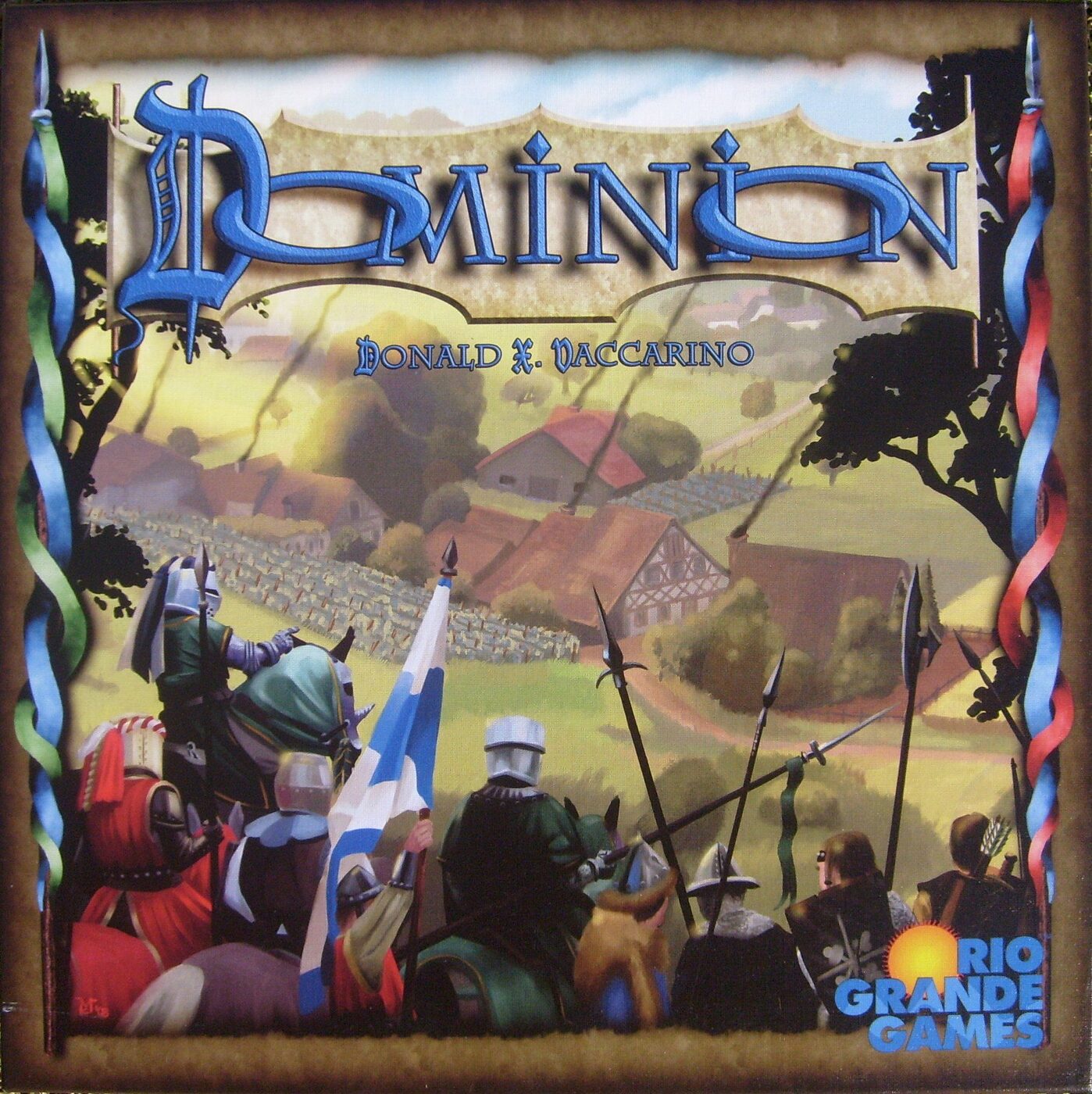 Dominion. © Rio Grande Games. Image via BGG.
BGG Rating: 7.60 | Rank: #146 | Players: 2-4 | Time: ~30 min
Dominion invented the genre in 2008 and remains one of its clearest expressions. You are a monarch expanding your kingdom, buying action cards, treasure, and victory points - all of which flow through the same shared market and go into the same shuffling deck.
Yes, Dominion has a slightly higher BGG weight (2.34) than Clank! (2.23). In practice, they feel similar to learn - but Dominion’s depth comes from card combinations rather than spatial decisions. The base game ships with 25 Kingdom card sets; each game uses 10. That means the interaction space is enormous. An engine built around Village + Smithy plays completely differently from one built around Chapel + Witch + Gardens.
That combinatorial depth is what makes Dominion last. It also means the game rewards thinking across multiple turns rather than optimising each turn in isolation. You’re building towards something. If you’re not asking “what does this deck want to do by turn 8?” you’re probably losing.
Go here if: You want to understand what deck-building actually is at its purest. No board, no spatial gimmicks - just the core loop with enormous card-combo depth.
Note: Dominion with expansion cards (Intrigue, Seaside, etc.) creeps significantly higher in weight. The base game is the right starting point.
Rung 4: Aeon’s End - Weight 2.80
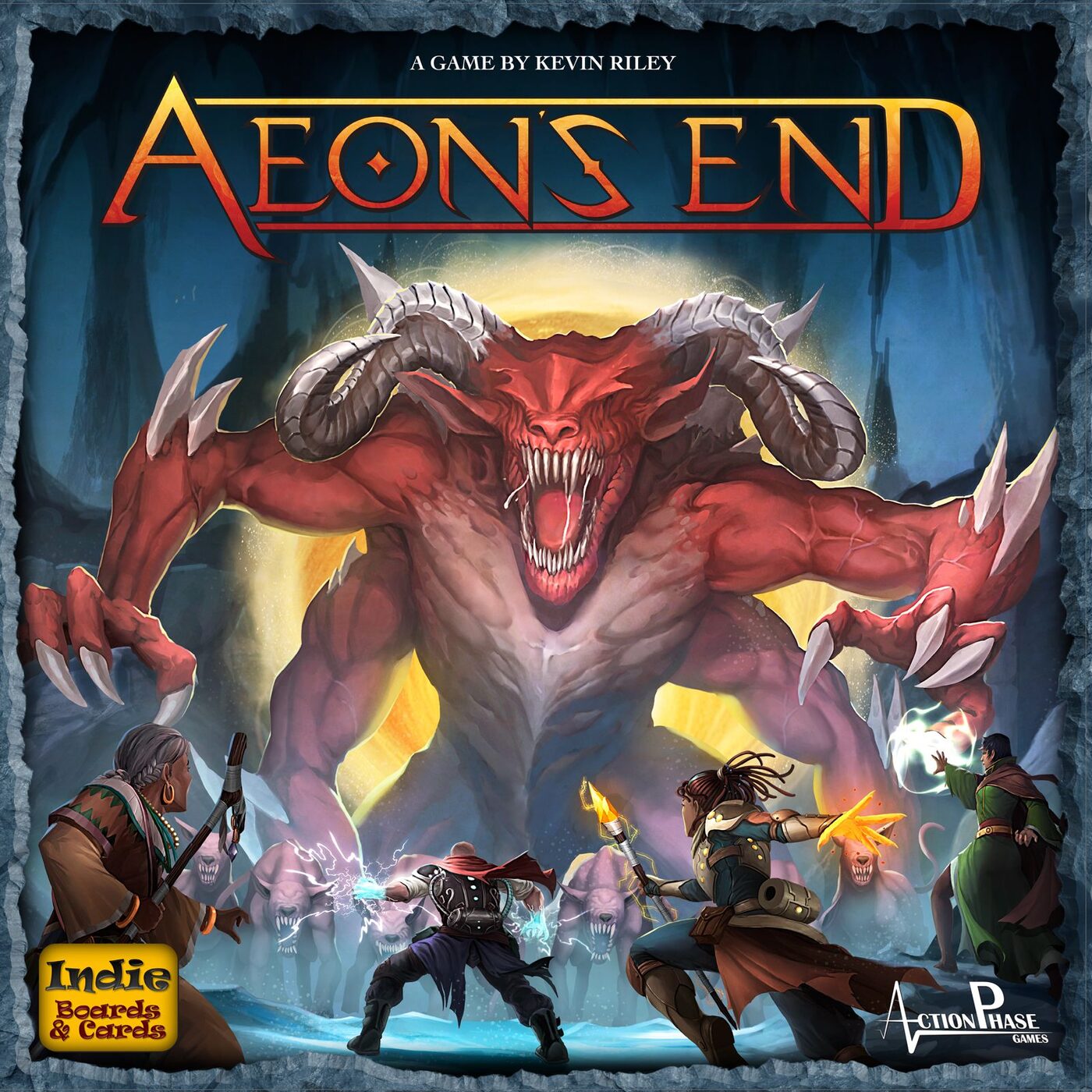 Aeon’s End. © Action Phase Games. Image via BGG.
BGG Rating: 7.86 | Rank: #108 | Players: 1-4 | Time: ~60 min
Aeon’s End is where the genre starts asking more of you. This is a cooperative deck-builder in which a team of Breach Mages defends their city against a nemesis - a big, specific boss with unique mechanics and a deck of attacks.
Two design decisions set Aeon’s End apart from everything below it on this ladder:
First: you never shuffle your discard. You flip it over and it becomes your new deck, in whatever order it’s in. This means your deck is partially deterministic - if you plan carefully, you know roughly what’s coming. This transforms the deck-building from reactive (“let’s see what I draw”) to proactive (“I need these three cards to cycle into my hand at the right time”).
Second: turn order is randomised by a turn order deck. Players and the nemesis draw from this deck - meaning the nemesis might get two turns in a row. This creates unpredictability and genuine dread that most cooperative games manufacture artificially.
The nemesis design is genuinely excellent. Each boss in the box (and across the game’s many expansions) requires a different strategic response. A deck configuration that crushed one nemesis will get eaten alive by another.
Go here if: You want cooperative deck-building with real strategic depth, and you’re comfortable with a 60-90 minute teach-and-play session.
Ceiling: The solo mode is strong (BGG solo best votes are high). The game is also expansion-heavy - if you love it, the rabbit hole goes deep.
Rung 5: Mage Knight - Weight 4.38
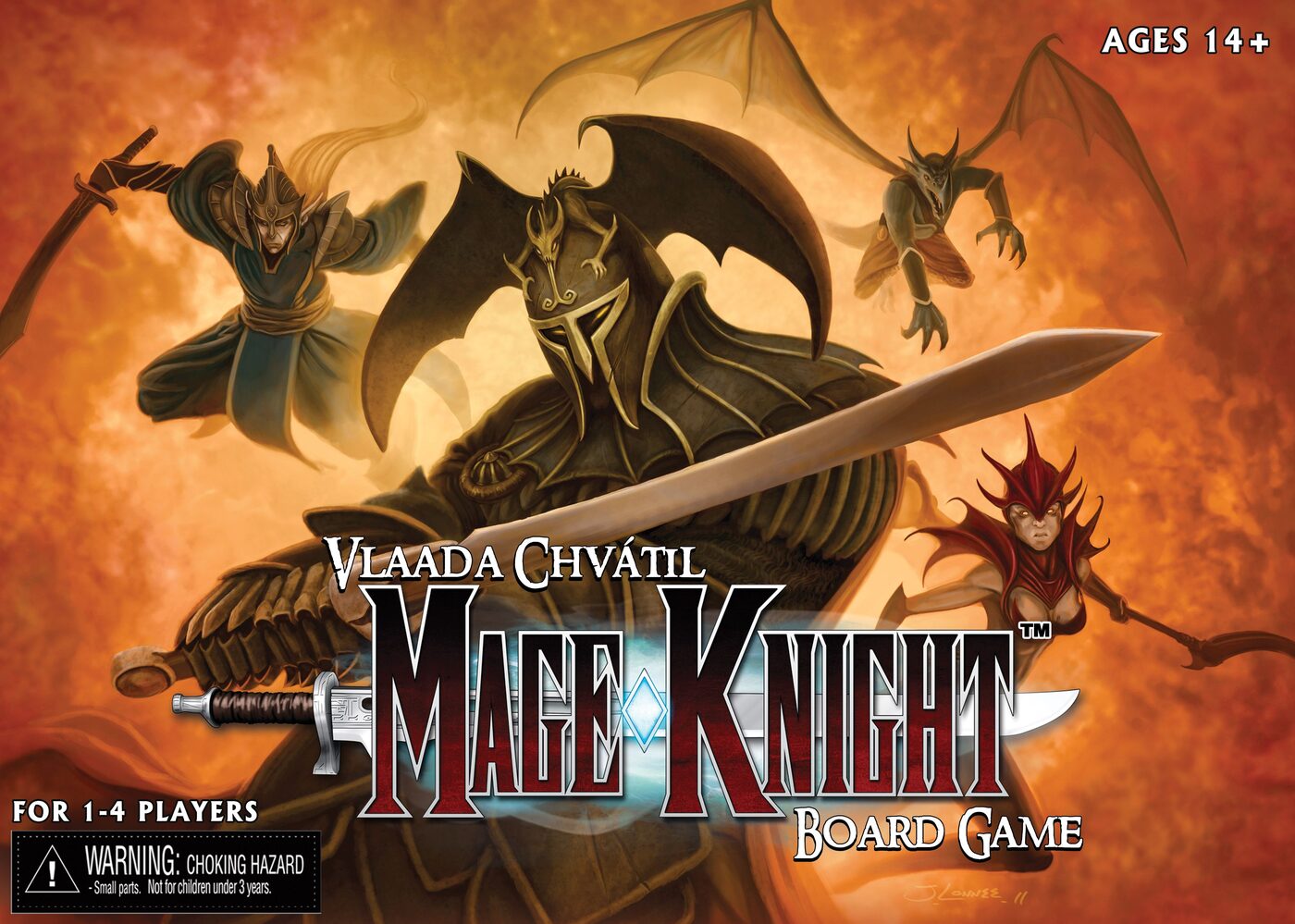
 Mage Knight Board Game. © Wizkids. Image via BGG.
BGG Rating: 8.08 | Rank: #40 | Players: 1-4 | Time: 60-240 min**
Mage Knight is the deck-building game that stops apologising for being complex. At 4.38 BGG weight, it is one of the heaviest games on the platform - and it earns that weight.
Here, deck-building is not the game. It’s the engine inside a larger game about exploration, tactical combat, city-conquering, and levelling up across multiple scenarios. You move through a hex-map, reveal tiles, fight enemies using a card-combat system that demands you combine cards in specific ways (Mana + Action, Sideways cards as movement, blocking with particular card types). Your hand is your entire resource for the turn - movement, combat, healing, spellcasting, all of it.
The complexity is layered. There’s a combat resolution stack. There are day/night cycles that change which spells and mana crystals are available. There are scenario objectives that run on a timer. There are reputation tracks, level-up decisions, monastery interactions, draconum threats, and city assault mechanics.
And yet - and this is why Mage Knight sits at #40 on BGG - it all coheres. When it clicks, the game produces the kind of systemic, emergent storytelling that few games manage. A solo session of Mage Knight can feel like reading a novel.
Go here if: You’ve played several of the games below this rung and you want a game that treats you like an adult. The learning curve is steep but the summit view is worth it.
Time commitment: Budget 60-90 minutes for your first setup. Solo full campaign: plan for 3-4 sessions.
Which Rung Are You On?
The ladder isn’t a prestige ranking - higher isn’t better, it’s just different. Star Realms at the office lunch table beats Mage Knight every time. Mage Knight solo on a rainy Sunday beats Star Realms in that context.
What the ladder tells you is where to go next. If Dominion is starting to feel solved, try Aeon’s End. If Star Realms has you wanting more moving parts, Clank! is waiting. If Aeon’s End feels manageable and you’re chasing that next challenge, Mage Knight is the final boss.
One step at a time. Every deck-builder at the top of this list has people who bounced hard off it the first time and came back later to find it the best game they own.
The shuffle is the thing. Keep shuffling.
All BGG weights, ratings, and rankings sourced from BGG XML API, August 2026. Images used with attribution from BoardGameGeek.